• العربية
  • پښتو
  • فارسی
Brand
  • Afghanistan
  • Sport
  • Markets
  • Afghanistan
  • Sport
  • Markets
  • Theme
  • Language
    • العربية
    • پښتو
    • فارسی
  • Afghanistan
  • Sport
  • Markets
All rights reserved for Volant Media UK Limited
volant media logo

Rights Activists Urge Arrest Of Taliban Leader, Court Chief At Spain Conference

Dec 13, 2025, 11:37 GMT+0

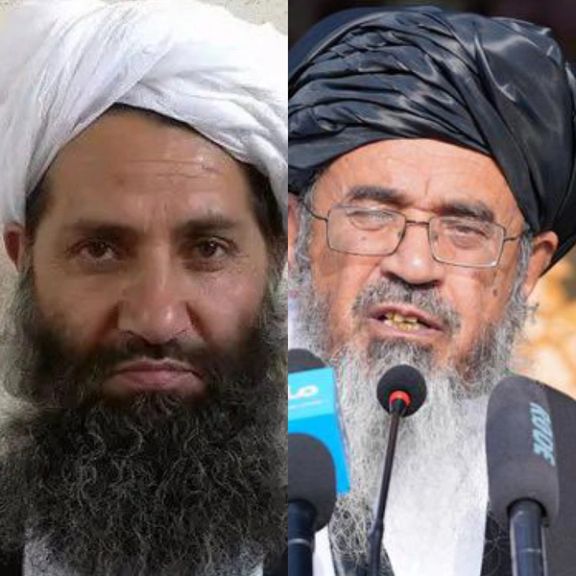
Human rights defenders attending the third special conference on Afghan women in Spain have called for international action to arrest Taliban leader Hibatullah Akhundzada and Abdul Hakim Haqqani, head of the Taliban’s Supreme Court.

The conference, held on Friday, 12 December, and hosted by Spain’s Ministry of Foreign Affairs in Madrid, highlighted that Afghanistan ratified the Convention on the Elimination of All Forms of Discrimination Against Women (CEDAW) in 2003 without reservations and is therefore legally bound to uphold and implement its provisions.

Participants said that more than four years after the Taliban’s return to power, the group’s policies have led to the systematic exclusion of women and girls from public, educational, professional and political life. They stressed that, given the Taliban’s refusal to engage meaningfully with international demands, concrete legal action at the global level is now required.

In July, the ICC issued arrest warrants for Akhundzada and Abdul Hakim Haqqani on charges of crimes against humanity linked to the systematic repression of women. The move was described as part of broader efforts to ensure justice and accountability for human rights violations in Afghanistan.

Conference participants emphasised that enforcement of the warrants would not be possible without practical cooperation from governments.

Citing credible United Nations reports, speakers said there is clear evidence of segregation and the systematic exclusion of women and girls from public life in Afghanistan a situation the UN special rapporteur has described as amounting to crimes against humanity and gender apartheid.

The conference also urged governments to support the formal recognition of gender apartheid as a distinct crime against humanity under international law.

Participants warned that without sustained political will, sufficient financial support and the meaningful participation of victims, accountability efforts would fail and impunity for serious human rights violations would continue.

Most Viewed

Pakistan Hosts Regional Meet On Afghanistan Without Taliban
1

Pakistan Hosts Regional Meet On Afghanistan Without Taliban

2

Taliban Ignore Afghanistan’s Interests By Backing Militants, Says Pakistan Army Chief

3

United Nations Delivers Education Kits To Four Million Afghan Children

4

European Parliament To Review Petition On Gender Apartheid, Taliban Status

5

Afghan Deportations Is Strategic Mistake, Says European Parliament Member

•
•
•

More Stories

Taliban Publicly Flog Man & Woman In Nangarhar Province

Dec 13, 2025, 11:02 GMT+0

The Taliban Supreme Court said on Saturday, 13 December, that a man and a woman were publicly flogged with 30 lashes each in Nangarhar province on charges of extramarital relations.

In a statement, the court said the punishment was carried out by a Taliban primary court in the Sherzad district of Nangarhar.

According to the statement, Taliban judicial and local officials, as well as local residents, were present during the flogging.

No details were released about the identities of those punished or the judicial process that led to the sentences.

The Taliban routinely detain and publicly flog individuals on a range of charges. The group describes the public enforcement of corporal punishment and executions as the “implementation of Sharia law.”

Over the past four years, hundreds of people have been publicly flogged, and at least 11 people have been executed. The most recent execution took place five days ago at Khost city stadium, where the Taliban said about 80,000 people were present to witness the execution.

Rule By Fear & Force Is Not Legitimate Governance, Says Haqqani

Dec 12, 2025, 18:03 GMT+0

Sirajuddin Haqqani, the Taliban’s interior minister, said in Khost on Friday that a government which rules people through “fear and force” is not a real government. He implicitly acknowledged that the Taliban relies on humiliation, violence and intimidation in its governance.

Addressing a gathering of local residents, Haqqani said people should not humiliate or condemn one another. “A government that controls people only by frightening them is not a government,” he said. “Between the people and a good government, there must be a bond of affection and trust.”

He added that a government has meaning only when it provides peace, justice and an atmosphere of trust for the population.

For more than four years, the Taliban have suppressed public protests with force and detained critics. The group has carried out public floggings and executions, actions that human rights organisations have sharply criticised as part of what they describe as widespread repression and a suffocating environment in Afghanistan.

Haqqani said Afghans have suffered for years because of their desire for freedom and independence. “The suffering and pain of Afghans have been because they refused servitude and sought independence and freedom,” he said.

In another part of his speech, Haqqani said: “Once, we were oppressed by the emperors of the world, but now we ourselves have so little tolerance that we condemn and humiliate people. This must stop. We should treat people in a way that removes hostility and enmity.”

Germany To Reject Resettlement Of 640 Afghan Refugees In Pakistan

Dec 12, 2025, 15:58 GMT+0

Germany’s Interior Ministry has announced that it will not relocate a number of Afghan refugees currently in Pakistan, reversing earlier commitments.

Ministry spokesperson Sonja Kock said some Afghan refugees will soon be informed that there is no longer any political justification for accepting them.

German media reported that, under the ministry’s new decision, the resettlement process for at least 640 Afghan refugees in Pakistan will be cancelled.

Around 1,800 Afghan refugees who fled to Pakistan after the Taliban takeover and applied for resettlement in Germany because they feared persecution remain in the country. The German government had previously promised to accept them.

According to Deutsche Welle, at least 130 Afghan refugees in Pakistan have already received letters informing them that their acceptance into Germany has been revoked. The letters were sent by GIZ, Germany’s development agency.

The letter states: “After further detailed examination, it has been decided that there are no grounds for granting admission to Germany under Section 22 of the Residence Act.” The notice does not explain why the earlier pledge of acceptance was withdrawn.

Reports say many of those affected previously worked as local staff on German-funded projects before the collapse of the former Afghan government and the Taliban’s return to power.

The Interior Ministry spokesperson said that among the remaining 220 former local employees, 90 are still eligible to apply for admission.

Germany’s previous government, a coalition of Social Democrats, Greens and Liberals, had pledged to admit women’s rights activists, lawyers, journalists and other Afghan dissidents through the so-called “human rights list” and “bridge list.”

That government relocated several Afghan women’s rights activists, lawyers, journalists and political opponents of the Taliban under special programmes. However, the current government under Chancellor Friedrich Merz has said it intends to restrict refugee resettlement programmes as much as possible.

According to official figures, from the Taliban takeover until April 2025, Germany admitted about 4,000 former Afghan local employees and nearly 15,000 of their family members.
Travelled Repeatedly To Pakistan To Free Baradar, Says Former Afghan FM

Dec 12, 2025, 13:59 GMT+0

Hanif Atmar, Afghanistan’s former foreign minister, says he travelled to Pakistan 10 times to secure the release of Mullah Abdul Ghani Baradar, now the Taliban deputy prime minister.

In an interview with Afghanistan International, Atmar referred to the recent “unity of voice” among Afghan political movements, saying all sides have jointly declared that their preference is not war but a political settlement achieved through negotiation and dialogue.

He said the Taliban must respond positively to this demand but added: “I am not sure the Taliban will do so.”

Atmar warned that if the Taliban refuse to engage in talks, they will push Afghanistan into a “major disaster” and create opportunities for the country’s enemies.

He said the international community should not support war and bloodshed in Afghanistan, but instead back a political solution and help facilitate intra-Afghan dialogue.

Atmar said Afghanistan is no longer a priority for the international community, but stressed that the world must still honour its commitments to the country.

He added that the Taliban have failed to uphold their obligations under the Doha Agreement, saying such behaviour contradicts Islamic teachings.

In another part of the interview, Atmar addressed rising tensions between the Taliban and Pakistan, describing them as a “real crisis” and saying: “These tensions will not be resolved by issuing fatwas.”

Referring to the previous Afghan government’s efforts to reach a political settlement with Pakistan, Atmar said: “As part of those efforts, I travelled to Pakistan ten times to secure Mullah Baradar’s release so that negotiations could move forward.” He added that he does not trust Pakistan.

Mullah Abdul Ghani Baradar is one of the founders of the Taliban and a close associate of the group’s founder, Mullah Omar. He was arrested by Pakistan’s intelligence service in 2010 and held until 2018. Baradar was released following US efforts, particularly by Zalmay Khalilzad, the former US special representative for Afghanistan, and later became head of the Taliban’s political office in Qatar.

Baradar was a signatory to the Doha peace agreement between the Taliban and the United States. He now serves as the Taliban administration’s deputy prime minister for economic affairs and is regarded as one of the most influential figures in Kabul’s current leadership.

Taliban Rule Amounts To System Of Gender Apartheid, Says UN Rapporteur

Dec 12, 2025, 12:31 GMT+0

Richard Bennett, the UN special rapporteur on human rights in Afghanistan, said the Taliban’s treatment of women amounts to “crimes against humanity” and should be described as a system of gender apartheid.

Speaking at the third Madrid meeting on the situation of women in Afghanistan, Bennett warned against normalising relations with the Taliban and said human rights conditions in the country have continued to deteriorate.

He said the Taliban have dismantled legal and judicial structures as well as institutions that supported women, leaving women particularly vulnerable to the consequences of these policies.

The UN rapporteur urged countries to make any engagement with the Taliban conditional on respect for human rights, especially the rights of women.

Bennett said the vision for Afghanistan should not be abandoned and described the current situation as a test for the international community. He warned that normalising relations with the Taliban would be both morally and strategically wrong and stressed that the group must be held accountable.

He emphasised that clear conditions must be set for any interaction with the Taliban and that no engagement should proceed unless those requirements are met. He called on governments to uphold their international commitments and to support the rights of Afghan women and citizens.

Reiterating the need for accountability, Bennett said the Taliban have targeted women, ethnic minorities, human rights defenders and former government employees.