Former Afghan President Hamid Karzai Travels To Germany

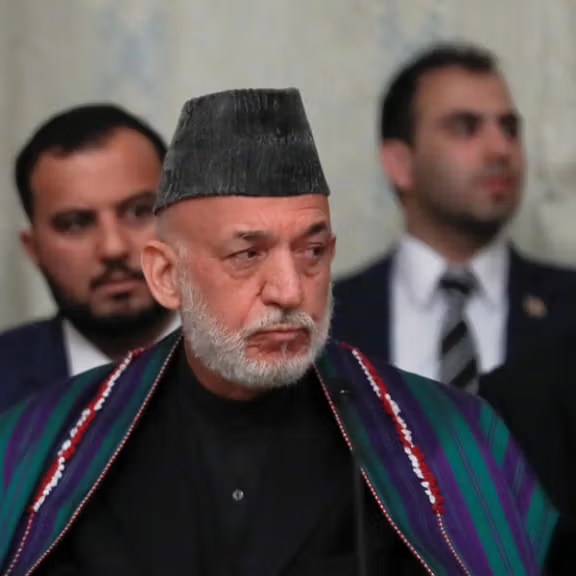
Hamid Karzai, Afghanistan’s former president, travelled to Germany on Friday for medical reasons, sources close to him told Afghanistan International.

Hamid Karzai, Afghanistan’s former president, travelled to Germany on Friday for medical reasons, sources close to him told Afghanistan International.
According to the sources, Karzai is in Germany for routine annual medical check-ups.
The visit comes more than four years after the Taliban returned to power, a period during which Karzai and other senior figures from the former Afghan government have faced restrictions on their freedom of movement. His foreign travel has at times encountered obstacles under Taliban rule.
Karzai’s trip is viewed as significant, as Western countries particularly Germany continue to value his views on Afghanistan’s future and regard him as an important figure in any potential political dialogue involving Afghans.
This is Karzai’s second visit to Germany this year. He previously travelled there in May 2025 for eye treatment.
Last year, Karzai also attended a meeting at the historic Bonn Conference Hall, where he stressed the need for inclusive national dialogue among Afghans.
In the past four years, Karzai has also travelled to the United States and the United Kingdom.
After returning to power, the Taliban initially imposed strict limits on Karzai’s foreign travel, though those restrictions have gradually been eased, according to people familiar with the matter.

Residents of a district in northern Afghanistan clashed with Taliban members on Friday after a Taliban-linked company moved into a residential area to begin gold mining operations, local sources told Afghanistan International.
The incident took place in Chah Ab district of Takhar province, where Taliban forces and personnel connected to a gold mining company entered the area to launch an extraction operation. Several people on both sides were injured, according to the sources.
A video obtained by Afghanistan International shows residents throwing stones at Taliban members, while gunfire can be heard in the background. The footage also shows local residents fleeing the area after shots were fired. Heavy machinery belonging to the mining company is visible at the site.
Witnesses said the operation was intended to extract gold from the area, a move opposed by local residents. Tensions escalated when unidentified individuals who had recently arrived in the village for gold exploration opened fire to disperse the crowd, wounding at least one person.
Residents responded by hurling stones at the company’s vehicles, the sources said.
The Taliban have, over the past four years, placed increased emphasis on mining activities across several provinces as a key source of revenue.
Critics and local residents have repeatedly raised concerns about the lack of transparency surrounding mineral extraction under Taliban rule, including how contracts are awarded and how revenues from Afghanistan’s natural resources are used.

The Afghanistan Freedom Front said it carried out a rocket attack on a Taliban court building in northern Afghanistan, killing four Taliban members and wounding two others.
In a statement issued on Friday, the group said the attack targeted the Taliban’s Court of Appeal in Maimana, the capital of Faryab, at about 6:30 p.m. on Thursday. The AFF said the strike hit a meeting of the Taliban’s judicial police, which it described as an enforcement arm of the Taliban’s Ministry for the Propagation of Virtue and Prevention of Vice.
The statement did not say whether any AFF fighters were injured in the attack.
The Taliban have not issued an official response and have not confirmed the reported casualties.
Several residents of Maimana told Afghanistan International that an explosion was heard in the city on Thursday evening. Local sources said explosives placed inside a container detonated at a Taliban court building.
In recent months, the Afghanistan Freedom Front has said it would step up attacks against the Taliban’s morality police after the detention of several girls in Kabul. Since then, the group has claimed responsibility for a series of attacks targeting offices of the Taliban’s Ministry for the Propagation of Virtue and Prevention of Vice in multiple provinces.

Donald Trump warned that the United States would take action if Iranian authorities fire on peaceful protesters and carry out violent killings, as demonstrations continued across the country.
In a post on his social media platform, Truth Social, Trump said that the violent suppression of protests is the Iranian government’s “custom” and that Washington would respond if such actions occur.
“We are locked and loaded and ready to go,” Trump wrote.
Protests in Iran entered their sixth day on Friday, January 2, according to reports. Iranian authorities have detained dozens of protesters, and at least seven people have been killed.
The demonstrations were sparked by the sharp and unprecedented fall of the Iranian rial against the US dollar, deepening economic turmoil and public anger over the government’s failure to address widespread livelihood concerns.
Iranian officials have not publicly responded to Trump’s remarks.

Zabihullah Mujahid, the Taliban’s chief spokesperson, has warned Pakistan against attempting to dominate the Taliban, saying the group makes its decisions independently and is not dependent on Islamabad.
Mujahid said claims that the Taliban operates under Pakistan’s influence were the result of what he described as “20 years of propaganda”. He said the Pakistani military had expected the Taliban, after returning to power, to govern in line with Islamabad’s wishes.
He urged Pakistan to stop what he called “dreaming” of controlling the Taliban administration.
According to internal and international reports, many Taliban leaders and commanders lived in the Pakistani cities of Quetta and Peshawar during the two decades of war with the former Afghan government and US-led forces. Senior Pakistani officials, under pressure from Kabul and Washington, largely refrained from expelling Taliban figures, particularly members of the Haqqani network.
Analysts have long argued that Pakistan used the Taliban as a proxy force against the former Afghan government and India’s interests in Afghanistan.
Since returning to power, the Taliban have rejected Pakistan’s requests to expel fighters from Tehreek-e-Taliban Pakistan, or TTP, from Afghan territory. The group was responsible for one of the deadliest years for Pakistan’s military in 2025.
In an interview with journalist Mirwais Afghan published on Thursday, Mujahid addressed the causes of rising tensions and clashes between Pakistan and the Taliban administration. He accused Pakistan of fuelling instability in Afghanistan at the request of the United States.
Referring to remarks by Donald Trump about reclaiming Bagram Air Base, Mujahid said “a coordinated game is underway”, which he claimed was being driven by “a particular circle in Pakistan”.
He said those involved had “taken on the war project as a contract”. While Mujahid did not name individuals, he was referring to the Pakistani military leadership under Field Marshal Asim Munir, according to analysts.
Pakistan recorded its deadliest year in more than a decade in 2025, with at least 1,000 security incidents reported and about 4,000 deaths. TTP claimed responsibility for 3,573 attacks during the year, resulting in the deaths of 3,818 Pakistani security personnel, according to official figures.
Islamabad asked the Taliban to cooperate in preventing TTP attacks, but the request was rejected. After diplomatic efforts failed, Pakistan launched military strikes inside Afghanistan and began expelling millions of Afghan migrants. Taliban officials have said the pressure has not altered their position.
Struggle For Control
Mujahid said another source of tension was Pakistan’s alleged attempt to exercise full control over the Taliban government. He said the Taliban is not a Pakistani proxy and should not be treated as one.
He said that after returning to power, the Taliban established their own governing system and independently assumed control of Afghanistan’s internal and external affairs. This, he said, angered what he described as a “special circle” in Pakistan and led to what he called a conspiracy against the Taliban.
Mujahid said the Taliban is capable of defending itself but declined to provide details about its military capabilities, calling them “military secrets”.
He again rejected Pakistan’s accusations that the Taliban is sheltering TTP fighters, saying the group does not require sanctuary in Afghanistan. He said TTP maintains territory and military facilities inside Pakistan, referring to its members as “Waziristani migrants” who he claimed had been fully “contained”.
A drone crashed on Thursday in Maidan Wardak province, sources close to the Taliban said.
According to the sources, the unmanned aircraft went down in Maidan Shahr, the provincial capital. The origin of the drone remains unclear.
Taliban members circulated images on social media showing the wreckage of an overturned drone lying on a snow-covered hillside, with Taliban fighters seen standing around the remains.
The cause of the crash has not yet been determined, and Taliban officials have not issued an official statement on the incident.
Taliban authorities have repeatedly acknowledged that Afghanistan’s airspace is not fully under their control.
In Aqrab, Taliban spokesperson Zabihullah Mujahid said US drones continued to conduct surveillance flights over Afghanistan. He added that American drones have been operating in Afghan airspace since the Taliban’s return to power, entering through some neighbouring countries and violating Afghanistan’s airspace.
Previously, Pakistan carried out drone strikes in parts of Khost and Nangarhar provinces, according to local officials.