ISIS-K Claims Kabul Bombing That Killed Seven, Including Chinese Citizen

The Islamic State group’s Khorasan branch, known as ISIS-K, has claimed responsibility for a suicide attack on a Chinese restaurant in Kabul’s Shahr-e Naw area.

The Islamic State group’s Khorasan branch, known as ISIS-K, has claimed responsibility for a suicide attack on a Chinese restaurant in Kabul’s Shahr-e Naw area.
The explosion occurred at about 3 p.m. local time on Monday, January 19. Taliban authorities have confirmed that seven people, including one Chinese national, were killed and that 13 others were wounded.
In a statement published by ISIS’s Amaq News Agency, the group said a suicide bomber entered a Chinese restaurant in Shahr-e Naw and detonated explosives among Chinese nationals and their guards.
ISIS-K claimed the attack killed and wounded Chinese citizens, Afghan civilians and Taliban members guarding the site. Without providing evidence, the group said the total number of dead and wounded was 25.
The statement said Chinese nationals were targeted over what the group described as China’s treatment of Uyghur Muslims.
Earlier, Afghanistan International, citing sources, reported that the incident was a suicide attack.
Taliban officials said the Chinese national killed in the blast was a Muslim from China’s Xinjiang region, identified as Abdul Rahman.
Video obtained by Afghanistan International shows the blast destroyed the signboard and parts of the Chinese restaurant China Lanzhou Beef Noodle in the Shahr-e Naw neighbourhood of Kabul.
An explosion in Kabul’s Shahr-e Naw area on Monday killed at least seven people and injured 13 others, according to Emergency Hospital Afghanistan.
Hospital officials said at least 20 people were brought to the facility following the blast. The figures are preliminary and cover only cases registered at Emergency Hospital.
Dejan Panic, head of Emergency Hospital Afghanistan, said the wounded included four women and one child. He said several patients were being assessed for surgery with cuts and bruises, adding that seven people were already dead when they arrived at the hospital.
Khalid Zadran, spokesperson for the Taliban police command in Kabul, confirmed that the explosion occurred on Gul Froshi Street and caused casualties. He said the blast took place at a hotel and that seven people, including a Chinese national, were killed. He added that the type of explosion had not yet been determined.
Zadran said the Chinese victim, identified as Abdul Rahman, was a Muslim from China’s Xinjiang region.
Earlier, at least five eyewitnesses told Afghanistan International that Chinese nationals appeared to have been the main target of the attack.
Video obtained by the outlet showed damage to the signboard and parts of the Chinese restaurant China Lanzhou Beef Noodles in the Shahr-e Naw area.
Witnesses said both Chinese nationals and Afghan civilians were injured. Some reported that the explosion may have been carried out by a suicide attacker.
Residents of Kabul reported hearing a powerful blast in Shahr-e Naw on Monday. Images shared with Afghanistan International showed a column of smoke, injured people lying on the ground and civilians fleeing the scene.

China’s embassy in Tajikistan warned on Monday that security conditions along the Afghanistan–Tajikistan border are “extremely dire and complex” following a recent clash.
It urged Chinese citizens to leave border areas as soon as possible.
In a statement, the embassy advised Chinese nationals and companies operating in border regions of Afghanistan and Tajikistan to closely monitor the security situation, strengthen precautionary measures and withdraw from the area in an orderly manner.
The warning came after Tajikistan’s State Committee for National Security said on Sunday that four militants linked to a terrorist group were killed while attempting to cross from Afghanistan into Tajik territory.
The Chinese embassy said the deteriorating security situation posed serious risks to the safety of Chinese citizens and businesses in the region.
Security concerns for Chinese nationals have grown following a series of attacks near the border. On November 26, 2025, an armed assault in the border town of Shamsiddin Shohin in Tajikistan’s Khatlon province killed three Chinese citizens and wounded another. China’s embassy at the time strongly condemned the attack, calling it a serious criminal act.
A second armed attack occurred in the same area on November 30, also resulting in casualties among Chinese citizens and prompting Beijing to issue a security alert.

Taliban authorities have confirmed that an explosion in Kabul’s Shahr-e Naw area on Monday caused casualties.
Khalid Zadran, spokesperson for the Taliban police command in Kabul, said the blast occurred in a hotel in Gulforoshi Alley and that investigations are under way to determine the number and nature of the casualties.
Earlier, at least five eyewitnesses told Afghanistan International that Chinese nationals were the apparent target of the explosion.
Video obtained by Afghanistan International shows damage to a signboard and parts of the Chinese restaurant China Lanzhou Beef Noodle in Shahr-e Naw.
Witnesses said both Chinese nationals and Afghan civilians were injured in the blast. Some also reported that the explosion may have been carried out by a suicide attacker.
Residents of Kabul reported hearing a powerful explosion on Monday. Images shared with Afghanistan International showed a column of smoke rising from the area, injured people on the ground and civilians fleeing the scene.

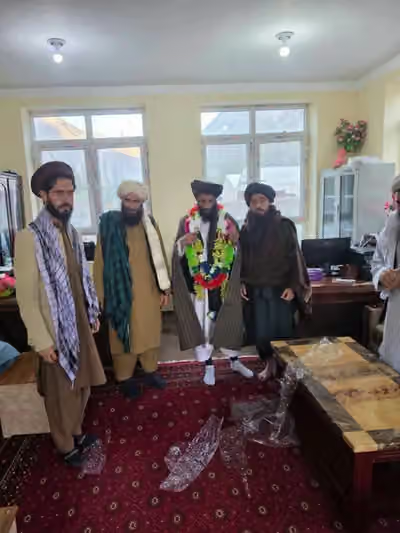
Abdul Kabir, the Taliban’s minister for refugees, has met with Kenichi Masamoto, Japan’s newly appointed ambassador in Kabul, to discuss humanitarian assistance and future cooperation, according to a Taliban statement.
The Taliban Ministry of Refugees said the Japanese ambassador told the meeting that Tokyo had provided about $550 million in aid to Afghanistan through United Nations agencies since the Taliban returned to power, up to last year.
In a statement released on Monday, the ministry said the funding has been used for humanitarian assistance, support for refugees, alternative livelihoods, healthcare, water supply, women’s empowerment and other sectors.
According to the statement, the Japanese ambassador pledged that Tokyo would continue its cooperation with Afghanistan and would not interfere in the country’s internal affairs.
The statement added that the ambassador also announced new assistance for Afghanistan, saying the Japanese government has approved a further $19.5 million aid package to support refugee-related and humanitarian programmes.
Abdul Kabir thanked Japan for its continued assistance and called for expanded cooperation. He said Afghanistan is facing serious challenges due to climate change and what he described as the effects of “foreign occupation,” and requires sustained international support.
He added that millions of Afghans have returned to the country over the past four years and are in urgent need of humanitarian assistance.

Ali Ahmad Jalali, Afghanistan’s former interior minister, says efforts to shape the country’s future must begin with the establishment of a legitimate government.
He argued that debates over constitutions and state structures are meaningless without political legitimacy.
Speaking online at a two-day conference titled Future Outlook: Political System, Social Justice, Sustainable Development, and Afghanistan’s Position in the Region and the World, Jalali said Afghanistan’s crisis has reached such depth that politicians, academics and the public must first pursue fundamental political change.
He said the legitimacy of institutions flows from the legitimacy of the state itself, stressing that Afghans must be able to form a system grounded in the will of the people.
Jalali described Afghanistan as being ruled by a totalitarian system that, he said, derives its authority not from popular consent but from its own interpretations and definitions imposed on society.
The academic conference, organised by the Trust and Stability Movement of Afghanistan, was held over two days, January 17–18, in Frankfurt.
Mohammad Asif Zaeefi, head of the Trust and Stability Movement of Afghanistan, said the conference aimed to diagnose the country’s political, economic and social crises, as well as Afghanistan’s position in the region and the wider world.
Zaeefi said the movement has developed a four-stage roadmap focused on achieving national consensus, followed by regional and international consensus, and ultimately a transition toward state-building. He said Afghanistan currently suffers from deep conceptual and definitional ambiguity, both domestically and in its relations with the international system.
Parviz Arzu, a member of the movement’s executive committee, said neutrality could help remove Afghanistan from regional and global rivalries, benefiting both the country and the wider region.
He said such a process must begin with domestic consensus and then be pursued through diplomatic engagement with regional states and major powers, with the involvement of the UN Security Council.
Conference organisers said the aim of the gathering was to provide space for dialogue and academic reflection on Afghanistan’s future political system, social justice, sustainable development, and regional and global standing.
They added that a plan for Afghanistan’s future was presented at the conclusion of the conference, noting that imported models of governance had failed in the past and that any viable solution must be rooted in the country’s domestic realities.
