UN Deputy Chief Meets Iran’s Ambassador In Kabul
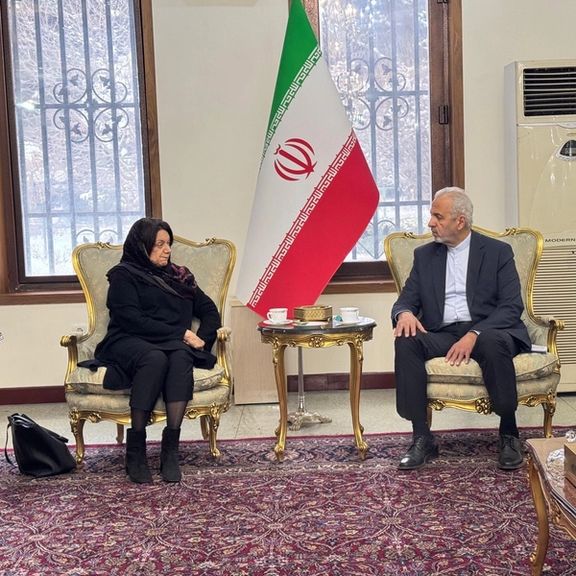
Rosemary DiCarlo, the United Nations under-secretary-general for political and peacebuilding affairs, met Sunday with Alireza Begdeli, Iran’s ambassador to Afghanistan, during her visit to Kabul.

Rosemary DiCarlo, the United Nations under-secretary-general for political and peacebuilding affairs, met Sunday with Alireza Begdeli, Iran’s ambassador to Afghanistan, during her visit to Kabul.
Iran’s embassy in Kabul said the meeting focused on the activities of the UN Assistance Mission in Afghanistan (UNAMA) and cooperation between the Islamic Republic of Iran and the UN mission. The talks were held at the Iranian embassy, and no further details were released.
DiCarlo arrived in Kabul on Saturday, coinciding with the International Day of Education. UN Secretary-General spokesperson Stéphane Dujarric said earlier that her trip was aimed at following up on the Doha process, a UN-led diplomatic effort on Afghanistan.
The UN Assistance Mission in Afghanistan established the first working group on counter-narcotics under the Doha process in November 2024. A second working group focused on economic issues was formed in January 2025 to help coordinate economic assistance to Afghanistan under Taliban rule.
The United Nations has said a fourth round of Doha talks would be held following the establishment of these two working groups. The Taliban have recently announced that the next meeting of the Doha process working groups will take place in Kabul.
During her visit, DiCarlo has also met Taliban Foreign Minister Amir Khan Muttaqi and Interior Minister Sirajuddin Haqqani.


Rosemary DiCarlo, the United Nations under-secretary-general for political and peacebuilding affairs, met Sirajuddin Haqqani, the Taliban’s interior minister, in Kabul, according to a Taliban statement.
The Taliban Interior Ministry said early Sunday that the meeting focused on engagement between the Taliban and the international community, cooperation in counter-narcotics efforts, economic stability, easing restrictions on the private sector and the effectiveness of UN humanitarian assistance.
Haqqani told DiCarlo that efforts to combat drug production and trafficking in Afghanistan had produced positive results, the statement said.
The ministry said DiCarlo assured Haqqani that the United Nations would continue its humanitarian assistance to Afghanistan. The UN delegation, led by DiCarlo, also stressed the need for “continued engagement”, according to the statement.
Quoting the UN official, the ministry said that as part of the third phase of the UN-led Doha process, working groups have been formed and are expected to hold their next meeting in Kabul.
DiCarlo arrived in Kabul on Saturday and also held talks with Taliban Foreign Minister Amir Khan Muttaqi on the Doha process.
The US diplomat has served as UN under-secretary-general for political and peacebuilding affairs since 2018.
The UN-led Doha process was launched to create a political framework and dialogue among the international community, regional countries and the Taliban to address Afghanistan’s political, security and humanitarian crises. Three rounds of talks have been held so far, with the most recent led by DiCarlo. Taliban representatives took part in the latest meeting.

Rosemary DiCarlo, the United Nations under-secretary-general for political and peacebuilding affairs, met Taliban Foreign Minister Amir Khan Muttaqi in Kabul on Saturday to discuss the UN-led Doha process, the Taliban Foreign Ministry said.
In a statement, the ministry said the two sides held extensive talks on engagement and coordination between the Taliban administration and the United Nations, as well as on Doha process meetings. Discussions also covered counter-narcotics efforts, support for the private sector and the return of migrants.
Muttaqi called on the UN official to help lift banking sanctions on Afghanistan and to facilitate the release of the country’s central bank assets, according to the statement.
He also raised concerns about drug cultivation in some countries in the region, warning that production outside Afghanistan would harm not only Afghanistan but also the wider region and the world. He did not name any country, although Taliban officials have previously alleged that drugs are cultivated in Pakistan.
DiCarlo emphasised cooperation within the framework of the Doha process working groups and described the continuation of the Doha meetings as beneficial for all sides, the statement said.
The United Nations and the Taliban have previously discussed counter-narcotics and private sector support during Doha talks and have established technical working groups in those areas.
The UN has sought to create conditions for meaningful dialogue between the Taliban authorities, regional representatives and Afghan stakeholders, including women, civil society members and human rights activists. The Taliban, however, have shown little interest in talks with their opponents.
According to the Taliban statement, DiCarlo also expressed hope that joint cooperation could be strengthened through the Doha process.
The UN Assistance Mission in Afghanistan established the first counter-narcotics working group under the Doha process in November 2024. A second working group focused on economic issues was later formed to help coordinate economic assistance to Afghanistan under Taliban rule.
The United Nations has said a fourth Doha meeting would be held following the establishment of these two working groups.
At the third Doha meeting, held on July 1 and 2, 2025, with the participation of countries’ special envoys for Afghanistan, Taliban representatives attended, but women, civil society and political opponents were excluded, drawing widespread criticism.
At the time, the United Nations said the meeting aimed to increase international engagement with Afghanistan in a coherent and structured manner.

More than 2 million adolescent girls in Afghanistan are being denied access to secondary education, the United Nations said on the International Day of Education.
The agency warned that the continued restrictions will undermine both the future of girls and the country’s development and stability.
UNICEF and UNESCO said in a joint statement Saturday that Afghanistan is the only country in the world where secondary and higher education for women and girls are effectively banned.
The agencies called for urgent, collective action and greater international investment in education to ensure what they described as full, safe and inclusive access to learning for all.
The UN General Assembly has designated January 24 as the International Day of Education.
For nearly four and a half years, secondary schools have remained closed to girls in Afghanistan, and women and girls are still barred from attending universities. At the same time, the higher education system has been weakening amid university closures and the migration or marginalisation of lecturers and students.
Suhyon Kim, head of UNESCO’s office in Afghanistan, said: “When girls are denied access to education, a nation pays the price. Strengthening foundational learning and supporting female teachers are vital investments for Afghanistan’s recovery and resilience.”
Tajudeen Oyewale, UNICEF’s representative in Afghanistan, said: “Afghanistan urgently needs female teachers, nurses, community health workers and doctors. In a situation where women can only be treated by women, who will care for sick girls and women in the future if girls are deprived of education today?”
The agencies urged immediate action to protect the right to education in Afghanistan.

Representatives from about 20 European Union member states travelled to Kabul last week for talks on deporting asylum seekers to Afghanistan, Belgium’s state broadcaster reported Saturday.
Europe is seeking to resume the return of rejected asylum applicants, undocumented migrants and convicted criminals to Afghanistan, according to the report by Belgian broadcaster BRF.
The broadcaster said Freddy Roosemont, head of Belgium’s Office of Foreigners, was part of the delegation and flew to Kabul alongside representatives from other European countries.
The European Union has opened discussions with the Taliban aimed at facilitating deportations. European governments are seeking to establish a working arrangement under which the Taliban authorities would confirm that people deported from Europe are Afghan nationals.
Belgium’s Ministry of Asylum and Migration said the Taliban told the European delegation it was ready to cooperate in verifying the identities of those facing deportation.

Donald Trump said the role of NATO forces in the war in Afghanistan has been exaggerated, claiming allied troops stayed behind US soldiers and away from front-line fighting.
Speaking Thursday on the sidelines of the World Economic Forum in Davos, Trump told Fox News: “We’ve never needed them. We have never really asked anything of them. You know, they’ll say they sent some troops to Afghanistan, or this or that. And they did, they stayed a little back, a little off the front lines.”
Trump also voiced scepticism that NATO members would come to the United States’ defence if Washington were ever in need.
The remarks prompted strong reactions from several allied leaders and officials.
British Prime Minister Keir Starmer described the comments as “insulting and appalling”, noting that 457 British service personnel were killed during the Afghanistan war. In a video posted on his account on X, Starmer said the remarks had hurt the families of those killed as well as the wider British public.
Al Carns, the UK armed forces minister, also pushed back, saying British forces served on the front lines in Afghanistan and often beyond.
Polish Prime Minister Donald Tusk responded earlier by urging that Trump be reminded of Polish soldiers who were killed in Afghanistan.
In the United States, former national security adviser John Bolton described Trump’s comments as an attack on NATO. Writing on X, Bolton said: “Trump is embarrassing the American people by his attacks on NATO allies that fought with us in Afghanistan, not to mention justifiably outraging the allies.”
The White House, responding to the criticism, said: “President Trump is right.”