Two Tamadon TV Journalists Released From Taliban Prison

Mohammad Rahmati, managing director of private broadcaster Tamadon TV, and network employee Mohammad Reza Ehsani have been released from Taliban custody, sources say.
Mohammad Rahmati, managing director of private broadcaster Tamadon TV, and network employee Mohammad Reza Ehsani have been released from Taliban custody, sources say.
The two journalists were arrested on 23 June on the orders of Abdul Hakim Sharaee, the Taliban’s justice minister.
Sources said Sirajuddin Haqqani, the Taliban’s interior minister, instructed the group’s governor in Kabul to release them.
On 23 June, Taliban forces raided Tamadon TV’s headquarters in Kabul on the Taliban justice minister’s orders and halted the broadcaster’s operations. Mohammad Rahmati and Mohammad Reza Ehsani were detained following the raid.
The two journalists were held at the Kabul governor’s detention facility. The Taliban has not explained the reason for their arrests.
According to the sources, Rahmati and Ehsani were released on 5 July.
Informed sources previously told Afghanistan International that Rahmati suffered from heart disease, diabetes and high blood pressure. They said his health had deteriorated in Taliban custody and that he lacked access to medicine and medical care.
In June 2024, the Taliban’s Justice Ministry announced that Tamadon TV’s operations would be suspended because of its alleged affiliation with the Islamic Movement of Afghanistan and its use of what the ministry described as state land that had been“seized illegally.
The ministry said media organisations belonging to Afghanistan’s political parties were not permitted to operate.
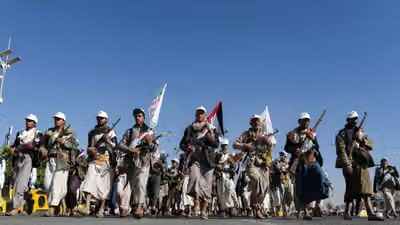
Pakistan’s military has rejected the UNAMA report that hundreds of Afghan civilians were killed or injured in its cross-border attacks, saying the report is baseless. A Pakistan army spokesperson said that it targeted only Tehreek-e-Taliban Pakistan sites.
Ahmed Sharif Chaudhry, the Pakistani army spokesperson, said in a news conference on Friday that the country’s forces had operated only against hideouts, training centres and infrastructure used by Tehreek-e-Taliban Pakistan between October 2025 and the end of June 2026.
He claimed that those killed in the attacks were members of armed groups and that the operations were carried out in self-defence to protect Pakistani citizens.
Chaudhry also questioned reports by UNAMA and Amnesty International, saying they were largely based on accounts from sources inside Afghanistan who, according to him, operate under restrictions on freedom of expression imposed by the Taliban administration.
He added that the reports had ignored deadly attacks by armed groups against Pakistan, as well as air strikes carried out by foreign forces during the war in Afghanistan.
The remarks came after UNAMA said in a new report that at least 499 civilians were killed and 1,216 others injured inside Afghanistan between October 2025 and the end of June 2026 as a result of air strikes, artillery attacks and border clashes between Pakistan and the Taliban.
The UN mission said many of the victims were women and children. In some cases, people who went to rescue the wounded were targeted in a second strike.
According to UNAMA, one of the deadliest incidents occurred in Paktia province on 28 June, when two consecutive attacks on a residential building killed at least 22 people, including five children, and injured 185 others.
UNAMA stressed that under international humanitarian law, all parties to the conflict are required to protect civilians and humanitarian workers and avoid attacks that could result in civilian casualties.
Pakistan has repeatedly accused the Afghan Taliban of providing safe haven to members of Tehreek-e-Taliban Pakistan, an allegation the Taliban has denied.
Islamabad, meanwhile, says its cross-border operations in Afghanistan will continue.
The World Bank says Afghanistan's trade has shifted sharply towards Central Asia and Iran after disruption along the Pakistan route. Central Asian corridors now handle 48 per cent of imports and Iran 46 per cent, while Pakistan's share has fallen to almost zero.
At the same time, India has become Afghanistan's largest export market, taking 33.6 per cent of its exports, while Iran has become its biggest source of imports, supplying 31.4 per cent.
In its July report, the World Bank said Afghanistan's economy continues to face structural challenges despite relatively stable domestic demand, higher domestic revenues and easing food inflation. It said rapid population growth, regional trade disruptions and heavy reliance on domestic revenues continue to weigh on the economy.
The bank said current economic growth has failed to keep pace with Afghanistan's rising population, particularly following the large-scale return of migrants. According to the report, real per capita income is around 5.6 per cent lower than before the Taliban returned to power, placing additional pressure on household living standards.
General Inflation Eases but Living Costs Remain Under Pressure
The World Bank said Afghanistan's annual inflation rate fell to 7.6 per cent in June 2026, down from 8 per cent in May.
It attributed the decline mainly to lower food prices during the agricultural harvest season and continued imports. Prices of vegetables, fresh and dried fruit, sugar and dried bread all fell. Food inflation declined by 1.6 per cent compared with the previous month and by 7.2 per cent compared with the same period last year.
However, core inflation, which excludes food and energy prices, increased to 8.3 per cent. The bank said rising housing, healthcare and transport costs continue to fuel inflationary pressures.
Afghani Weakens Against the US Dollar
According to the report, the Afghan afghani depreciated by 1.6 per cent against the US dollar in June compared with May, with the average exchange rate reaching AFN64.4 per dollar.
Despite the monthly decline, the afghani remained 8.3 per cent stronger than a year earlier.
The World Bank also reported a 4 per cent decline in the Real Effective Exchange Rate (REER), saying the weaker rate had slightly improved the competitiveness of Afghan exports in regional markets.
Trade Deficit Widens as Pakistan Border Closures Hit Exports
Afghanistan's trade deficit widened to 984.3 million US dollars in June, up 11 per cent from the previous month and 19 per cent higher than a year earlier.
Exports totalled 77.7 million US dollars during the month, down 2 per cent from May but up 19 per cent year-on-year.
The World Bank said prolonged border closures with Pakistan were a key reason behind weaker food exports and the complete halt of coal exports.
According to the report, Afghanistan's coal exports fell to almost zero, directly linked to the closure of trade routes through Pakistan.
By contrast, textile exports increased significantly, reaching 21.5 million US dollars in June. This represented a 67 per cent rise compared with the previous month and a 304 per cent increase from a year earlier. Most of these exports were shipped to China via Central Asia.
India remained Afghanistan's largest export destination with a 33.6 per cent share, followed by Iran, Uzbekistan and China.
Central Asia and Iran Become Afghanistan's Main Trade Corridors
Afghanistan's imports rose by 10 per cent in June compared with the previous month, reaching 1.062 billion US dollars.
Central Asian routes became the country's main import corridor, accounting for 48 per cent of imports in June, up from 41 per cent in May.
Iranian routes accounted for 46 per cent of imports, while trade through Pakistan remained at a very low level.
Iran supplied 31.4 per cent of Afghanistan's imports, followed by China, the United Arab Emirates, Uzbekistan and Kazakhstan.
The World Bank warned that Afghanistan's heavy dependence on a small number of trading partners and transit routes leaves its economy vulnerable to political and economic developments across the region.
Monthly Government Revenue Falls but Annual Collections Increase
According to the World Bank, the Taliban administration collected 17.3 billion afghanis in domestic revenue in June, a 37 per cent decline from the previous month.
The decrease was mainly attributed to unusually high revenue collected in May.
Nevertheless, total domestic revenue since the start of the 2026 fiscal year reached 64.5 billion afghanis, an increase of 8.7 per cent compared with the same period last year.
Tax revenue totalled 6.7 billion afghanis, customs revenue 2.8 billion afghanis and non-tax revenue 7.4 billion afghanis.
The World Bank warned that customs revenues remain vulnerable because of regional trade disruptions and ongoing border restrictions.
Security Remains the Taliban Administration's Largest Budget Item
Public spending by the Taliban administration totalled 17.5 billion afghanis in June, down 33.8 per cent from the previous month.
The security sector received 26.8 billion afghanis, accounting for 46.4 per cent of total government expenditure, making it the largest budget allocation.
Education received 10.2 billion afghanis, representing 17.6 per cent of total spending, followed by governance, economic affairs and private sector development, which received 5.9 billion afghanis, or 10.2 per cent.
In its conclusion, the World Bank said the shift of part of Afghanistan's trade towards Central Asian routes has strengthened the country's supply chain resilience. However, dependence on a limited number of transit routes, declining customs revenues and continuing regional tensions continue to leave the economy vulnerable.
The bank added that although some macroeconomic indicators, including lower inflation and higher domestic revenues, show signs of improvement, economic growth remains insufficient to offset population growth and improve living standards.
Sources in Herat say the Taliban detained at least four women at shopping centres on the city’s 64-Metre Road on Friday afternoon over their clothing and hijab.
Eyewitnesses said several men tried to prevent the arrests, but Taliban officers took the women away.
The Taliban has resumed detaining women in Herat over the past three days.
Witnesses said dozens of women, including some wearing clothing approved by the Taliban, fled the area in fear.
Herat’s 64-Metre Road is one of the city’s largest shopping areas. It is busier on Fridays than on other days and is known by some residents as the “Juma Bazar”.
The latest wave of arrests began three days earlier. On Wednesday, the Taliban detained at least five women in different parts of Herat, including 64-Metre Road, the Pul-e Rangina area and several shopping centres.
On Thursday, Taliban morality police also detained an unknown number of women in several areas of the city.
With at least four women detained on Friday, the arrests continued for a third consecutive day.
The Taliban’s propagation of virtue and prevention of vice department in Herat says women in the province should not wear manteaux and must follow the dress code approved by the group.
A wider wave of arrests began on 6 June, when Taliban officers detained dozens of women in different parts of the city for allegedly wearing manteaux, failing to cover their faces or not observing the group’s prescribed dress code.
The arrests prompted protests by residents of Herat’s Jebrael township on 9 June. Taliban forces opened fire to disperse the demonstrators, killing at least two teenagers and wounding more than 20 people. Several protesters were also detained.
Three days later, a group of residents gathered outside the Taliban governor’s office in Herat and chanted “Woman, Life, Freedom” and “Education, Work, Freedom”.
The Taliban dispersed the gathering and detained several participants.
Despite domestic and international criticism, the arrests did not stop, and further cases involving women in different parts of Herat were reported in the following weeks.
Pakistan’s army spokesman Ahmed Sharif Chaudhry says Afghan citizens carried out most of the country’s 28 suicide attacks this year, again accusing the Taliban of supporting armed groups.
Chaudhry told a news conference in Rawalpindi on Friday, 31 July, that evidence had linked Afghan nationals to most of this year’s suicide attacks and bombings.
He said Afghan citizens were also involved in recent attacks in Tank district and Karachi, adding that the attacker in Tank, Khyber Pakhtunkhwa, was an Afghan national.
The military spokesman said Afghan citizens and people with links to Taliban security forces were among those killed or detained during Pakistani security operations. He did not provide specific figures.
Chaudhry said Pakistan’s criticism was not directed at the Afghan people, but that the Taliban was responsible for the incidents.
He claimed that terrorism is the Taliban’s business and that the group used terrorism to preserve its economy and diplomatic relations.
The Pakistani military spokesperson also accused the Taliban of assisting armed groups and said there was no difference between the groups Islamabad labels “Fitna al-Hindustan” and “Khawarij”.
Pakistan uses the term “Khawarij” for Tehreek-e-Taliban Pakistan and “Fitna al-Hindustan” for Baloch separatist groups.
Chaudhry attributed the rise in attacks in Pakistan to the activities of Taliban-linked armed groups and to the expansion of Pakistani security operations.
He said Pakistani security forces had carried out 40,348 intelligence-based operations this year and killed 2,084 members of armed groups. According to him, 3,145 security incidents occurred in Pakistan during the same period.
The military spokesperson added that Islamabad had no intention of negotiating with the groups and said their members must submit to the law or face action by Pakistani security forces.
The Taliban and Pakistan have been at odds for months over the activities of Tehreek-e-Taliban Pakistan, with the tensions leading to major clashes.
Islamabad accuses the Taliban of sheltering TTP members and leaders in Afghanistan and allowing them to use Afghan territory to plan and carry out attacks in Pakistan.
In response, Pakistan has repeatedly carried out air strikes in Afghanistan, while the two sides have clashed along the Durand Line.
The Taliban has consistently rejected the allegations and described instability and TTP activity as Pakistan’s internal problem.
Taliban leader Hibatullah Akhundzada has reshuffled 21 officials across the group’s judicial, financial, economic, security and religious institutions, according to Taliban spokesperson Zabihullah Mujahid.
Mujahid announced the appointments on Thursday, 30 July.
The changes affect senior positions in the Supreme Court, the Finance Ministry, the Ministry of Mines and Petroleum, the Ministry for the Propagation of Virtue and Prevention of Vice, the Central Darul Ifta and several provincial institutions.
Mohammad Gul Sayad, formerly head of the Kandahar zone military court, was appointed deputy chief justice for military affairs of the Supreme Court.
Sardar Mohammad Abul Faizan, the former deputy chief justice for military affairs, was named director-general of the Central Darul Ifta, the Taliban body responsible for issuing religious rulings.
Khair Jan Khairkhah, the former head of the Central Darul Ifta, was appointed deputy minister for military affairs at the Ministry for the Propagation of Virtue and Prevention of Vice.
Nematullah Hassan, previously technical and professional deputy at the General Directorate for Municipal Affairs, was named deputy finance minister for revenue and customs.
Several senior appointments were also made at the Ministry of Mines and Petroleum.
Mohammad Ishaq Sahibzada, the former deputy minister of public works was appointed deputy minister for finance and administration.
Abdul Matin Saeed, previously deputy finance minister for revenue and customs, was named deputy minister for geological surveys.
Mahmoud Shah Zahid, the former deputy at the General Directorate of State-Owned Companies, was appointed technical deputy minister.
Hesamuddin Sabiri, a former deputy minister at the Ministry of Mines and Petroleum, was transferred to the General Directorate for Municipal Affairs as a deputy director for technical and professional affairs.
Mohammad Sadiq Enqelabi, the former deputy governor of Kandahar, was appointed head of security at the Ministry of Mines and Petroleum.
Akhundzada also appointed Azizur Rahman Sharif, the former head of public works in Kandahar, as head of the Oil and Gas Operations Company.
Abdullah Mutasim, previously commercial director of the state-owned oil and gas company, was named the company’s deputy director for financial affairs.
Saifuddin Taib, the former deputy for coordinating government affairs at the Administrative Office of prime minister, was appointed deputy governor of Kandahar.
Further changes were made within the Central Darul Ifta and the Supreme Court.
Saeed Ahmed Shahidkhel, the former military affairs deputy minister at the Ministry for the Propagation of Virtue and Prevention of Vice, was appointed deputy head of the Central Darul Ifta.
Sheikh Abdul Zahir, previously a deputy director at the Central Darul Ifta, was named a member of the directorate.
Abdul Rashid Saeed, the former director-general of the Supreme Court secretariat, was appointed administrative affairs head of the Central Darul Ifta.
Rahmatullah, formerly an administrative official at the Central Darul Ifta, was named head of the Supreme Court secretariat.
As part of the judicial reshuffle, the former intelligence-section judge at the Kabul zone military court was appointed head of the Kandahar zone military court.
The former judge of Shahrak district in Ghor was named judge of the intelligence section at the Kabul zone military court.
The Taliban also appointed the former head of the department responsible for monitoring decrees and orders in Kandahar as chancellor of Paktika University.
A former member of the Kandahar Ulema Council was named head of that monitoring department, while Abdul Ghaffar Maiwandi was appointed its deputy.