• العربية
  • پښتو
  • فارسی
BrandBrand
  • Afghanistan
  • Sport
  • Analysis
  • Markets
  • Afghanistan
  • Sport
  • Analysis
  • Markets
  • Theme
  • Language
    • العربية
    • پښتو
    • فارسی
  • Afghanistan
  • Sport
  • Analysis
  • Markets
All rights reserved for Volant Media UK Limited
volant media logo

Russia Using Taliban Ties To Reshape Regional Politics, Says Pakistani Analyst

Oct 10, 2026, 12:25 GMT+1

A Pakistani security analyst says Russia’s changing stance towards the Taliban and ISIS suggests Moscow is reshaping its Afghanistan policy and creating a new “Great Game” in the region.

Imtiaz Gul, head of Pakistan’s Centre for Research and Security Studies, wrote in an article published by The Express Tribune on Saturday, 10 October, that recent remarks by Russian Foreign Minister Sergei Lavrov about the Taliban administration and its fight against ISIS had raised serious questions about Moscow’s objectives.

He said Lavrov told participants at the Moscow Format meeting on 5 October that they should acknowledge that the Taliban administration had successfully governed the country. Lavrov also praised Taliban security forces for fighting ISIS and other terrorist groups in Afghanistan.

Gul said Russia had in July referred to ISIS as “Islamic State-Khorasan Province” and described it as a threat based in Afghanistan. However, he said Lavrov did not use that term on 6 October and instead described the Pakistani branch of ISIS as a group carrying out terrorist attacks in Afghanistan and Pakistan.

According to Gul, this apparent shift strengthens the Taliban’s narrative about ISIS activity in the region. The Taliban claims ISIS centres are in Pakistan and are used to conduct operations against neighbouring countries, including Afghanistan.

He questioned whether Moscow’s decision to move away from the term “Khorasan Province” and adopt language closer to the Taliban’s narrative was coincidental or part of a broader change in Russia’s calculations towards Afghanistan and Pakistan.

Gul also pointed to Lavrov’s opposition to the deployment of NATO military infrastructure in Afghanistan and neighbouring countries, arguing that Moscow remains deeply concerned about a renewed Western military presence in the region.

He suggested that by moving closer to the Taliban, Russia could be sending a political message to the United States and Pakistan. According to Gul, Moscow may be prepared to assist Kabul in countering threats if Washington and Islamabad support armed groups opposed to the Taliban.

The Pakistani security analyst also cited Russia’s allegations that ammunition had been supplied from Pakistan to Ukraine as another possible factor in Moscow’s changing calculations. He wrote that Russia may now see Pakistan as aligned with the US- and European-led coalition supporting Ukraine.

Gul questioned whether these changes in relations between Russia, the Taliban and Pakistan could also explain why the latest Moscow Format meeting ended without a joint statement or a significant outcome.

Relations between the Taliban and Pakistan have become increasingly strained in recent months. Both sides accuse each other of supporting armed groups, while clashes along the border have also increased.

Russia is the only country to have formally recognised the Taliban administration. Moscow has expanded its ties with Kabul this year and supported greater political and economic engagement with the Taliban.

The Taliban has repeatedly accused Pakistan of supporting ISIS. Following recent attacks by Taliban opponents in Nuristan and Badakhshan, Taliban authorities also suggested that ISIS might have played a role in the fighting.

However, observers say claims linking armed Taliban opponents to ISIS are not supported by available evidence. Fighting in Nuristan and Badakhshan has largely involved the Afghanistan Freedom Front, which includes former members of Afghanistan’s security forces. No independent evidence of ISIS involvement in those clashes has been presented.

The Moscow Format meeting brought together representatives from Russia, the Taliban, Pakistan, Iran, China and several other regional countries. Russia sought to mediate between the Taliban and Pakistan, but their disagreements overshadowed the talks.

The Taliban delegation rejected the proposed wording of the final declaration, and the meeting ended without a joint statement. Pakistan said its disagreement with the Taliban was substantive and was not merely about wording.

Most Viewed

Taliban Bars Afghan, Indian & Iranian Women From Kabul Exhibition, Say Sources
1

Taliban Bars Afghan, Indian & Iranian Women From Kabul Exhibition, Say Sources

2

More Than 110 Hectares In Chabahar To Be Allocated To Afghanistan, Says Iranian MP

3

Terrorist Groups Operating From Afghanistan Require Action, Says Pakistan PM

4

ISIS-K Remains One Of Islamic State’s Strongest Branches, Says UN

5

Child Soldiers, Sexual Exploitation Persist Under Taliban, Says US State Department

•
•
•

More Stories

Taliban Faces Growing Risk Of Civil War, Says Japanese Media

Oct 10, 2026, 11:26 GMT+1
100%

Nikkei Asia says continued clashes between the Taliban and Pakistan, along with failed Chinese mediation, have complicated Afghanistan’s security situation and could increase the risk of renewed civil war.

The Japanese outlet warned that continued tensions could strengthen armed groups opposed to the Taliban and increase the risk of Afghanistan sliding back into civil war.

In an article published on Friday, 9 October, Nikkei Asia said recent clashes between the Afghanistan Freedom Front and Taliban forces showed that groups opposing the Taliban administration were stepping up their military activities.

The publication also pointed to growing tensions between the Taliban and Pakistan, saying China’s efforts to ease the dispute had so far failed.

China hosted talks between the Taliban and Pakistan in May 2025, followed by negotiations in Kabul in August that year. In April 2026, China hosted seven days of talks in Urumqi and urged both sides to avoid further escalation and work towards a comprehensive agreement. However, none of the negotiations or mediation efforts has yet produced a breakthrough.

Two Pakistani government officials told Nikkei Asia that the failure of peace efforts had encouraged anti-Taliban groups to intensify their attacks. One official said these groups expected fighting between the Taliban and Pakistan to expand if the deadlock in bilateral relations continued.

Experts interviewed by Nikkei Asia said continued clashes with Pakistan could weaken the Taliban.

They were also not optimistic that differences between Kabul and Islamabad would be resolved quickly through Chinese mediation, stressing that the success of such efforts would depend on the willingness and readiness of both sides to reach an agreement.

Nikkei Asia warned that increased activity by anti-Taliban groups, combined with continued tensions with Pakistan, could reverse progress towards peace and push Afghanistan towards wider violence or even renewed civil war.

The report comes as continuing border clashes with Pakistan and increased activity by armed groups opposed to the Taliban have added to the security challenges facing the Taliban administration.

Iranian MP Backtracks on Comments About Allocating Land to Afghanistan

Oct 10, 2026, 10:32 GMT+1
100%

Iranian MP Mohsen Zangeneh has walked back remarks about allocating more than 110 hectares of land in Chabahar to Afghanistan, saying no Iranian territory has been handed over.

Responding on Friday, 9 October, to widespread criticism of his earlier remarks, Zangeneh said claims that 110 hectares of Iranian territory had been handed over to Afghanistan were false reports spread by media opposed to the Islamic Republic.

He said his previous comments referred to allocating about 10 hectares of land at Chabahar port and around 100 hectares within the port’s free zone for Afghan investment.

Zangeneh added that Afghanistan could develop infrastructure such as a dry port in the designated area and said the purpose of the arrangement was to facilitate the country’s access to international waters.

he said that the meaning of this understanding is that Afghanistan can invest in this area and that it did not involve transferring Iranian territory or sovereignty.

Zangeneh also said Iran was prepared to welcome Afghan investment along its southern coast, including in the Makran region and Chabahar, while expanding its own investments in Afghanistan.

On Thursday, Zangeneh told Sahar TV that under a preliminary understanding, about 10 hectares of land on the Chabahar coast and more than 100 hectares in the port’s special economic zone were to be allocated for Afghanistan.

He had said that talks with Taliban officials had resulted in an agreement allowing Afghanistan to have an area of its own within the Chabahar Free Zone.

Zangeneh also said the Taliban had requested additional coastal land in Chabahar, but that no final agreement had been reached because of limited land availability.

During an Iranian delegation’s visit to Kabul, he also reported talks on increasing trade between Iran and Afghanistan to $10 billion, establishing a joint industrial town or park and expanding industrial cooperation.

His remarks drew widespread reaction on Iranian social media, with some users and critics interpreting the proposal as a transfer of Iranian territory to Afghanistan.

However, Chabahar’s governor also denied reports that land in the county was being transferred to foreign nationals, saying no request had been submitted, and no executive action or land transfer had taken place.

Mehdi Arab-Sadegh, a critic of the proposal, wrote on X in a message addressed to Zangeneh that you pushed total out to bring in the Taliban?! blood has been shed for every inch of this land.

Referring to Article 77 of Iran’s constitution, he also questioned on what basis Zangeneh and Iran’s industry minister had reached such an agreement and presented it to Afghanistan as good news.

Chabahar has in recent years become an important alternative route connecting Afghan trade to international waters. Rising tensions between the Taliban and Pakistan and repeated closures of their commercial crossings have increased the importance of Iranian trade routes for Afghanistan.

India also plays a role in developing and operating Chabahar port and considers it an important route for access to Afghanistan and Central Asia.

Over 6.5 Million Afghans Returned From Iran, Pakistan In Three Years, Says UN

Oct 9, 2026, 16:42 GMT+1
100%

The International Organization for Migration says more than 6.5 million Afghans returned from Iran and Pakistan over the past three years, warning that Afghanistan lacks the capacity to absorb them.

The organisation published the third part of its report on the situation and reintegration of Afghan returnees on Thursday, 8 October. The report examined undocumented migrants who had spent at least eight months in Afghanistan after returning.

Poverty, unemployment, lack of shelter and limited access to basic services were identified as some of the main challenges facing returnees as they try to reintegrate.

According to the report, 53 per cent of assessed returnees aged 14 or older had no access to education, while 50 per cent remained unemployed. It also found that 54 per cent of returnee households were unable to meet their basic needs.

The report also described the housing situation as concerning. It found that 77 per cent of assessed returnees were living in temporary accommodation and 51 per cent did not have enough living space.

The International Organization for Migration said a lack of documentation was also preventing access to essential services. Only 21 per cent of households said all family members had identity documents, while 43 per cent lacked documents required to access essential services.

According to the report, food, shelter and cash assistance were the most urgent needs among returnees.

It also found that 75 per cent faced difficulties accessing disaster-response services, 62 per cent had problems accessing healthcare, 61 per cent lacked adequate access to electricity and 53 per cent struggled to obtain drinking water.

Meanwhile, 75 per cent of returnees who took part in the survey said they did not intend to leave their current place of residence. However, the report showed that employment and income opportunities had a direct influence on their future decisions.

According to the findings, 16 per cent of returnees said they wanted to leave Afghanistan again. That figure stood at 11 per cent in the first phase of the assessment and five per cent in the second.

Iran and Pakistan have intensified the deportation of Afghan migrants in recent years. The returns have continued despite many people facing unemployment, poverty, inadequate shelter and limited access to essential services after arriving in Afghanistan.

International organisations and human rights groups have repeatedly warned about the consequences of forcibly returning Afghan migrants from Iran and Pakistan and have called for the process to be halted.

They say returnees in Afghanistan face a severe economic crisis, unemployment, shortages of adequate shelter and limited access to basic services.

Child Soldiers, Sexual Exploitation Persist Under Taliban, Says US State Department

Oct 9, 2026, 15:42 GMT+1
100%

The US State Department says the Taliban made no meaningful effort to combat human trafficking in 2026, leaving Afghanistan in the lowest tier of its annual report.

The report said Afghanistan lacks a system for identifying trafficking victims and referring them to support services.

It said the recruitment and use of children in combat and support roles continued during the reporting period, along with the sexual exploitation of boys through the practice known as “Bacha Bazi”.

The US State Department said the Taliban reported no investigations, prosecutions or convictions of human traffickers and provided no information showing that victims had been identified or supported.

New Taliban decree and penalties deemed insufficient

Taliban leader Hibatullah Akhundzada issued a decree around two years ago banning human trafficking and calling for such cases to be addressed.

According to the report, the decree prohibits human trafficking and provides prison sentences of between one and three years for first and subsequent offences.

However, the US State Department said Taliban authorities were not meeting the minimum standards required to eliminate human trafficking.

It said the decree does not provide a clear definition of human trafficking and that the penalties are not sufficiently stringent to deter the crime. The report also said some provisions appear to implicitly recognise concepts associated with slavery.

Legal experts have also raised concerns about the lack of clear definitions, the conflation of human trafficking with migrant smuggling, the absence of explicit protections for defence lawyers and reliance on confessions without sufficient safeguards against coercion.

Child recruitment and bacha bazi continue

The report said the Taliban and other armed groups continue to unlawfully recruit and use children in combat and support roles.

According to the US State Department, the Taliban uses coercion and deception to recruit children, some of whom are drawn from religious schools in Afghanistan and Pakistan.

The report said groups including ISIS-K and the National Resistance Front also use children in direct fighting, transporting and planting explosives, carrying weapons, spying and guarding bases.

The US State Department also said that despite bacha bazi being formally prohibited, the practice continues and observers have reported the involvement of Taliban members.

Under the practice, boys, typically aged between 10 and 18, are subjected to sexual exploitation and used for entertainment.

According to the report, the Taliban has made no effective effort to protect victims of bacha bazi or end the practice.

Lack of adequate support for trafficking victims

The report said the Taliban had not reported identifying any trafficking victims or providing services to them, and that there were no regular and effective mechanisms for identifying victims and referring them to support centres.

According to the report, security forces sometimes detain potential victims, including children begging on the streets, without screening them for signs of trafficking.

Some child victims are also held in detention facilities alongside adults, exposing them to forced labour, physical violence and sexual abuse.

The US State Department said Taliban restrictions on non-governmental organisations, the ban on women working in most sectors and the detention of female employees for travelling without a mahram have made it more difficult to provide support services to victims.

A lack of funding and specialised facilities for adult victims were also identified as major problems.

The report also warned that Taliban corporal punishments for what it considers moral offences, including sex outside marriage, could discourage victims of sex trafficking from reporting abuse because they may themselves be punished for acts, they were forced to commit as a result of trafficking and exploitation.

However, the report noted that 58 children were released from Taliban ranks with the assistance of an international organisation.

Following discussions with the Taliban, the organisation helped secure the children’s release and supported their return to civilian life.

Growing vulnerability of women, children and migrants

The US State Department said women, men and children inside and outside Afghanistan are subjected to forced labour, debt bondage and sexual exploitation.

According to the report, trafficking within Afghanistan is more widespread than cross-border trafficking.

Children are exploited in sectors including carpet weaving, brickmaking, domestic work, agriculture, mining, construction, begging, lorry driving and the trafficking of drugs and weapons.

The report added that some poor or indebted families sell their children to traffickers or force underage girls into marriage in exchange for money.

According to the US State Department, Taliban restrictions on the movement of women and girls and their access to education and employment have increased their vulnerability to exploitation.

Women, girls and families returning to Afghanistan from Iran and Pakistan, internally displaced people and those associated with the former government are also at greater risk.

The report said some Afghans pay intermediaries to help them find work in countries including Iran, Pakistan, Türkiye and European states, but some of these intermediaries and employers force them into labour or sexual exploitation.

Afghan men and boys, particularly in agriculture and construction in Iran, Pakistan, Greece, Türkiye and Gulf countries, also face forced labour and debt bondage.

The report said some Afghan refugees in Iran, Iraq, Pakistan, Türkiye, Europe and Central Asia do not report exploitation to authorities because they fear deportation to Afghanistan.

Lack of effective prevention measures

The US State Department said Taliban authorities had failed to take effective measures to prevent human trafficking.

According to the report, relevant authorities had neither maintained an inter-agency working group against trafficking nor effectively implemented a national action plan.

The report said that although the Taliban issued a decree during the previous reporting period declaring human trafficking illegal under Islamic law and ordering relevant authorities to coordinate, investigate cases and conduct public awareness activities, it provided no evidence that these measures had been implemented.

It also said there had been no effective action to prevent the unlawful recruitment of children or reduce demand for commercial sexual exploitation.

The US State Department said Taliban restrictions on the rights of women and minorities, as well as limits on the work of non-governmental organisations, had created conditions that increased the vulnerability of at-risk groups and obstructed support for trafficking victims.

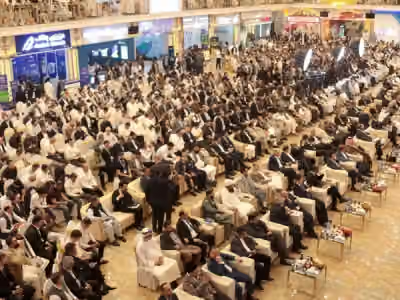
Taliban Bars Afghan, Indian & Iranian Women From Kabul Exhibition, Say Sources

Oct 8, 2026, 17:41 GMT+1
100%

Sources told Afghanistan International that the Taliban barred women from entering the Imam Abu Hanifa International Exhibition in Kabul, including Afghan women and invited female visitors from India and Iran.

Sources told Afghanistan International on Thursday, 8 October, that women had been prohibited from entering the exhibition grounds and that only men were allowed to attend the event.

According to the sources, several Indian and Iranian women who had been invited by their countries’ representatives to visit the exhibition or attend stands also faced restrictions imposed by Taliban personnel and were not allowed into different sections of the venue.

One source at the site said: “Afghan women are not even allowed into the exhibition grounds and can only watch from behind closed gates. Some Iranian women who were present at the venue were also not allowed to enter the stands.”

Sources said members of the Taliban’s Ministry for the Promotion of Virtue and Prevention of Vice were stationed at the exhibition entrances and prevented women from entering. They said the restriction continued on the second day of the event.

The fifth national and international Imam Abu Hanifa Exhibition opened in Kabul on Wednesday, 7 October, with hundreds of domestic and foreign companies taking part. The seven-day event is being held at the Afghanistan International Exhibition Centre in Chaman-e-Hozori.

Meanwhile, Fawzia Koofi, a women’s rights activist and former Afghan MP, criticised the Taliban’s treatment of women at the exhibition and said several women had been detained during the event.

Koofi said the Taliban were portraying the exhibition as a success while women had not only been denied the right to have independent stands, but some had also been beaten and detained.

She also criticised the presence of foreign officials and guests at the exhibition, asking whether they would accept such treatment of women in their own countries.

Koofi added that the continued participation of foreign figures and delegations in such events risked legitimising and normalising policies that exclude women from public life.

The Taliban has not yet responded to reports that women were barred from the Imam Abu Hanifa Exhibition or to allegations that women were detained and mistreated.

The Indian and Iranian embassies have also not yet commented on the reports.