Explosion Targets Radical Pro-Taliban Cleric in Herat

Local sources reported an explosion at a mosque in Gazargah area of Herat city. The target of the explosion was, reportedly, Mawlawi Mujib ur Rahman Ansari, Imam of Gazargah Mosque.

Local sources reported an explosion at a mosque in Gazargah area of Herat city. The target of the explosion was, reportedly, Mawlawi Mujib ur Rahman Ansari, Imam of Gazargah Mosque.
So far, conflicting reports have been published about the death of this Mawlawi. A source confirmed to Afghanistan International that Mawalwi Ansari's body was taken to the 600-bed hospital in Herat city.
Ansari was a loud critic of the previous government of Afghanistan and a supporter of the Taliban. Earlier in 2022, at a meeting of Taliban scholars in Kabul, he had said that "anyone standing against the current government [the Taliban government], should be beheaded".
At the Taliban’s Ulema gathering in Kabul, Ansari had declared his strong support for the Taliban.
Ansari was the Imam of Herat Gazargah Mosque. His sharp statements on the current affairs of Afghanistan and on Afghanistan’s sects were always in the news.
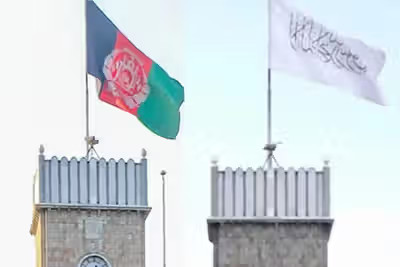

Mansoor Ahmad Khan, Pakistan's ambassador in Kabul, said that regional and international understanding is needed for Pakistan to recognise the Taliban government. Khan urged the Taliban government not to allow terrorist groups to operate in Afghanistan.
Despite the Taliban’s efforts for recognition, even Pakistan, which is one of the main allies of the group, has not recognised them.
Taliban claims that they have changed their policies and behaviour and have met major international demands.
The Taliban stressed that they will not allow any group to attack the territory of neighbouring countries. However, the group has not yet been able to stop the Pakistani Taliban from attacking Pakistani soldiers from Afghanistan.
In an interview with TOLOnews, Pakistan's ambassador encouraged the Taliban to embrace an "inclusive political structure". Ahmad Khan described Afghanistan as a multi-ethnic country and according to him, political stability cannot be achieved without the participation of all ethnic groups.
He also acknowledged that the legitimacy of the Taliban government is linked to human rights issues, especially the reopening of secondary schools for girls across Afghanistan.

Afghanistan’s medical council in a statement said that unknown individuals killed Shukria Alokozai, a female doctor. Dr. Alokozai had been working in the maternal section of 102-bed hospital in Khair khana area of Kabul.
Alokozai’s dead body was found in Panjsad Famili area of Kabul on Wednesday, August 31.
Afghanistan’s medical council in their statement on Thursday, September 1, expressed their condolences.
Taliban’s officials have not commented on the issue and the identity of the attacker is also not clear yet.
Since Taliban’s takeover, a large number of female practitioners and civil society members have been killed mysteriously.

Two Taliban members have allegedly sexually assaulted a teenager on the outskirts of Jalalabad city, local sources said. The victim's father has requested officials of Nangarhar province to punish the perpetrators, according to documents obtained by Afghanistan International.
In the documents, it has been stated that two Taliban men sexually assaulted a boy at a farm.
A source told Afghanistan International that the two who have been accused of the rape, are members of a Taliban police station on the outskirts of Jalalabad city.
They started to form friendly relations with this boy a month ago, and on Saturday afternoon last week, they took him to a farm and sexually assaulted him.
A social activist in the city said that such incidents have repeatedly taken place, but some victims remain silent for various reasons.
In recent days, Qari Saeed Khosty, the former spokesperson of the Taliban's Ministry of Interior, has also been accused of sexually assaulting a female student.
Previously, a Taliban commander in Ghor Province was arrested on charges of sexually assaulting his bodyguard and then, was released as well.

Over 110,600 people have been affected by floods in 2022 across Afghanistan, stated UN Office for the Coordination of Humanitarian Affairs (OCHA) in its latest report released on Thursday.
The report also stated that 2022 saw the lowest level of spring flooding as compared to the past five years, but witnessed a surge in atypical floods during the summer season (June-August).
OCHA in its report added that more than half of the flooding incidents (56%) and more than a third of the affected families (36%) were recorded in the eastern region of the country.
“The 2022 Humanitarian Response Plan (HRP) had already accounted for a proportion of the population to be affected by sudden-onset emergencies throughout the year and the provision of emergency assistance is part of ongoing response activities under the 2022 HRP. Partners had already been delivering humanitarian assistance in flood-affected areas and have pivoted existing supply stocks and services to reach flood affected communities,” the report stated.
OCHA said that while supplies for short-term emergency assistance are mostly available, complementary development support to rebuild destroyed houses and service infrastructure; restore livelihoods through livestock and grain replenishment; and put in place preventive investments (for example, the building of dams or establishment of early warning systems) can mitigate prolonged suffering and avert further risks of double exposure to natural disasters and climate-related shocks.

Taliban has announced that since their takeover last year, they have distributed electronic IDs to more than 2 million Afghans. Taliban’s Statistics and Information Directorate said that distribution of electronic IDs had collected 1 billion and 67 million Afs in revenue.
Bakhtar News Agency, quoted the Taliban officials as saying that the income through electronic ID distribution has been deposited to the Taliban’s government account.
E-IDs are currently being distributed across the country while former government officials have expressed concerns about the issuance of Afghanistan citizenship to the terrorist groups’ members.
Massoud Andarabi, former minister of interior in the previous government, said, “The Taliban is distributing Afghanistan IDs and passports to international terrorist groups, including al-Qaeda, in order to conceal their connections with them.”
Andarabi claimed that the Taliban started this initiative after the advice of their trusted circles among the Pakistan military.
Taliban’s Statistics and Information Directorate said that there are 73 centers for E-ID distribution across Afghanistan and this could boost the distribution process further.
According to reports, the increase in demand for IDs has been for the purpose of getting passports in order to leave Afghanistan.
Earlier, it had been reported that Mullah Hassan Akhund, Taliban’s prime minister, had ordered the group officials to distribute passports with paper IDs as well due to an increase in the demand for passports. The previous government had banned passport distribution with paper IDs.
Electronic ID distribution had begun in April 2018 and Ashraf Ghani, Afghanistan’s fugitive president, was the first to receive it.