• العربية
  • پښتو
  • فارسی
Brand
  • Afghanistan
  • Sport
  • Markets
  • Afghanistan
  • Sport
  • Markets
  • Theme
  • Language
    • العربية
    • پښتو
    • فارسی
  • Afghanistan
  • Sport
  • Markets
All rights reserved for Volant Media UK Limited
volant media logo

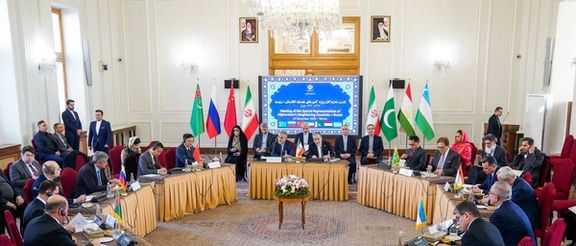
Iran Hosts Regional Talks, Says Afghan Security Affects All Neighbours

Dec 14, 2025, 10:04 GMT+0

Iran’s Foreign Minister Abbas Araghchi said on Sunday that stability in Afghanistan is a strategic necessity for the entire region, stressing that the country’s security is “directly tied to the interests of all neighbouring countries.”

Araghchi made the remarks at the “Meeting of Special Representatives of Afghanistan’s Neighbouring Countries Plus Russia,” held in Tehran. Special representatives from Russia, Pakistan, China, Tajikistan, Uzbekistan and Turkmenistan attended the gathering. The Taliban declined to participate.

Iran’s Foreign Ministry spokesperson Esmail Baghaei said at the opening of the meeting that all developments related to Afghanistan would be reviewed.

Addressing the meeting, Araghchi said establishing regular mechanisms for dialogue among Afghanistan’s neighbours is a strategic necessity. “These meetings not only prevent misunderstandings,” he said, “but also enable coordination of policies and economic, border and humanitarian programmes, helping to strengthen mutual understanding and convergence of views among regional countries. They provide a suitable platform for reducing tensions and boosting constructive cooperation among neighbours.”

The Iranian foreign minister also said that “no extra-regional blueprint can resolve regional problems and crises,” adding that imported solutions or decision-making from outside the region do not bring stability to any country.

Araghchi emphasised the importance of expanding regional economic cooperation with Afghanistan, saying improved conditions could allow the country to serve as a link between Central Asia and South Asia, and between West Asia and the Asia-Pacific, creating a corridor for energy transit and trade.

Ahead of the meeting, Iran facilitated discussions among anti-Taliban political groups, resulting in a joint declaration titled “National Solidarity of Afghanistan’s Political Parties and Movements.” Encouraged by Tehran, Afghan political factions issued a statement calling for the resolution of Afghanistan’s crisis through political dialogue.

Hanif Atmar, Afghanistan’s former foreign minister, described the Tehran meeting as an important opportunity to advance a political process. He urged regional countries to support the launch of intra-Afghan negotiations and to “ask Afghan parties to hold these talks as soon as possible, in cooperation with the United Nations.”

Most Viewed

Taliban Ignore Afghanistan’s Interests By Backing Militants, Says Pakistan Army Chief
1

Taliban Ignore Afghanistan’s Interests By Backing Militants, Says Pakistan Army Chief

2

United Nations Delivers Education Kits To Four Million Afghan Children

3

Taliban Renews Call For China To Launch Aynak Copper Mine

4

Taliban Leaders In South-West Hold Security Meet In Kandahar

5

Afghan Deportations Is Strategic Mistake, Says European Parliament Member

•
•
•

More Stories

Two Resistance Groups Say They Hit Taliban Targets In Kunduz

Dec 13, 2025, 17:51 GMT+0

The Afghanistan Freedom Front (AFF), led by Yasin Zia, and the National Resistance Front (NRF), led by Ahmad Massoud, have reported carrying out separate attacks against Taliban forces in Kunduz province.

In a statement issued on Saturday, 13 December, the AFF said its fighters killed two Taliban members and wounded three others in an attack on Friday evening in Kunduz. The group claimed the dead included a Taliban commander identified as Qari Ubaid.

The NRF said its forces carried out an attack on Thursday evening, 11 December, near a Taliban checkpoint in the Sixth Police District of Kunduz city, killing two Taliban members and wounding another.

The Taliban have not commented on the claims made by either group.

The United Nations has said that over the past three months, armed opposition fronts have not posed a significant challenge to Taliban rule, noting that six such groups claimed responsibility for 41 attacks during the period.

Taliban Justice Minister Accused Of Detaining Dozens In Kabul Land Dispute

Dec 13, 2025, 15:35 GMT+0

Sources in Darulaman, western Kabul, told Afghanistan International that Taliban Minister of Justice has detained at least 38 local residents after they buried a neighbour in a cemetery near the ministry compound.

According to local sources in the Afsar area of Darulaman, residents buried one of their neighbours on Wednesday, 10 December, in a cemetery located close to the Ministry of Justice. After the burial, armed officers from the ministry reportedly ordered residents to exhume the body and move it to another location.

The incident comes amid growing controversy surrounding the conduct of the Taliban’s minister of justice. Even Taliban officials have privately acknowledged that the minister acts outside established legal frameworks and is not accountable to any authority, according to sources.

The ministry had previously warned residents against burying their dead in the cemetery, claiming it falls within a designated green zone. Local residents dispute this, saying the cemetery has been used by the community for decades. They say the Taliban has now ordered graves to be exhumed and remains relocated.

Sources say the residents most of whom are Shia protested on Wednesday after Taliban officials halted the burial. Taliban officers subsequently detained at least 38 people, including the local mosque’s imam and a community elder.

Videos obtained by Afghanistan International show dozens of residents marching along Darulaman Road in protest.

A local resident said that three days after the arrests, there was still no information about the detainees’ whereabouts or condition. He said residents contacted Police District 6 and other Taliban authorities but received no response.

Residents also say the Ministry of Justice has declared the land of their neighbourhood mosque to be “Emirati” property. Locals insist the mosque land was donated by a community member and has a valid Sharia-compliant title deed.

According to sources, the actions are being carried out on the direct orders of the Taliban’s justice minister. Residents allege the minister is attempting to force them out of the area through intimidation and pressure.

Broader Land Disputes in Southwest Kabul

The latest incident follows earlier allegations involving land seizures in the Darulaman area. On 19 November, residents of the Sanatorium neighbourhood said Abdul Hakim Sharayi, the Taliban’s minister of justice, forcibly evicted families from their homes and transferred the properties to relatives and associates.

The minister reportedly resides in the Darulaman Sanatorium area. Sources said armed men loyal to him expelled women and children from their homes, forcing them into displacement.

Taliban authorities have not publicly responded to the allegations.

Taliban Education Minister Backs Supreme Leader As Haqqani Criticises Rule By Fear

Dec 13, 2025, 14:08 GMT+0

Neda Mohammad Nadeem, the Taliban’s minister of higher education, has warned that disobedience to Taliban leader Hibatullah Akhundzada would weaken the authority of the regime. He said that in an Islamic system there can be only one leader who must be obeyed by all.

Addressing young Taliban members on Friday during a speech at a religious school in Paktia province, Nadeem said that the existence of “multiple amirs” would lead to corruption and the failure of the system. He urged Taliban members to follow Akhundzada’s orders without question.

Nadeem, regarded as a close and trusted associate of Akhundzada in Kabul, made the remarks on the same day that Sirajuddin Haqqani, the Taliban’s interior minister, publicly criticised the leadership’s treatment of the population in Khost province.

Speaking in Khost, Haqqani criticised what he described as a Taliban “government of fear and intimidation.” He said that while the Taliban had once been oppressed by the “emperors of the world,” they now showed little tolerance themselves.

Haqqani urged Taliban officials to treat the population in a way that would reduce hostility and resentment, warning that governance based solely on fear could not succeed.

Afghanistan’s National Radio and Television later released an audio recording of Nadeem’s speech, in which he called on Taliban forces not to oppose Akhundzada or attempt to establish another self-appointed leader. He said Taliban members must obey orders to serve in any “fort,” “district” or “army unit” when instructed.

Without naming any individual or faction, Nadeem stressed that no one should regard themselves as an “amir” or act independently. He reiterated that in what he called the “Islamic system,” there is only one amir, and all must obey him. He concluded by urging Taliban members to be ready to sacrifice their lives and property to defend the system.

Supporters of Sirajuddin Haqqani often refer to him using the title “Khalifa,” while official Taliban texts describe Hibatullah Akhundzada as Amir al-Mu’minin, a title that emphasises absolute obedience. In Islamic terminology, a Khalifa is traditionally seen as a successor to the Prophet in political and social governance, while Amir al-Mu’minin denotes a leader of the faithful with both religious authority and political power.

Public disagreement between Haqqani and Nadeem is not new. In December 2024, the two ministers clashed verbally during a graduation ceremony at a religious school in western Kabul.

At the event, Nadeem sharply attacked Taliban critics, calling them “enemies of God, enemies of the Islamic system, slaves of infidels, apostates and unbelievers,” and argued that only religious scholars could confront them.

When Haqqani later addressed the gathering, he struck a markedly different tone, saying it was inappropriate to use harsh language against the population or to label people as corrupt. He said an Islamic system has a responsibility to guide those who go astray and warned that corruption and disbelief would arise from the authorities’ own “narrow-mindedness and weakness.”

In those remarks, Haqqani indirectly criticised the Taliban leadership’s approach to governance, highlighting ongoing internal tensions within the movement.
Will Not Attend Regional Tehran Meeting On Afghanistan, Says Taliban

Dec 13, 2025, 12:41 GMT+0

The Taliban’s Ministry of Foreign Affairs said on Saturday it will not take part in a regional meeting on Afghanistan scheduled to be held in Tehran. Zia Ahmad Takal, deputy spokesperson for the ministry, said the Taliban had received an invitation but decided not to attend.

According to Takal, the decision was based on the Taliban’s view that Afghanistan already maintains active relations with regional countries through existing regional organisations and cooperation frameworks, and has made what he described as significant progress in this regard.

Tehran is set to host the regional meeting on “developments related to Afghanistan” on 16 and 17 December. One of the key issues on the agenda is reducing tensions between the Taliban and Pakistan.

The meeting is expected to be attended by special representatives from Pakistan, Tajikistan, Uzbekistan, Turkmenistan, China and Russia.

On Thursday, Iran’s Foreign Ministry spokesperson Esmail Baghaei told reporters: “The Islamic Republic of Iran attaches fundamental importance to security and stability in its neighbourhood and, in this context, will spare no effort to reduce tensions among regional countries and strengthen mutual understanding.”

Referring to recent tensions between the Taliban and Pakistan, Baghaei added: “We hope this meeting can play an effective role in promoting convergence and easing tensions.”

The meeting comes amid a sharp deterioration in relations between the Taliban and Pakistan. Since clashes erupted between the two sides, Iran has repeatedly called for mediation and de-escalation, but neither party has so far responded substantively to Tehran’s efforts.

A day earlier, Iran’s representative to the United Nations expressed concern about the expansion and activities of terrorist groups in Afghanistan, saying Iran is “directly and immediately” affected by developments in the country. He warned that “without the formation of an inclusive national government, conflict in Afghanistan will intensify.”

Ahead of the meeting, Iran also facilitated discussions among Afghan opposition political groups, resulting in a joint statement known as the “Unity of Afghan Political Parties and Movements.” Encouraged by Tehran, the groups issued a declaration calling for the resolution of Afghanistan’s crisis through political dialogue.

Rights Activists Urge Arrest Of Taliban Leader, Court Chief At Spain Conference

Dec 13, 2025, 11:37 GMT+0

Human rights defenders attending the third special conference on Afghan women in Spain have called for international action to arrest Taliban leader Hibatullah Akhundzada and Abdul Hakim Haqqani, head of the Taliban’s Supreme Court.

The conference, held on Friday, 12 December, and hosted by Spain’s Ministry of Foreign Affairs in Madrid, highlighted that Afghanistan ratified the Convention on the Elimination of All Forms of Discrimination Against Women (CEDAW) in 2003 without reservations and is therefore legally bound to uphold and implement its provisions.

Participants said that more than four years after the Taliban’s return to power, the group’s policies have led to the systematic exclusion of women and girls from public, educational, professional and political life. They stressed that, given the Taliban’s refusal to engage meaningfully with international demands, concrete legal action at the global level is now required.

In July, the ICC issued arrest warrants for Akhundzada and Abdul Hakim Haqqani on charges of crimes against humanity linked to the systematic repression of women. The move was described as part of broader efforts to ensure justice and accountability for human rights violations in Afghanistan.

Conference participants emphasised that enforcement of the warrants would not be possible without practical cooperation from governments.

Citing credible United Nations reports, speakers said there is clear evidence of segregation and the systematic exclusion of women and girls from public life in Afghanistan a situation the UN special rapporteur has described as amounting to crimes against humanity and gender apartheid.

The conference also urged governments to support the formal recognition of gender apartheid as a distinct crime against humanity under international law.

Participants warned that without sustained political will, sufficient financial support and the meaningful participation of victims, accountability efforts would fail and impunity for serious human rights violations would continue.