
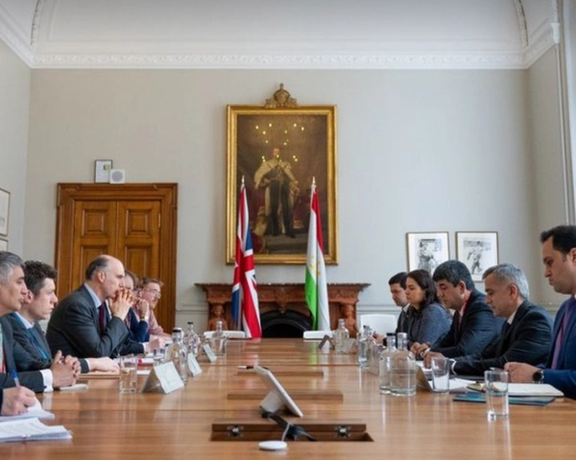
On Thursday, a delegation from Tajikistan met with British representatives in London to discuss bilateral cooperation and the situation in Afghanistan. The discussions included topics such as security threats, terrorism, and extremism.
On Friday, the Tajikistan foreign ministry had issued a statement announcing that a memorandum of cooperation had been signed between the heads of the delegations of Tajikistan and the UK.
The memorandum outlines a commitment to continue constructive dialogue to strengthen relations on issues of mutual interest between London and Dushanbe. However, no further details had been provided about any additional agreements made during the meeting.
The discussions are considered significant given Tajikistan's proximity to Afghanistan and the security concerns in the region.

The Afghanistan Independent Human Rights Commission (AIHRC) announced that Taliban has arbitrarily arrested cultural and civil activists. AIHRC stressed that despite the widespread reactions to these arrests, the Taliban has not responded to domestic and international demands.
In a statement on Saturday, AIHRC referred to Amnesty International's annual report on the human rights situation in Afghanistan and urged national and international organisations to implement the recommendations suggested by the human rights group.
Earlier, Amnesty International had reported that the Taliban has widely and systematically killed and tortured Afghan citizens.
The watchdog group added that former Afghan government soldiers, former officials, armed members of the resistance groups, and ISIS members have been the main victims of the Taliban's cold-blooded killings.
AIHRC has also mentioned the detentions of Zakaria Osuli and Rasul Parsi, university professors; Narges Sadat, a women's rights activist; Musa Shaheen, a local singer; Mortaza Behboudi, Afghan French journalist; Sayed Mohammad Hosseini, a cultural activist; and Matiullah Wesa, an education activist, who remain in the Taliban prison.
The commission has asked the Taliban for the immediate release of these activists.
Iranian Sunni Preacher, Mawlawi Abdul Hamid, criticised Taliban’s policies regarding the education of Afghan girls. During his Friday prayer sermons, Abdul Hamid added that he was afraid that the Taliban's actions would "hurt Islam”.
The Sunni preacher added that the current era is not the like the time of Rashidun Caliphs and urged the Taliban to update their views according to the current era.
Mawlawi Abdul Hamid said, "It is not hundred or two hundred years ago. It is not the era of the Rashidun Caliphs...This era has its own needs. Today, when someone talks about Islam, he must present Islam in the present time and [according] to what is stated in the Quran, and not based on the fatwa of an Islamic school a thousand years back”.
Mawlawi Abdul Hamid emphasised that the "jurisprudents" of the past in Islam had issued fatwas based on the conditions during their time. According to him, "If Imam Abu Hanifa was alive today, he would have changed hundreds of his fatwas. The world has changed."
This Iranian cleric stressed that he is disappointed that Afghan women and girls have been forced to flee Afghanistan for Europe and neighbouring countries to continue their education. He added that in Islam it has been emphasised that men and women should pursue both religious and modern education.
Abdul Hamid also spoke about the rights of other ethnic and religious groups under the Taliban regime. He said that the Taliban should include all ethnic and religious groups in their regime. He said that no ethnic group should feel discriminated against under the Taliban reign in Afghanistan.
The Iranian Sunni preacher urged the Taliban to pay special attention to the Hazaras and Shiites and said, "They (Shiites) should not feel that they are deprived of their rights because of their religious differences from the rest of Afghans."
Mawlawi Abdul Kabir, the Taliban’s deputy prime minister for political affairs, said that the group believes in the electoral system. In a meeting with Roza Otunbayeva, the UN special envoy in Kabul, Abdul Kabir said that the Taliban wants an election based on expertise.
The Taliban-controlled Bakhtar News Agency report did not provide further details about Abdul Kabir's comments on elections. The United Nations Assistance Mission in Afghanistan has not yet commented on the meeting with the Taliban deputy prime minister.
In this meeting with Otunbayeva, several other senior officials of this group, including Khairullah Khairkhah, the Minister of Information and Culture of the Taliban, and Anas Haqqani, brother of Sirajuddin Haqqani, the Minister of Interior of this group, were also present.
The Taliban’s deputy prime minister speaks about believing in elections, while the Taliban seized power by force in 2021 and has no domestic or international legitimacy.
On the other hand, the Taliban constantly asks the people to pledge allegiance to the leader of this group and obey the orders of Mullah Hibatullah Akhundzada.
In practice, after taking over Afghanistan in August 2021, the Taliban abolished all elected institutions, including the election commissions of Afghanistan.
The Taliban rejects the system based on elections and people's votes, and last year, to gain legitimacy, they organised a Loya Jirga in Kabul through which they received a "pledge of allegiance" from their supporters.
In the past one and a half years since their takeover of Afghanistan, the Taliban has abolished the Parliament, the provincial councils, the Ministry of State for Parliamentary Affairs, as well as the Afghan Constitution.
The Taliban has also revoked the license of political parties and denied women and girls basic rights to education, work, and travel.
Abdul Bari Jahani, former minister of information and culture, said that the power in Afghanistan is in the hands of Pashtuns, particularly those from Kandahar. Jahani added that Taliban violates the rights of other ethnic groups and Pashtuns will pay for the group’s actions.
In an open letter to the Taliban leaders, Jahani stressed that due to the monopoly of power by the Taliban, especially the Kandahari Taliban, all other ethnic groups in Afghanistan, including non-Kandahari Pashtuns, have become pessimists towards every Pashtun.
Abdul Bari Jahani is a famous Pashto poet and writer. Jahani emphasised in this letter that neither the Pashtuns nor any other ethnic group in Afghanistan have the right to monopolise power and exclude other ethnic groups, who live in Afghanistan just like the Pashtuns, for centuries.
This well-known Pashto poet wrote in his letter to the Taliban leaders that history of Afghanistan has proven that one can take power by force, but it is impossible to maintain it forcefully.
Jahani, who is from Kandahar province, said that due to the monopoly of power by the Taliban, all ethnic groups in the country, including Tajiks, Hazaras, Uzbeks, Turkmens, and other smaller ethnic groups and even non-Kandahari Pashtuns, are disappointed with the Taliban and all Pashtuns.
He has emphasised that educated Afghans inside and outside the country have been disappointed due to the closure of schools and universities and the ban on women's work.
Imangali Tasmagambetov, Secretary General of the Collective Security Treaty Organisation (CSTO) warned that the risk of "terrorists" infiltrating from Afghanistan to Central Asia has increased. Tasmagambetov added that drug trafficking from Afghanistan too has been on the rise.
The Secretary General of CSTO discussed the threats from Afghanistan at the meeting of leaders of the Collective Security Treaty Organisation in Moscow on Friday.
According to Tasmagambetov, terrorist groups infiltrate from Afghanistan into the territories of CSTO member states.
Armenia, Belarus, Kazakhstan, Kyrgyzstan, Russia, and Tajikistan are members of the Collective Security Treaty Organisation.
Tasmagambatov urged the members of the Collective Security Treaty Organisation to seriously consider the threats originating from Afghanistan.
The Collective Security Treaty Organisation had previously said that 4,000 ISIS fighters were stationed on the Afghanistan-Tajikistan border.