Taliban Conducts Heavy Weapons Military Training In Afghan Province Bordering Iran

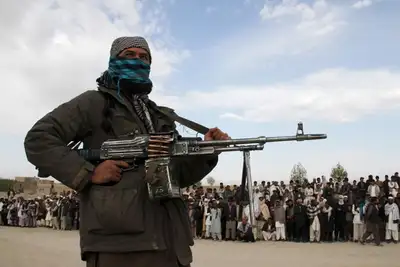
The Taliban-controlled Bakhtar News Agency, on Thursday, reported that the third regiment border forces in Nimroz conducted military training with heavy weapons.

The Taliban-controlled Bakhtar News Agency, on Thursday, reported that the third regiment border forces in Nimroz conducted military training with heavy weapons.
Mohammad Nabi Mullahworor, a Taliban military official, said that the purpose of these exercises was to for more “military experience" of the Taliban forces.
Mullahworor stressed that these trainings have been conducted by “professional” trainers in Zaranj city of Nimroz province.
These trainings are conducted by the Taliban as there was a border skirmish that took place between Iranian and Taliban border guards in Nimroz province and Iranian border guards used heavy weapons and artillery in attacking Taliban positions.
Nimroz, which is on the border with Iran, has witnessed several armed clashes between the Taliban and Iran.

The United Nations Spokesperson, Stephane Dujarric, said on Thursday that the UN is "extremely concerned" about the reports of a ban on international organisations in the education sector in Afghanistan.
He said that it would be another horrendous step backward for the people of Afghanistan. The UN spokesperson emphasised that the Taliban’s ban will have negative impacts on Afghan women, girls, youth, and for the future of Afghanistan.
The Taliban has not officially announced the ban on the educational activities of non-governmental organisations. However, Wahidullah Hashemi, head of international relations of the Taliban Ministry of Education, said in an audio tape that was provided to Afghanistan International, that foreign organisations have been issued a one-month timeline to stop their projects in the education sector.
According to him, this order has been communicated verbally to these organisations.
Dujarric too said in a news conference in New York that the Taliban has not yet officially informed the United Nations about imposing a ban on the operations of the UN agencies in the education sector.
He added that the UN officials in Afghanistan are in contact with the Taliban to ascertain what is being planned by the group.

Despite the Taliban’s previous claims of less water in the Kamal Khan and Kajaki dams, the Taliban-controlled Bakhtar News Agency reported an increase in the water levels of the Kajaki dam.
Mohammad Ershad Ahmadi, a Taliban official in the electricity department of Kandahar, said that due to the increase in the water level and capacity of turbines in the Kajaki dam, the department supplies 24 hours electricity to Kandahar city now.
Recently, amid tensions between the Taliban and the Islamic Republic over the water rights issue from the Helmand River, Taliban officials had claimed that the Kamal Khan Dam does not have enough water to cross a distance of over 600 kilometers to reach Iran.
Amir Khan Muttaqi, Taliban’s foreign minister, on May 22, said that the group is committed to providing Iran’s water right according to the 1973 agreement, but the drought in the region must be considered too.
In response, Iranian officials had asked the Taliban to let an Iranian expert team assess the water levels inside Afghanistan.
Some of the Taliban officials, including Sher Abbas Stanikzai, the Taliban’s deputy foreign minister, had responded that dams are considered sensitive sites in Afghanistan and the Taliban will not allow Iranian experts to visit these sites.

A day after Afghanistan International’s report about the Taliban’s recent order to ban the operation of organisations active in the education sector, the UN Children’s Agency expressed concerns about the decision.
Samantha Mort, UNICEF’s Afghanistan spokesperson, said that the agency will seek clarification from the Taliban.
On Thursday, Reuters reported that UNICEF was following up with the Taliban over whether international organisations would be excluded from education projects, which could affect hundreds of thousands of students.
UNICEF has warned that if international non-governmental organisations are not allowed to operate in the education sector, it may impact thousands of Afghan students.
In May, UNICEF announced that the organisation holds 21,000 education classes across Afghanistan. UNICEF had also announced that it will hold short-term educational courses for girls in Bamiyan province of Afghanistan.
UNICEF’s Afghanistan spokesperson has stated that if the international organisations are not allowed to operate, more than 300,000 girls may “lose out on quality learning”.
The Taliban has not commented on the matter yet. However, an audio file from Wahidullah Hashemi, the group’s director of international relations of the Ministry of Education, has been reviewed by Afghanistan International in which he said that foreign organisations have one month to stop their projects in the education sector in Afghanistan. According to him, currently, the verbal order has been conveyed to these organisations.

In a new report, Amnesty International has stated that the Taliban have committed war crimes of collective punishment against civilians in Afghanistan’s Panjshir province.
The report, ‘Your Sons Are In The Mountains’: The Collective Punishment of Civilians In Panjshir by the Taliban, documents serious international human rights and humanitarian law violations, including extrajudicial executions, torture, hostage-taking, unlawful detention, and the torching of civilian homes.
The report stated that the Taliban have retaliated against captured National Resistance Front (NRF) fighters, and targeted the civilian population in Panjshir to force compliance and submission after they seized power and noticed an opposition rising in the region.
The global rights watchdog called on the Taliban authorities to investigate the cases documented, and hold fair trials before ordinary civilian courts where warranted.
It also renewed its call for the United Nations Human Rights Council to create an independent international accountability mechanism with a focus on preserving evidence for future justice processes, including prosecutions as well as public reporting and monitoring.
“In Panjshir, the Taliban’s cruel tactic of targeting civilians due to suspicion of their affiliation with the NRF is causing widespread misery and fear with a clear goal of intimidation and punishment,” said Agnès Callamard, Amnesty International’s Secretary General.
The report talks about how the Taliban has conducted village-wide arbitrary arrests of all adult men and older boys, detained them without charge, and subjected them to beatings and other abuse.
The report also documents several cases of mass extrajudicial executions of NRF fighters by the Taliban.
In at least three cases, the Taliban also tortured to death civilians they had arrested in the Bazarak and Rokha districts of Panjshir province.

The Taliban-controlled Afghanistan embassy in Islamabad announced that nearly 250 Afghan refugees have been arrested in Islamabad, Rawalpindi, and its surroundings. The embassy said that refugees who had legal documents had also been arrested.
The Afghan embassy added that “arresting Afghan refugees by the Pakistani police has been ongoing”.
A video clip documented by an Afghan refugee, shows Pakistani police around a residential building. According to the video clip, the police had come to the area to "arrest Afghans without visas".
Also, several refugees complained that their families were not informed about the fate of their relatives who were detained by the Pakistani police. One of the refugees allegedly claimed that an Afghan refugee was released after bribing the police.
On Wednesday, Taliban’s representative in Islamabad asked Pakistani government to stop arresting Afghan refugees.
Apparently, these Afghan refugees have been arrested by Pakistan anti-terrorism forces for not having legal documents.
Afghanistan embassy in Pakistan said that their representatives met with police officials so that the situation of these refugees can be determined as soon as possible, and they can be released from Pakistani detention centers.
Earlier, the police of Pakistan responded to Afghanistan International and confirmed the arrest of 175 Afghans who had been transferred to a prison in Rawalpindi.
After the takeover of Afghanistan by the Taliban, hundreds of Afghans, including officials and former government employees entered Pakistan to escape the Taliban’s persecution.
They have repeatedly expressed their concern over their unclear legal and residence status and the possibility of being arrested by the Pakistani police.