Afghan & Kazakh Private Sectors Sign Agreements Worth $100 Million
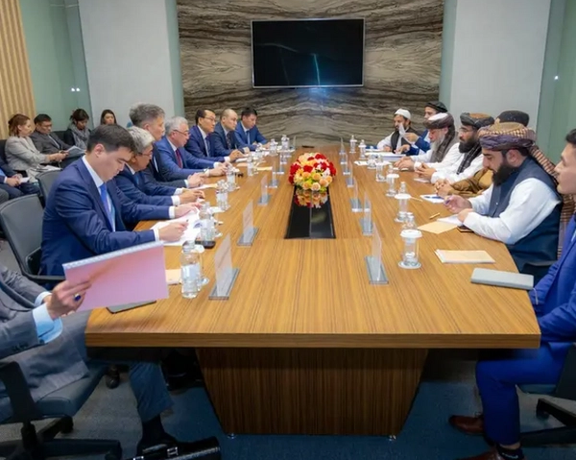
The Taliban’s Ministry of Commerce announced that the private sector of Afghanistan and Kazakhstan signed trade agreements worth over a hundred million dollars in Astana city.
The Taliban’s Ministry of Commerce announced that the private sector of Afghanistan and Kazakhstan signed trade agreements worth over a hundred million dollars in Astana city.
Nooruddin Azizi, Minister of Commerce of Taliban, and Serik Zhumangarin, Minister of Trade of Kazakhstan, met and discussed these agreements in Astana too.
In a statement on Thursday, the Ministry of Commerce of the Taliban announced that during the meeting, transit, trade, and banking between the two countries had been discussed.
TASS news agency reported on Thursday that Kazakhstan and the Taliban have agreed to have more cooperation in various fields.
According to TASS, Astana has agreed for the Taliban to open its trade representation in Kazakhstan.
Amir Khan Muttaqi, the Taliban’s foreign minister, said that talks with the US delegation in Qatar had been highly positive.
Muttaqi added that during negotiations between the two sides, the Taliban emphasised on "Washington's respect for Afghanistan's sovereignty".
According to Al Jazeera, Muttaqi also stressed that the United States should lift sanctions on the Taliban.
On Wednesday, the Taliban’s foreign minister said that the group will not allow Afghanistan's soil to be used against other countries, including the United States.
"We want to solve the issue of foreign prisoners in Afghanistan in such a way that all parties are satisfied," said the Taliban's foreign minister.
On July 30 and 31, US Special Representative for Afghanistan Thomas West; Special Envoy for Afghan Women, Girls, and Human Rights Rina Amiri, and Chief of the US Mission to Afghanistan based in Doha Karen Decker, along with other US officials met and discussed issues of critical interest with senior Taliban representatives and the group’s technocrats in Doha.
During a meeting with the Taliban delegation in Doha, the US special representatives emphasised on the "immediate and unconditional" release of US citizens who had been detained in Afghanistan.
While asking for the release of detained American officials, the US envoys did not provide details about the number of Americans in detention under the Taliban in Afghanistan. However, earlier, the US Secretary of State Anthony Blinken had referred to the detention of several US citizens by the Taliban and said that about 175 US citizens remained in Afghanistan, some of whom had entered the country after the fall of the Afghan government in August 2021.
Kazakhstan’s Minister of Trade and Integration Serik Zhumangarin announced that his country is ready to implement educational programmes for Afghan students.
Zhumangarin said that Kazakhstan is ready to give scholarships to 30 Afghan students this year.
On Thursday, at the Afghanistan-Kazakhstan business conference, the Kazakh trade minister said that Astana will continue to provide humanitarian aid to the people of Afghanistan.
Nooruddin Azizi, Minister of Trade of the Taliban, had also been present at this business conference.
After taking over Afghanistan in August 2021, the Taliban have closed schools and universities for girls and have not elaborated on when the group will reopen these educational centers.
However, several countries, including Kazakhstan, provide scholarships to Afghan students so that girls can continue their education.
According to Kazakh media reports, more than 450 Afghan students are currently studying in Kazakhstan.
Michael McCaul, Chairman of the US House Committee on Foreign Affairs, criticised the country’s special envoy for women and human rights in Afghanistan for meeting Taliban members in Doha.
McCaul said, “There are more repressive edicts against Afghan women and girls today than there were when Amiri took office.”
The Chairman of the US House Committee on Foreign Affairs stressed that the US representatives’ engagement with the Taliban doesn’t help Afghan women.
Following the meeting with the Taliban's foreign minister in Doha, Amiri said that she met with the group's representatives due to "Afghans and human rights defenders insisting on direct engagement with the Taliban”.
The US-Taliban meeting in Doha has been met with wide-ranging criticisms. Several Afghans who have been part of the protest movement of Afghan women have said that Amiri as a US government envoy should not justify her meetings with the Taliban for human rights or women’s rights issues.
Meanwhile, the chairman of the US House Committee on Foreign Affairs stressed that US engagement with the Taliban is like legitimising the group and said that Afghans didn’t ask for more US engagement with the group.
He said that “these meetings should stop”.
Some Afghan politicians and activists have said that the US sees its own interests in engaging with the Taliban and that Rina Amiri, an envoy of the US Department, acts based on Washington's policy and interests.
Former Afghan parliamentarian, Fawzia Kofi, on Wednesday, said that foreign diplomats cannot be blamed for "protecting the interests of their governments". She asked the anti-Taliban fronts to “mobilise around” their own narratives.
Pakistan’s deputy foreign minister Hina Rabbani Khar announced that Afghans are involved in the destabilisation of the country and Islamabad has shared its evidence with the Taliban.
Khar told Pakistan media outlets that even those Afghans who had entered the country with medical visas had taken part in some of the attacks against targets inside Pakistan.
On Wednesday, Khar added that Islamabad has evidence which show that Afghans are involved in terrorist attacks in Pakistan.
Pakistan's Foreign Ministry also said in a separate statement that Afghan citizens were involved in the deadly attack on an army base in Baluchistan province. In a statement on Wednesday, the ministry added that the attackers were residents of Kandahar province.
According to Pakistani media reports, the Ministry of Foreign Affairs of Pakistan has sent a letter to the Taliban-controlled Embassy in Islamabad and asked the representatives of the Taliban to receive the bodies of the three terrorists.
Last month, the Pakistani army issued a statement about the participation of Afghan citizens in attacks inside Pakistan and said that such attacks have become a grave concern for Islamabad.
Taliban announced that in the last two days, the group has rejected 17 Iranian fuel tankers due to quality issues.
In a statement, the Taliban's National Standard Authority stressed that 13 tankers had been returned to Iran from Farah province’s Mil 78 border terminal on Tuesday and four tankers had been returned from Nimroz border terminals with Iran on Wednesday.
The Taliban’s office added that it has recently increased its assessments of the quality of fuel imported from Iran.
Earlier, the Taliban had announced that they had rejected another 40 tankers of low-quality fuel from Iran.
This group has previously too often announced that it had returned low-quality imported Iranian petroleum products back to the country.
The petroleum products needed by the Afghan market have been mainly imported from neighbouring countries including Iran, Pakistan and Central Asian countries.
