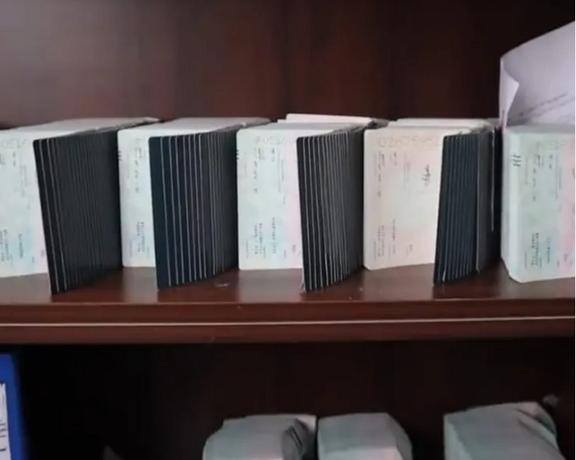
Taliban’s Ministry of Foreign Affairs Announces Issuance of Passports to Afghans In Iran

The Taliban’s Ministry of Foreign Affairs announced that the process of issuing passports to Afghan citizens in Iran has started.

The Taliban’s Ministry of Foreign Affairs announced that the process of issuing passports to Afghan citizens in Iran has started.
Hafiz Zia Ahmad, a spokesperson for the ministry of foreign affairs of the group, said on social media platform X that priority has been given to newborn Afghan children.
Zia Ahmad emphasised that these children should have electronic Afghan identity cards.
However, he added that the baby's birth certificate, electronic ID cards of the child's father, passport, and residence card of the host country are also acceptable for issuing passports to the newborn Afghan children.
The Islamic Republic of Iran handed over the Afghan embassy in Tehran to the Taliban earlier in 2023. Meanwhile, the Islamic Republic has kept its embassy active in Kabul. However, Tehran has not recognised the Taliban yet.


Afghanistan Journalists Center announced on Sunday that Hamisha Bahar TV and Radio stations have resumed operations in Nangarhar province.
Taliban shut down the operations of the broadcast network about three weeks ago and had also insulted the employees of the TV and radio stations.
According to Afghanistan Journalists Center, Atal Stanekzai, the director of Hamisha Bahar Radio and TV, confirmed the reopening of the stations and said that the Taliban’s directorate of information and culture allowed the resumption of the broadcast network’s operations at around 4pm local time on Sunday.
Sediqullah Qureshi Bedloon, the head of the directorate of information and culture in Nangarhar, said that the operations had been temporarily shut down due to “violations".

Zahra Haqparsat, a leader of the Afghan Women's Unity and Solidarity Movement, announced that the Taliban released eight members of this group after several hours of detention.
The Taliban forces arrested these women on Sunday evening for planning an in-house protest in Khair Khana area of Kabul.
Haqparast said on social media platform X that the movement’s members had been released due to the "united advocacy” of Afghan citizens.
She expressed hope that "there will be no harm to the protesters and their families”.
It is not known which agency of the Taliban had arrested these women activists.
Khalid Zadran, the spokesman of the Taliban Police in Kabul, denied the arrest of these protesters.
A member of the movement told Afghanistan International that the Taliban surrounded the house in which the women activists had gathered and entered it to arrest the activists.
According to Afghanistan International’s source after being suppressed by the Taliban, women protesters have shifted to in-house movements, but it seems that the Taliban can now infiltrate these places too.

Sultan Barakat, who is close to the Taliban, announced that the seventh session of the Afghanistan Future Thought Forum (AFTF) concluded on Sunday in Jakarta, the capital city of Indonesia.
According to Barakat, AFTF saw the participation of 30 Afghan men and women and was headed by Fatima Gilani, the former chairperson of the Afghan Red Crescent Society.
Barakat added that the participants discussed current challenges and potential confidence-building measures in Afghanistan.
Barakat did not provide any details about the presence of Taliban representatives at the AFTF meeting, but reliable sources told Afghanistan International that Farooq Azam, the advisor to the Ministry of Water and Energy of the Taliban, had travelled from Kabul to Jakarta to participate in this meeting.
These sources added that this meeting had been held as part of the efforts in line with the "policy of engagement with the Taliban".
Barakat also stressed that "diplomats from Japan, Malaysia, Indonesia, Belgium, Sweden, Canada, Australia, Norway, the European Union, and representatives of the World Bank" met with the participants.
Afghanistan International sources said that Afghan politicians and civil society members, including former Afghan ambassador Omar Samad; lawyer Kawun Kakar; former diplomat Asila Wardak; Kabul University professor Faiz Zaland; former Afghan minister Ehsan Zia; former member of parliament Abdul Qayyum Sajjadi; political activist Jafar Mahdavi; former interior minister Wais Barmak; former parliamentarian Golali Safi; civil society activist Khadija Mahdi, and political activist Ayoub Erfani participated in the meeting.

The National Resistance Front (NRF) attacked a Taliban base in Hesa-e Awal district of Kohistan in northern Kapisa province.
In a statement, NRF added that in the attack "three Taliban terrorists" had been killed and two other Taliban members had been wounded.
According NRF, the attack was carried out at around 2am in the Bazar-e-Shirkat area at the center of Hesa-e Awal Kohistan District of Kapisa Province.
The National Resistance Front led by Ahmad Massoud added that the attack lasted for half an hour and rocket launchers were used in it.
NRF stressed that during the attack, the front’s forces have not been harmed.
During the last month, the National Resistance Front and Afghanistan Freedom Front have announced that they have carried out attacks on Taliban outposts in Kabul, Badakhshan, Takhar, Baghlan, Parwan, Kapisa, and Nuristan provinces.
The Taliban has not yet reacted to the NRF statements.

Mawlawi Mohammad Hossein Gergich, an Iranian Sunni cleric, asked the Taliban to return "two thousand acres lands of the people of Sistan" on the Afghan border.
Gergich said, “Those lands are ours. They belong to the Iranian nation and the Baloch people. If you don't give us water, [at least] don't take our lands."
The Iranian Sunni cleric said that years ago, Iranian authorities had built a border wall with Afghanistan, and "a major part of our territories had been left out on the other side of the wall".
In recent days, following an Iranian expert’s statement on Afghanistan, the issue of the border wall between Afghanistan and Iran has become controversial.
Entekhab news website recently quoted an expert on Afghan affairs and reported that there was a mistake while drawing the border wall in Zabul and part of Iran's land was placed on the other side of the wall. The expert claimed that now the Taliban insists that the official border is the wall built by Iran and "they [ Taliban] have taken over the lands”.
However, Gergich warned the Taliban to return the lands of "Sistan and the Baluchistan people".
During his Friday prayer sermons, he said that when the Iranian authorities wanted to build this wall, he had voiced his concerns that "this [building wall] is stupidity and useless”.
He accused the Iranian officials of misusing the funds for this wall and said, "We lost two thousand hectares of quality land in Sistan due to the stupidity of a few people."
Gergich said that after the construction of this wall, the farmers of Sistan got a "green card" to cross the other side of the wall, but now this card has been invalidated and they are not allowed to work on their lands on the Afghan side of the border.
Following the reactions about the Afghanistan-Iran border wall, on Monday, Nasser Kanaani, the spokesman of the Iranian Foreign Ministry, said in a press conference in response to journalists' questions that he did not have updated information on this issue and also did not confirm media speculations about the wall.
In response to a question about whether Iran will take action to take back these lands, he said, "No land was given, so there is nothing for us to take back."
Kanaani emphasised that "the Islamic Republic of Iran has exercised its full sovereignty over the defined borders”.
The Taliban has not reacted to the wall and land issue.