Monitoring Human Rights Situation In Afghanistan, Says Indian Representative at UN
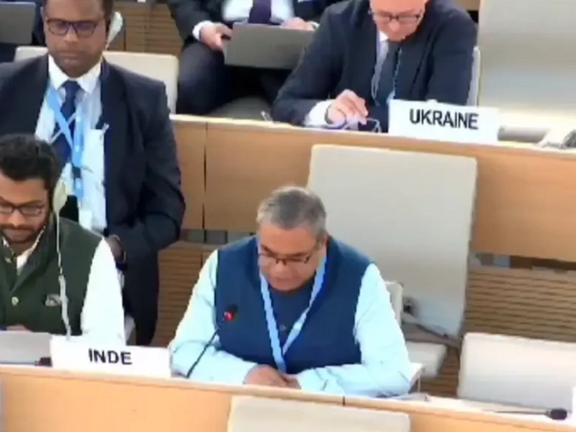
Indra Mani Pandey, India's Permanent Representative in the UN, said that his country will continue to monitor human rights situation in Afghanistan.
Indra Mani Pandey, India's Permanent Representative in the UN, said that his country will continue to monitor human rights situation in Afghanistan.
He also called for the provision of the rights of Afghan women and girls and their participation in development and achievements of Afghanistan over the past twenty years.
At the meeting of the United Nations Human Rights Council, Pandey added that his country has so far supplied 50,000 tonnes of wheat, 28 tonnes of relief items to the victims of natural disasters, 200 tonnes of medicines, vaccines and other sanitary items to Afghanistan.
Pandey also said that India in collaboration with the United Nations has provided 1,100 feminine hygiene kits to women rehabilitation centers.
The United Nations Human Rights Council started its 54th session on Monday. A major part of the discussion on the first day of this summit had been devoted to the situation in Afghanistan.

China has appointed a new ambassador to Afghanistan. Taliban Prime Minister Mullah Hassan Akhund accepted the new Chinese ambassador's credentials on Wednesday.
Bilal Karimi, Taliban’s Deputy Spokesperson said that a special reception ceremony for Zhao Xing, the new Chinese ambassador, was held in the Arg (presidential palace) with the presence of the group's prime minister, Mullah Hasan Akhund.
It seems that this is the first public and official meeting of the Taliban Prime Minister after his return from Kandahar. Mullah Hassan Akhund returned to Kabul on July after a two-month absence.
Since returning to Kabul, he has not attended official meetings. Recently, Taliban spokesperson Zabihullah Mujahid told the media that Mullah Hasan Akhund has health issues.
Bilal Karimi on Wednesday said that Zhao Xing, in a meeting with the officials of the group, said that China respects the territorial integrity and independence of Afghanistan.
According to the Taliban, Xing stressed that China does not follow the policy of interference in the Afghanistan affairs.
Former Chinese ambassador to Afghanistan, Wang Yu's term ended last month.
Karimi, quoting the Chinese ambassador to Afghanistan, has written that he is trying to expand political and economic relations and cooperation between China and Taliban.
Akhund has also said that by appointment of Xing as ambassador, diplomatic relations between China and Afghanistan will expand.
In this meeting, Taliban’s Prime Minister said that the relations between the two countries have seen new developments after the group's takeover of power in Afghanistan.
China is one of the countries that has close relations with the Taliban. This country has been eyeing Afghanistan's mines for the past two years and has signed several mining contracts with the Taliban.
Local sources told Afghanistan International that Abdul Ghafar Saber, one of the former Jihadi commanders, was assassinated on Monday, in Rostaq district of Takhar province.
Saber's relatives have also confirmed his death.
So far, the motive behind his murder is not clear.
A source said that he was one of the companions and commanders of Piram Qol Ziaee and was probably killed due to personal enmity.
On the other hand, in the past two years, commanders and former security forces members have also been killed in the same way, which was attributed to revenge killing of Taliban members.
Thomas West, US Special Representative for Afghanistan, describes Taliban's fight against ISIS-K as serious.
During a speech at the Stimson Center on Tuesday, West said that the Taliban have killed at least eight ISIS-K commanders in Afghanistan in the past two years and that ISIS-K attacks on civilians, especially members of Hazara ethnic group, have decreased.
He added that he does not want to "exaggerate" the impact of the Taliban crackdown on ISIS-K activities, but ISIS-K attacks on civilians are not as often as before.
A day after the anniversary of the September 11 attack in 2001 by Al-Qaeda, the US representative delivered a speech at this center regarding the withdrawal of US forces and its impact on Afghanistan.
According to West, Tehreek-e-Taliban Pakistan (TTP) is now a security threat in the region.
Pakistan has accused the Afghan Taliban of not being able to control the Pakistani militia staying in Afghanistan. The sharp increase in terrorist attacks in Pakistan has been attributed to the activities of TTP and their freedom of action in Afghanistan following the return of the Taliban to power in Afghanistan.
So far, Washington has not taken a position regarding Islamabad's requests to the Taliban to prevent the infiltration and attacks of Pakistani militia. Also, in the past two years, Washington has not seriously criticised the Taliban's relationship with the TTP and other militant groups, which are considered a threat by the regional countries.
Lotte Knudsen, Head of Delegation of the EU to the UN, said that to ensure peace and stability in Afghanistan, an inclusive political process with the participation of all Afghans, including women and ethnic and religious minorities, is necessary.
Knudsen also asked the Taliban to end human rights violations.
At the meeting of the United Nations Human Rights Council on Monday, she called on the Taliban to erode policies that lead to the exclusion of women from the social, economic and civil spheres.
Knudsen stressed that ensuring peace and stability in Afghanistan depends on an inclusive political process with the participation of all Afghans, including women, ethnic and religious minorities, as well as the LGBT community.
Knudsen also called for the accountability of the group regarding repeated violations of human rights "necessary".
The international community and regional countries have always asked the Taliban to agree to the formation of an inclusive government, but the Taliban has not yet complied to the international demands.
The United Nations Human Rights Council started its 54th session on Monday. A major part of the speeches on the first day of this summit had been devoted to the situation in Afghanistan.
Volker Türk, United Nations Human Rights Commissioner, said that despite the Taliban's announced general amnesty, extra-judicial killings, torture and arbitrary arrests have resumed in Afghanistan.
Türk added that the UN continues documenting human rights violations against former employees and security forces members of the previous Afghan government.
On Monday, the UN official at the meeting of the Human Rights Council said that since the takeover of Kabul, Taliban has imposed a systematic assault on the people that violates human rights and freedoms of people, especially women and girls.
Referring to the prohibition of education for women and girls, he described the Taliban’s oppression against women and girls as "cruel".
According to Türk, the Taliban's increasing restrictions on women and girls’ fundamental freedoms, confines them “to the four walls of their homes”.
He added that women and girls' disobedience to the Taliban rules leads to arbitrary arrest, harassment, and even physical violence.
Türk also said that in the past two years of the Taliban’s rule, laws and institutions that once had been supplying protection for human rights, have been systematically eroded.
According to him, the laws that previously protected women from violence or enabled a good environment for the media, are now suspended.
Türk added that the Taliban have resumed corporal punishment and public executions. “There are ongoing reports of extrajudicial killings, torture and ill-treatment as well as arbitrary arrests and detentions,” he said.
He stated that in the Taliban-controlled Afghanistan, rights of accused people are being violated due to failure to maintain procedural safeguards and the absence of a criminal justice system.
He said that the Taliban has appointed bodies to monitor prisons and the judicial process, but so far it has not been seen how these institutions work.
In his speech at the Human Rights Council, Türk addressed Taliban’s repressive actions toward the media too.
He said that the Taliban's restrictions on the media represented a "targeted attack" on freedom of expression and opinion.
This UN official said that journalists in Taliban-controlled Afghanistan are being prohibited from publishing content that is against the Taliban's religious interpretation.
He also pointed to the banning of foreign films and covering female presenter’s faces on television.
According to him, the Taliban's restrictions have caused many media outlets to halt operations. Civil society faces similar restrictions, he said.
He added that with arbitrary arrests, the Taliban uses it as a tool to silence “dissents and free speech”.
The United Nations Human Rights Council started its 54th session on Monday. A major part of the speeches on the first day of this summit had been devoted to the situation in Afghanistan.