UN Secretary-General Meets Afghan Women Rights Activists
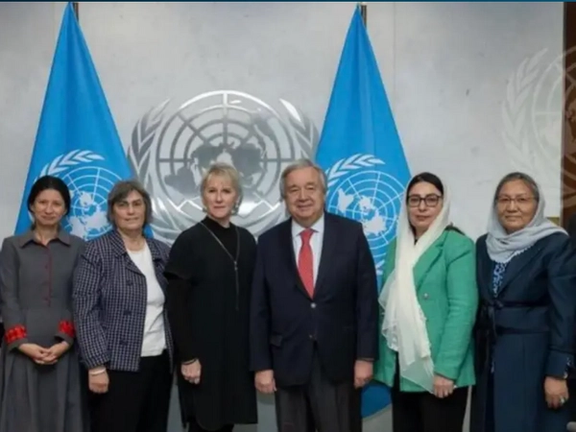
A group of Afghan women's rights activists met with Antonio Guterres, the Secretary General of the United Nations.

A group of Afghan women's rights activists met with Antonio Guterres, the Secretary General of the United Nations.
Asila Wardak, an Afghan women's rights activist, who attended the meeting, told Afghanistan International that Guterres emphasised that the Taliban will not be recognised without ensuring women's right to education and work.
According to Wardak, the UN Secretary-General said that issues related to Afghanistan are on the agenda and a priority for the United Nations.
Guterres added that he intends to engage and support more on the issues related to Afghanistan.
Habiba Sarabi, a member of the peace negotiations team of the previous Afghan government with the Taliban, and Shahrzad Akbar, the former chairperson of the Afghanistan Independent Human Rights Commission, were also present in this meeting.
It has been said that this is the first meeting of the Secretary General of the United Nations with Afghan women activists after the Taliban’s return to power in Afghanistan.
In the past two years, the Taliban has imposed extensive restrictions on the lives of Afghan women.
Despite international pressure, the Taliban has not reversed its restrictive measures, especially regarding Afghan women's right to work and education.


The Taliban’s commission formed to address Afghan immigrants’ problems announced that since September 17, more than 200,000 people have returned to Afghanistan only through the Torkham border crossing.
Pakistan's deadline for deporting immigrants was announced on October 3 and has been implemented from November 1 this year.
According to the decree attributed to Hibatullah Akhundzada, the leader of the Taliban, a special commission has been formed for the transfer and relocation of the deported Afghan immigrants.
On Monday, on the X social media platform, the commission reported that the number of returnees since November 1 has reached 15,207 families, all of whom have returned to the country via the Torkham border crossing.
The number of immigrants who have returned to the country through the Spin Boldak crossing has not been announced so far.
Following the end of the one-month deadline, on November 1, Pakistan intensified the detention and forced deportation of Afghan immigrants without legal documentation in the country.
The country first detains undocumented immigrants and then, forcibly deports them.
Despite the repeated demands of the United Nations and several countries to stop the process of deportation of Afghan immigrants, Pakistan and Iran continue to deport them.

On Monday, the Taliban's Ministry of Propagation of Virtue and Prevention of Vice, announced that it will provide job opportunities to clerics who have returned from Pakistan to Afghanistan.
Taliban’s spokesperson for the ministry in a statement said that these people will be appointed as "ombudsmen".
Following the takeover of power in 2021, the Taliban formed a cabinet in which the Ministry of Women's Affairs was nullified, and the Taliban's Ministry of Propagation of Virtue and Prevention of Vice was established instead.
In the past two years, this Taliban ministry has issued a series of orders that, according to international human rights organisations, violate the fundamental rights of Afghan citizens. It has appointed ombudsmen all over Afghanistan who widely and systematically restrict the freedoms of citizens.
Despite its declaration that ombudsmen do not have the right to use violence against the people, Afghanistan International has documented numerous cases of such violence by them in the last two years.
Afghanistan International published video clips showing that Taliban ombudsmen have been subjecting people to harsh treatment in various provinces.

The United Nations announced that the Taliban's order to ban opium cultivation has caused Afghan farmers to lose more than one billion dollars in income from the sale of opium.
The UN Office on Drug and Crime (UNODC) said that following the issuance of the decree, opium cultivation has decreased by 95 percent in Afghanistan.
When the Taliban took over Afghanistan in 2021, the country was the largest exporter of opium in the world and the main source of heroin in Europe and Asia.
In April 2022, the Taliban declared a ban on the cultivation and production of narcotics. It had a severe impact on hundreds of thousands of farmers and daily wage workers who relied on the income generated from this crop to sustain their livelihoods.
The United Nations has now confirmed the decline of opium cultivation in Afghanistan, emphasising on the urgent need for more aid to the villagers and alternative cultivation for a future without opium in the country.
Ghada Waly, Executive Director of UNODC, welcomed the decrease in opium production in Afghanistan. At the same time, he said that it has important consequences and risks that should be considered.
Waly stressed that today the people of Afghanistan need urgent humanitarian aid instead of lost income to meet their needs.
The United Nations said that although growing wheat may reduce food insecurity to some extent in Afghanistan, it is far less profitable than opium.

Akbar Ahmadian, Secretary of the Supreme National Security Council of Iran, met Mullah Abdul Ghani Baradar, the Taliban’s Deputy Prime Minister, on Sunday, and said that Iran supports the independence, stability, and progress of Afghanistan.
According to ISNA, Ahmadian stressed on cooperation with the Taliban in various fields, including commercial and industrial affairs, transportation, agriculture, and Iran’s water rights.
According to the report, the Secretary of the Supreme National Security Council of Iran has appreciated the position of the Taliban towards Palestine.
Iran, like other countries, does not officially recognise the Taliban. Nevertheless, despite tensions on water rights issues, it maintains a close relationship with the Taliban.
In this meeting, Abdul Ghani Baradar asked for the development of economic and commercial cooperation, especially the activation of the transit sector, Chabahar port, and an increase in air transportation.
According to ISNA, Baradar emphasised on their commitment to implementing agreements between Afghanistan and Iran, especially in the water management issues, and considered the economic development of the border regions and joint investments for the mutual interests of both sides.
Before this meeting, Baradar had met with Hossein Amir Abdollahian, the Iranian Foreign Minister, after which Abdollahian had said that Afghanistan is considered important in the foreign policy of Iran. He also discussed the issue of Afghan immigrants in Iran and the issue of Iran's water rights.
Baradar arrived in Tehran leading a delegation of 30 people on Saturday at the invitation of the Iranian government.
This is Mullah Baradar's first visit to Iran in the last two years. He had previously traveled to Tehran as the head of the political office of the Taliban in Doha.

Zhao Sheng, China's ambassador to Afghanistan met Amir Khan Muttaqi, Taliban's foreign minister, on Sunday, and urged Pakistan and the Taliban to resolve the issue of deportation of undocumented refugees "in a cordial manner”.
The Taliban's foreign ministry quoted Sheng as saying that China is "ready to help" regarding the immigrant issue.
Abdul Qahar Balkhi, the Taliban’s foreign ministry spokesperson wrote on X social media platform that Muttaqi, in the meeting with the Chinese ambassador, discussed “forced deportation of refugees at the beginning of the cold winter, usurping their assets and other rights, and several other related issues”.
China has a close trade and political relationship with Pakistan. This is the first time that China has expressed an opinion regarding the issue of deportation of undocumented immigrants from Pakistan.
The Chinese ambassador has expressed their interest in cooperating with the Taliban in solving the issue of undocumented immigrants, which has become a big challenge for the Taliban.
The Taliban has criticised Pakistan for deporting undocumented Afghan immigrants on the eve of winter and has demanded more time for these immigrants.
Pakistan has declined the Taliban’s and Western countries' demands to extend the deadline for the deportation of immigrants.
Muttaqi has explained to the Chinese representative "about the [Taliban's] measures to welcome and resettle Afghan refugees”.
Taliban officials had previously made a commitment to assist immigrants to the best of their ability, although they did not provide specific details.