At ECO Summit in Uzbekistan, Afghanistan Flag & Representative Missing During Meets

The 16th Summit of the Economic Cooperation Organisation (ECO) Member States kicked off on Thursday, in Tashkent, the capital city of Uzbekistan.

The 16th Summit of the Economic Cooperation Organisation (ECO) Member States kicked off on Thursday, in Tashkent, the capital city of Uzbekistan.
In the group photo of the leaders of the member states of the ECO summit, the flag and representative of Afghanistan is missing.
The leaders of Azerbaijan, Iran, Kazakhstan, Kyrgyzstan, Uzbekistan, Pakistan, Tajikistan, Turkmenistan, and Turkey are present at the ECO summit.
Shavkat Mirziyoyev, the president of Uzbekistan, is the head of this round of the ECO summit.
The participants will discuss economic cooperation, investment, transportation, and the development of industrial cooperation during the ECO summit.
The Economic Cooperation Organisation, which is a regional intergovernmental economic structure, was established in 1984 by Iran, Pakistan, and Turkey, and its headquarters is in Tehran. Afghanistan and seven central Asian countries that had taken independence from the former Soviet Union received membership in the organisation in 1992.
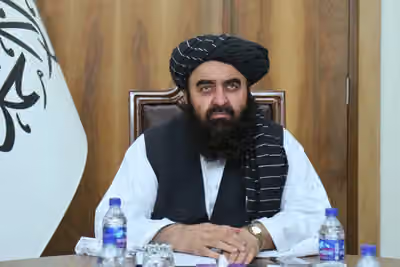
Thomas West, the US Special Representative for Afghanistan, echoed the call of the UN Special Rapporteur on Human Rights in Afghanistan, for an investigation into the deadly attacks in the Shia-dominated district 13 of Kabul.
On Wednesday, West wrote on the X social media platform that these senseless attacks on the Hazaras must stop and called for a full investigation.
Richard Bennett, the UN Special Rapporteur on Human Rights in Afghanistan, said that a thorough and transparent investigation should be conducted to identify the perpetrators of the Dasht Barchi attacks and hold them accountable. He described the attacks as "terrible".
At least seven people were killed, and 20 others were injured in a bomb explosion on a passenger vehicle in Dasht Barchi area of western Kabul on Tuesday evening.
ISIS claimed responsibility for this attack.

Iranian President Ebrahim Raisi said that a government that represents all ethnic, and religious groups must be formed in Afghanistan.
During a joint press conference with Emomali Rahmon, the president of Tajikistan in Dushanbe, Raisi said that Iran and Tajikistan share common concerns about the situation of the Afghan people.
The president of Iran called the US presence in Afghanistan for around two decades an “occupation” of the country and added, "The United States left nothing but destruction, and murder in Afghanistan."
Raisi added that as two neighbours, “We feel responsible towards the people of Afghanistan more than others.”
Addressing the press conference along with Raisi, the President of Tajikistan who continuously emphasised the formation of an inclusive government in Afghanistan over the past two years, said that Tajikistan, as a country that has experienced civil war, declares its support for the peaceful resolution of problems and conflicts through diplomacy and negotiations in Afghanistan.
The President of Iran visited Dushanbe city, the capital of Tajikistan, on Wednesday morning and met and spoke with Emmomali Rahmon, the President of Tajikistan, and Mahmadtohir Zokirzoda, the country’s chairman of the Assembly of Representatives.
According to the Iranian president’s office, in both meetings, the two sides discussed the situation in Afghanistan.
After the Taliban took control of Afghanistan in August 2021, several well-known figures of Afghanistan, including Ahmad Massoud, the leader of the National Resistance Front, have been stationed in Tajikistan. However, the authorities of this country have not officially confirmed the presence of these anti-Taliban figures.

Nikolai Patrushev, the Secretary of the Russian Security Council, called the situation in Afghanistan concerning and said that this country is still a source of serious security threats.
Patrushev said, "We are following closely and with concern what is happening in Afghanistan."
According to the TASS news agency, in a meeting with his counterparts from the members of the Commonwealth of Independent States, the Secretary of the Russian Security Council blamed the Western countries’ policies for the current situation in Afghanistan.
The 11th round of meetings of the Secretaries of the Security Council of the Commonwealth of Independent States was held on Wednesday in Moscow.
The participants of the meeting included secretaries of the Security Council of Azerbaijan, Armenia, Belarus, Kazakhstan, Kyrgyzstan, Moldova, Russia, Tajikistan, Turkmenistan, and Uzbekistan.
The Secretary of the Russian Security Council addressed his counterparts in this meeting and said that the situation in Afghanistan is a clear confirmation of the “destructiveness of Western policies”.
Patrushev called drug trafficking, terrorist groups’ attempts to infiltrate Central Asia from the Afghan borders, and the export of radicalism and illegal immigration as the threats posed by Afghanistan.
Meanwhile, Russian President Vladimir Putin addressed the meeting virtually and emphasised that it is important for members of the Commonwealth of Independent States to make maximum use of the intelligence-analytical potential of their Security Councils for a comprehensive study of the situation in the region and the world.

An official from the Taliban's Ministry of Information and Culture has stated that Pakistani authorities have asked the leaders of the group to shut down the Qosh Tapa canal.
Abdul Haq Hammad, Director of the Broadcasting Monitoring Department of the Ministry of Information and Culture of the Taliban said that Pakistani officials have discussed the Qosh Tapa Canal in official meetings with the Taliban.
During an interview with TOLOnews TV, Hammad added that Pakistani officials have repeatedly and clearly asked Taliban leaders in official meetings to "shut down the Qosh Tapa canal”.
Hammad did not name any Pakistani officials, but added that when asked why the canal should be shut, they said, "This canal is detrimental to us."
Hammad said that the reason for making this request is that the canal will contribute to Afghanistan's "self-sufficiency" and Pakistan is concerned that, once achieved, Afghanistan may no longer depend on Islamabad.
He argued that the military establishment has the monopoly of power in Pakistan and a significant portion of the country's political landscape revolves around the notion that "Pakistan's interests are served by the destabilisation of Afghanistan”.
This Taliban official made the claim even as Pakistan has always been accused of supporting Taliban.
Hammad called the civilian government of Pakistan "poor" and its status as "symbolic". He claimed that the Pakistani army has "considered Afghanistan's loss as its gain" in the past decades as he considered it to be the "most dangerous point" in Pakistan's policy towards Afghanistan.
In the past two years, the Taliban has invested a substantial amount of money in the Qosh Tapa canal project, which diverts a portion of the Amu River's water to the northern regions of Balkh, Jowzjan, and Faryab provinces.
It is said that the canal is intended to provide irrigation for approximately 550,000 hectares of land and serve up to three million people. Critics contend that the Taliban may have employed the canal to relocate their targeted population and advance the group’s strategic objectives.

Anwaar ul Haq Kakar, Pakistan's interim Prime Minister, announced that his government will not deport former Afghan intelligence officers due to threats they face in Afghanistan.
Following the collapse of the previous Afghan government in 2021, many of the former Afghan intelligence employees fled to Pakistan.
Pakistani PM told reporters on Wednesday that these former intelligence operatives might face revenge from the Taliban and their lives might be in danger, therefore, they will not be deported from Pakistan.
Kakar's interim government has started deporting 1.7 million "illegal" Afghan immigrants from all over Pakistan since November 1. He has ignored international criticisms about the deportation of these Afghans.
Referring to the return of the Taliban to power in 2021 and Pakistan witnessing a 60 percent increase in terrorism, he said that Afghans living illegally in Pakistan have caused instability and insecurity in the country.
Kakar added that 15 Afghan citizens were involved in this year's suicide attacks in Pakistan.
He also said that despite repeated assurances from the Taliban, the group has not taken any action against terrorism and in some instances, they have supported such elements.
Kakar stated that Pakistan has asked the Taliban to surrender all those wanted individuals by Pakistan to the country’s security agencies.
In defence of the plan to deport refugees, Pakistan's prime minister asserted that his country has both legal and moral rights to repatriate individuals living in Pakistan without legal documentation, including Afghans without residence permits.
According to him, the number of Afghans who voluntarily returned from Pakistan reached 252,000 people.
However, the United Nations has said that more than 78 percent of Afghan immigrants said they were forced to return to Afghanistan, fearing being arrested by the Pakistani police.
