Taliban Delegation Arrives In Islamabad To Participate in Tripartite Meeting

A Taliban delegation led by Nooruddin Azizi, the group’s Minister of Commerce and Industry, arrived in Islamabad to participate in a tripartite meeting.

A Taliban delegation led by Nooruddin Azizi, the group’s Minister of Commerce and Industry, arrived in Islamabad to participate in a tripartite meeting.
The delegation includes representatives of the Ministry of Finance, Ministry Transport and Civil Aviation and Ministry of Foreign Affairs.
In a statement, on Monday, the Ministry of Commerce and Industry of the Taliban stated that the delegation has traveled to Islamabad to participate in a tripartite meeting with the representatives of Uzbekistan and Pakistan.
The Afghan Embassy in Islamabad also posted a video stating that the delegation will address issues related to travel and trade between the two countries.
This Taliban delegation’s trip occurs even though Pakistan has recently faced criticism from the group’s officials following the deportation of Afghan immigrants from the country.
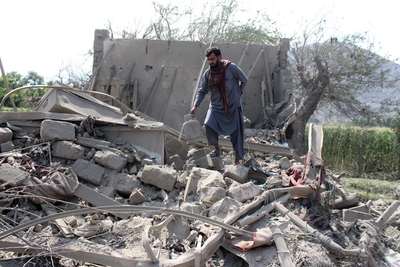

Pakistan announced that so far 220,398 immigrants without legal documentations have returned to Afghanistan through the Torkham and Chaman crossings.
Pakistan's state radio reported that thousands of undocumented immigrants return to their country through these two crossings every day.
According to this media report, on Sunday, 3,043 people returned to Afghanistan with 312 vehicles.
However, there is a difference between the figures published by the Taliban and the Pakistani media.
The Taliban Ministry of Refugees and Repatriation reported that a total of 5,570 migrants returned via the Torkham and Spin Boldak crossings on Sunday.
The Taliban had announced the return of 200,000 people to the country, earlier.
On October 3, Pakistan set a deadline for undocumented immigrants to leave the country voluntarily.
Following that, the Ministry of Interior of Pakistan now forcibly deports the immigrants.
As per estimates provided by the interim government of Pakistan, prior to the announcement of this decision, there were approximately 1.7 million Afghan immigrants residing in the country without legal documentation.

Pakistan's Chaman Police sent an official letter warning thousands of protesters to end their sit-in "for security reasons".
Over the last 23 days, thousands of protestors have been staging a sit-in at Chaman city near the border with Afghanistan, protesting against the prohibition on travel without visas and passports across the Afghanistan-Pakistan border crossings.
Yet, the protestors call the "security threats" as an excuse to halt their sit-in, emphasising on their determination to not yield to pressure from the Pakistani government.
In the official letter that appears to have been issued on Friday, November 10, Chaman Police wrote to the organisers of the sit-in, "Several countries are trying to attack the sit-ins."
In the letter, the local police department announced its inability to provide security for the protesters in the open area and asked the protesters to either end their sit-in or move their protest to a closed space.
The local police department of Chaman has warned that otherwise the responsibility of whatever happens will be on the organisers of the sit-in.
Amir Mohammad, one of the protestors, responded to the warning of the local police and said that only "Pakistani soldiers" will attack us. He said that "Pakistani security forces will be responsible" if the protesters are harmed.
The Prime Minister of the interim government of Pakistan Anwar ul Haq Kakar has taken unprecedented decisions regarding the border issues and immigrants in the country during the recent months.
During the first month of their reign, the interim cabinet led by Kakar set a deadline for more than 1.7 million Afghan refugees to leave Pakistan by November 1.
With the deadline set, Pakistan's Ministry of Interior has launched a massive operation to detain and forcibly deport refugees.
The interim government of Pakistan has also decided to implement a "single document policy" for movement across the borders between Afghanistan and Pakistan.
According to the new decision of the government of Pakistan, passengers will not be able to cross the border crossings with any other documents except a passport and visa.
The recent decision by the Pakistani government marks the end of a period where travellers could utilise outdated documents like agreements of the British India period and national identity cards to cross the border.

The government of Pakistan wants to open three new crossings on the border with Afghanistan to speed up the process of expelling Afghan refugees from their country.
On Monday, the Pakistani newspaper, Dawn, wrote in a report that the new crossings will be opened from today.
This newspaper, citing a report prepared by the Sindh Home Department, wrote that if "illegal Afghans" are not repatriated, Pakistan will face a security problem.
In the report, it has also been stated that the department responsible for deporting immigrants has encountered problems in registering and processing the identity of immigrants. According to reports published by Pakistani newspapers, approximately 88,000 refugees have voluntarily returned to Afghanistan only through the Chaman border crossing.
The government of Sindh has called the presence of Afghan immigrants a demographic threat to the state and has warned that if the immigrants are not returned to their countries, provincial demography will alter by 2040.
As per the official report from the Sindh Home Department, hundreds of thousands of refugees, both with and without official residency documentation, reside within the state.
The report indicates that roughly 150,000 Afghans reside in Sindh without residency documentation. Additionally, there are an estimated 26,820 individuals from Bengal and 1,980 individuals from Burma living in the region.

The National Congress Party of Afghanistan has stated that during a poll conducted recently, most respondents favoured a change in Afghanistan's political system, supporting the establishment of a “federal republic system”.
This party announced that the popularity of the Taliban regime and the "presidential republic" has decreased to less than 10%.
The survey, shared with Afghanistan International on Sunday, indicated a rise in separatist inclinations within Afghanistan. The party claimed, “46 percent of respondents expressed support for partition of the country”, which apparently is more than the reported 44 percent in favour of a federal system in Afghanistan.
The National Congress Party, led by Latif Pedram, is one of the few political parties in Afghanistan that seeks the establishment of a federal political system in the country. Pedram has repeatedly said that the centralised structure is the main problem of the Afghan people which could be addressed by establishing a "federal republic system".
He additionally emphasised that in the absence of establishing a federal republic, he does not dismiss the prospect of “partition” of Afghanistan.
The survey data has not been made available on the party's website for evaluation and confirmation by independent researchers.
On October 23, the National Congress Party announced that it had launched an online survey titled "Right to Self-Determination", regarding the preferred future political system for Afghanistan. In the poll, the participants were asked to choose "Islamic Emirate", "Presidential Republic", "Federal Republic" or “Partition” as their choice for the future of Afghanistan.
As per the party's report, over 103,000 individuals from over 71 countries took part in the survey. Approximately 81% of respondents are Farsi speakers, while around 7% of participants are Pashto speakers.
The gender breakdown of respondents included 11% women and 89% men, and most respondents were between the ages of 25 and 35.
The Islamic Emirate system achieved the least support among the four options presented, according to the collected statistics.
Only 4.2 percent of the respondents voted for an Islamic Emirate. Respectively, 5.5 percent wanted a presidential republic system.
The National Congress Party on Sunday published the results of the survey and told Afghanistan International that these results show the people's desire for "fundamental and serious change” in Afghanistan.

Abdul Latif Mansur, Taliban’s Minister of Energy and Water, traveled to Iran on an official visit on Saturday. Mansur said that he will discuss with the Iranian side about the extension of the electricity contract, tariff, and other issues.
The trip occurred a day after Mullah Baradar's return from Iran.
An Iranian official has stated that during the meeting between Iran's Head of Department of Environment and Abdul Ghani Baradar, the Taliban's Deputy Prime Minister, a verbal agreement was achieved concerning the water rights from the Helmand River.
According to him, Mullah Baradar promised that the water rights would be given as soon as the conditions are favourable.
Baradar visited Tehran on November 4 and returned to Kabul on November 9.
During a week, he met with several Iranian officials, including the head of Iran's Department of Environment.