Draft Plan to Fortify Afghan-Tajik Border Submitted To CSTO
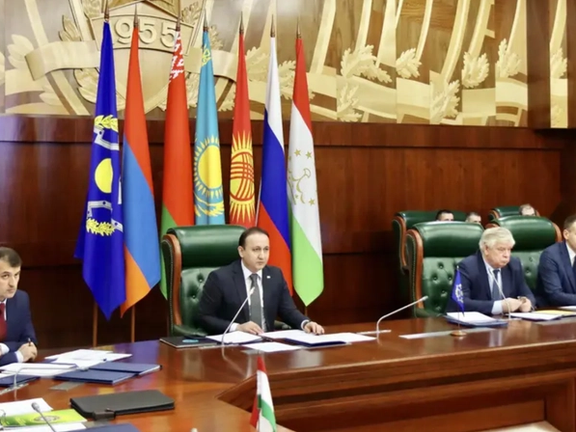
Tajikistan has announced the submission of a draft plan aimed at fortifying the nation's border with Afghanistan to the Collective Security Treaty Organisation (CSTO).
Tajikistan has announced the submission of a draft plan aimed at fortifying the nation's border with Afghanistan to the Collective Security Treaty Organisation (CSTO).
CSTO has held several military exercises near the border of Afghanistan since August 2021, following Taliban’s takeover of power.
On Saturday, the Ministry of Foreign Affairs of Tajikistan said that a meeting of representatives of the CSTO’s member countries took place in Moscow from February 27 to March 1.
According to the Tajikistan foreign ministry, in this meeting, the member states finalised the draft plans and presented documents for review in the CSTO’s Permanent Council.
Previously, Tajikistan’s Foreign Minister, Sirojiddin Muhriddin had said that the country expects the border fortifying plan to be approved in 2024.
According to Muhriddin, the plan was supposed to be approved in 2023, but due to technical reasons, it was postponed to 2024.
According to a new report by Rawadari, a human rights organisation, the Taliban is retaliating against the family members and relatives of former Afghan government employees.
The report highlights instances such as the murder of an eight-year-old child in Bamiyan, whose mother served in the former government's police forces. Additionally, it sheds light on the killing of a 13-year-old child in Badakhshan, whose father was a member of the popular uprising forces.
The eight-year-old child was kidnapped on July 28, 2023, and a week later, his body was found in the capital of the province. A Badakhshani child was also killed by unknown individuals on August 25, 2023, in Shuhada district of Badakhshan province.
Rawadari’s new report states that in 2023, at least 82 employees of the former government of Afghanistan were victims of targeted and extrajudicial killings.
It included 68 former security forces members and 14 other employees of the former government's civil departments.
As per the report, in 2023, at least 506 people were killed, and 266 others were injured in various incidents of human rights violations in Afghanistan.
Former government employees, human rights defenders, Taliban opponents, and other citizens are the victims of these incidents.
According to the report, the fatalities include 390 men, 58 children, 38 women, and 20 individuals whose identities remain unidentified. These incidents encompass targeted, mysterious, and extrajudicial killings, as well as suicide attacks and the detonation of mines and explosives.
The US Department of State announced that Benafsha Yaqoobi, a former member of the Afghanistan Human Rights Commission, and 11 other women were the winners of the "Women of Courage" award for 2024.
The award will be presented next Tuesday in a ceremony attended by First Lady Jill Biden and US Secretary of State Antony Blinken.
The US Department of State announced on Friday that Yaqoobi, who is visually impaired, has worked for years as an advocate for women facing violence and, in 2007, co-founded the "Rahyab Organisation" with her husband to educate and empower visually impaired individuals in Afghanistan.
The statement from the US Department of State mentioned that Yaqoobi has consistently advocated for the differently abled and provided educational opportunities for visually impaired and blind children. According to the statement, Yaqoobi is currently in exile and continues to advocate for the rights of the disabled, blind children, and Afghan girls.
According to the US Department of State announcement, along with Yaqoobi, 11 other women and a group from around the world have also been recognised with this award.
Among them, Fariba Baluch, a human rights activist from Iran, has also been awarded.
The US Department of State's International Women of Courage Award has been presented annually since 2017 to women who have demonstrated exceptional courage, strength, and leadership in advocating for peace, justice, human rights, gender equality, and the empowerment of women and girls.
Last year, Zakera Hekmat, an Afghan doctor and refugee advocate, was the recipient of this award.
Zarifa Yaqubi, an Afghan female activist who was imprisoned for about 41 days by the Taliban, has disclosed distressing details about the "horrible torture" of female prisoners.
Yaqubi, who was detained on November 3, 2023, along with four colleagues as they sought to announce the existence of a women's movement, spent 41 days in Taliban custody.
Currently residing in Canada, she addressed a press conference on Thursday, following the submission of the petition by a group of Iranian and Afghan activists urging the criminalisation of gender apartheid.
Yaqubi said that following the takeover of power by the Taliban, she protested "for justice and rights", but the Taliban arrested her because she was "a woman, a Shia, and a Hazara".
She revealed that during her imprisonment, the Taliban subjected her to severe mental and physical torture. “Its effects still hurt my soul and I still take medicine to forget those days," said Yaqubi.
During the press conference, Yaqubi shared details of her experience in the Taliban prison, highlighting that it commenced with insulting her ethnicity and sect, and then, they took her to the "place of torture" by grabbing her "hair".
She further disclosed that she lost consciousness due to the "electric shocks and kicks" inflicted by the Taliban. Despite that, Yaqubi considers herself fortunate. She explained, "From the walls and ceiling, you could hear the voices of women in tears, pleading, “torture me, but don't take my clothes, and don't subject me to rape."
Yaqubi stated that there are no health services in Taliban prisons, and she was not allowed to take a bath during her 41 days in prison.
According to her, she was not allowed to meet her family either.
Yaqubi mentioned other women prisoners who had a similar fate in the Taliban prison and women who are still there, such as Manizha Siddiqi.
This Afghan women's rights activist said that history will judge that the world today has forgotten the women and girls of Afghanistan.
She asked Canada to stand by Afghan women and take the lead in recognising gender apartheid in this country.
During the two and a half years of their rule, the Taliban has detained several women activists who protested against the policies of the group.
Human rights organisations, including UNAMA, have confirmed reports of torture of prisoners in Taliban prisons.
Submitting a petition to criminalise gender apartheid
A group of Afghan and Iranian activists have submitted a request to the Canadian Parliament, urging for the criminalisation of gender apartheid.
The request was submitted by Ali Ehsassi, a representative of the Canadian Parliament, who has stated that gender apartheid is a crime against humanity.
This petition was prepared by two organisations defending women's rights in Canada.
Members from two women's rights organisations, accompanied by former women representatives from the Afghan Parliament, as well as Afghan and Iranian activists, attended the Canadian Parliament on Thursday. They met with 10 members from the House of Representatives and the Canadian Senate, to discuss the petition.
These activists also met Jacqueline O'Neill, Canada's ambassador for women and security, and several officials of the country's foreign ministry.
A group of Afghan and Iranian activists have submitted a request to the Canadian Parliament, urging for the criminalisation of gender apartheid.
The request was submitted by Ali Ehsassi, a representative of the Canadian Parliament, who has stated that gender apartheid is a crime against humanity.
This petition was prepared by two organisations defending women's rights in Canada.
In the petition by these institutions and the activists, it has been stated that Canada can play a central role in raising global awareness and gaining international support to eliminate organised discrimination against women and girls in Afghanistan and other countries.
They asked the Canadian government to support the plan and implementation of a legal framework at the United Nations that addresses the issue of gender apartheid.
According to these activists, the framework should put forward explicit obligations and mechanisms aimed at preventing gender discrimination.
They are also urging Canada to collaborate with the UN Committee on the Elimination of Discrimination against Women in formulating a "general recommendation" that acknowledges international obligations to prevent gender apartheid.
Additionally, the activist called for Canada's support for a new UN convention that would criminalise gender apartheid.
Members from two women's rights organisations, accompanied by former women representatives from the Afghan Parliament, as well as Afghan and Iranian activists, attended the Canadian Parliament on Thursday. They met with 10 members from the House of Representatives and the Canadian Senate, to discuss the petition.
They asked these representatives for their support in expediting the International Criminal Court's investigation into the actions of the Taliban. The activists emphasised on the critical need to investigate gender-based harassment within the Taliban regime as a crime against humanity.
On Thursday, Ali Ehsassi formally introduced the petition from Afghan and Canadian institutions and activists in the Canadian Parliament. The parliamentary session coincided with a significant call from Richard Bennett, the UN Special Rapporteur on Human Rights, urging member states to submit a complaint against the Taliban to the International Criminal Court in The Hague.
Bennett emphasised that the Taliban's actions constitute sexual harassment and persecution of Afghan women, categorising it as an instance of a crime against humanity.
Gender apartheid has not been criminalised in the international laws, but Afghan and Iranian activists with the support of figures such as Narges Mohammadi, Nobel Peace Prize laureate; Shirin Ebadi, Nobel Peace laureate; and Sima Samar, the former head of Afghan Independent Human Rights Commission, requested this.
In its two-and-a-half-year rule, the Taliban has imposed extensive restrictions on women’s rights, including social activity, employment, education, and travel.
Numerous domestic and international activists, as well as human rights experts, believe that the Taliban's directives and treatment of Afghan women and girls exemplify a form of "gender apartheid”.
In response to the question of Afghanistan International’s reporter, Matthew Miller, US State Department spokesperson, said that the Doha agreement empowered the Taliban and weakened Afghan partners.
Marzia Hosseini, a reporter for Afghanistan International, citied remarks from several US experts and diplomats who labeled the Doha Agreement as "the worst agreement in the diplomatic history of the United States”. Hosseini asked Miller if the time had come to declare this agreement invalid.
Miller said that the deal forced the United States to withdraw troops without a clear plan for what should come next.
On August 30, 2021, the United States withdrew all its forces from Afghanistan during a challenging operation. Despite criticisms from various politicians, soldiers, and representatives in the US Congress, who view the withdrawal as a significant political mistake for both the United States and the Biden administration, President Joe Biden has staunchly defended the move, characterising the exit operation as a tremendous success.
Miller accused the Taliban of not fulfilling their commitments in the Doha Agreement and stated that the group has sheltered terrorist groups, including the Al-Qaeda leader. Previously, Miller emphasised on the need for the Taliban to be held accountable for the escalating activities of terrorist groups in Afghanistan.
The US State Department spokesperson also highlighted the Taliban's lack of commitment to engage in intra-Afghan talks and establish an inclusive political system. He emphasised on holding the Taliban accountable for fulfilling their commitments.
In response, the Taliban spokesperson said that the formation of an inclusive government is no longer viable following the collapse of the previous administration. He added that this matter is now independent of any involvement or influence from the United States.
