Iran's Border Guard Discovers Over A Tonne of Drugs Near Afghan Border
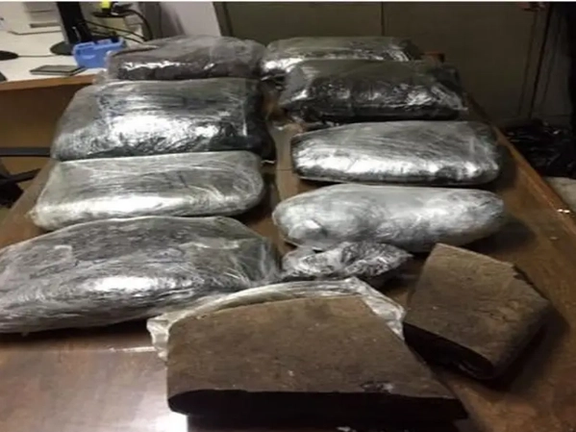
Commander Ahmadali Goodarzi of the Islamic Republic of Iran's Border Guard announced the discovery of one tonne and 230 kilogrammes of narcotics near the Afghan border.
Commander Ahmadali Goodarzi of the Islamic Republic of Iran's Border Guard announced the discovery of one tonne and 230 kilogrammes of narcotics near the Afghan border.
As reported by IRNA, Goodarzi revealed that the narcotics were ingeniously concealed within a transit vehicle, which was subsequently identified and intercepted by Iranian authorities.
Goodarzi further detailed that the operation took place at the Milak border crossing, leading to the arrest of an individual implicated in the drug smuggling operation.
The seized narcotics were identified as hashish, carefully hidden within the vehicle, Goodarzi added.
This incident marks yet another significant narcotics discovery by the Iranian border guard along the Afghanistan border in recent months.
Local sources told Afghanistan International that Taliban intelligence operatives detained Agha Lali, the former director of the National Directorate of Security (NDS) in Lashkargah city, along with seven other ex-NDS personnel.
The arrests were executed across various locales within Lashkargah, as confirmed by these sources.
On Sunday, the Pashto service of Afghanistan International was informed that following the collapse of the Afghan government, Lali had initiated a grocery business within Lashkargah.
Reports indicate that the Taliban apprehended him at his business premises, although the precise reasons behind the detention of Lali and his former colleagues remain undisclosed.
Family associates of Agha Lali have also confirmed his arrest to Afghanistan International. Additionally, it was revealed that besides Lali, the Taliban has apprehended seven more individuals previously affiliated with the government's intelligence service, spread out over different sections of the city. However, specifics regarding their identities have not been provided.
Taliban intelligence representatives in Helmand have opted not to comment on these arrests.
During a visit to the Taybad district, Abdullah Sohrabi, an assistant to the Iranian Foreign Minister, asserted the necessity for Iran to take control of markets in Afghanistan and unspecified "target countries."
Highlighting the geographical proximity to Afghanistan as a "golden opportunity," Sohrabi identified the Dogharoon border as a pivotal economic corridor linking the two nations, though he remained vague about the specifics of the "target countries."
Reports from Iranian media revealed that, in a meeting with the Governor of Taybad on Saturday, Sohrabi underscored the critical importance of nurturing and advancing Iran-Afghanistan relations.
Advocating for an intensified focus on large-scale economic initiatives, Sohrabi stated that such projects are essential for bolstering job creation and enhancing the Iranian economy.
He highlighted the critical role of the Dogharoon border, through which a substantial amount of Afghanistan's import needs are met. By boosting the economic capacity of this border, Sohrabi argued, there can be significant strides towards ensuring economic stability for border-adjacent families.
Situated 18 kilometres from Taybad and directly beside Afghanistan, the Dogharoon border stands as one of Iran's foremost economic gateways. It is a major conduit for the flow of goods from Afghan, Pakistani, and occasionally Indian merchants routed through the Persian Gulf to Bandar Abbas customs before transiting through Dogharoon.
Despite the lack of formal recognition for the Taliban regime by any country following their ascendancy in Afghanistan, regional nations, including Iran, have visibly deepened their economic and political engagements with the group.
Taliban leaders have consistently invited Iranian investors to explore investment opportunities within Afghanistan.
Tajikistan has announced the submission of a draft plan aimed at fortifying the nation's border with Afghanistan to the Collective Security Treaty Organisation (CSTO).
CSTO has held several military exercises near the border of Afghanistan since August 2021, following Taliban’s takeover of power.
On Saturday, the Ministry of Foreign Affairs of Tajikistan said that a meeting of representatives of the CSTO’s member countries took place in Moscow from February 27 to March 1.
According to the Tajikistan foreign ministry, in this meeting, the member states finalised the draft plans and presented documents for review in the CSTO’s Permanent Council.
Previously, Tajikistan’s Foreign Minister, Sirojiddin Muhriddin had said that the country expects the border fortifying plan to be approved in 2024.
According to Muhriddin, the plan was supposed to be approved in 2023, but due to technical reasons, it was postponed to 2024.
According to a new report by Rawadari, a human rights organisation, the Taliban is retaliating against the family members and relatives of former Afghan government employees.
The report highlights instances such as the murder of an eight-year-old child in Bamiyan, whose mother served in the former government's police forces. Additionally, it sheds light on the killing of a 13-year-old child in Badakhshan, whose father was a member of the popular uprising forces.
The eight-year-old child was kidnapped on July 28, 2023, and a week later, his body was found in the capital of the province. A Badakhshani child was also killed by unknown individuals on August 25, 2023, in Shuhada district of Badakhshan province.
Rawadari’s new report states that in 2023, at least 82 employees of the former government of Afghanistan were victims of targeted and extrajudicial killings.
It included 68 former security forces members and 14 other employees of the former government's civil departments.
As per the report, in 2023, at least 506 people were killed, and 266 others were injured in various incidents of human rights violations in Afghanistan.
Former government employees, human rights defenders, Taliban opponents, and other citizens are the victims of these incidents.
According to the report, the fatalities include 390 men, 58 children, 38 women, and 20 individuals whose identities remain unidentified. These incidents encompass targeted, mysterious, and extrajudicial killings, as well as suicide attacks and the detonation of mines and explosives.
The US Department of State announced that Benafsha Yaqoobi, a former member of the Afghanistan Human Rights Commission, and 11 other women were the winners of the "Women of Courage" award for 2024.
The award will be presented next Tuesday in a ceremony attended by First Lady Jill Biden and US Secretary of State Antony Blinken.
The US Department of State announced on Friday that Yaqoobi, who is visually impaired, has worked for years as an advocate for women facing violence and, in 2007, co-founded the "Rahyab Organisation" with her husband to educate and empower visually impaired individuals in Afghanistan.
The statement from the US Department of State mentioned that Yaqoobi has consistently advocated for the differently abled and provided educational opportunities for visually impaired and blind children. According to the statement, Yaqoobi is currently in exile and continues to advocate for the rights of the disabled, blind children, and Afghan girls.
According to the US Department of State announcement, along with Yaqoobi, 11 other women and a group from around the world have also been recognised with this award.
Among them, Fariba Baluch, a human rights activist from Iran, has also been awarded.
The US Department of State's International Women of Courage Award has been presented annually since 2017 to women who have demonstrated exceptional courage, strength, and leadership in advocating for peace, justice, human rights, gender equality, and the empowerment of women and girls.
Last year, Zakera Hekmat, an Afghan doctor and refugee advocate, was the recipient of this award.
