Uzbekistan To Invest In Electricity & Railway In Afghanistan, Says Taliban

The Taliban's Ministry of Commerce and Industry has said that Uzbekistan has expressed readiness to invest in Afghanistan's electricity transmission and railway sectors.

The Taliban's Ministry of Commerce and Industry has said that Uzbekistan has expressed readiness to invest in Afghanistan's electricity transmission and railway sectors.
On Wednesday, the Taliban announced that Nooruddin Azizi, the group's Minister of Commerce and Industry, met with Abdulla Aripov, the Prime Minister of Uzbekistan.
According to the Taliban’s Ministry, Uzbekistan will invest in transmitting electricity from Surkhan Darya to Pul-e-Khumri and then to Kabul, as well as in the Hairatan-Herat-Spin Boldak railway line.
The Taliban's Ministry of Commerce said that the meeting discussed increasing trade between the two countries and attracting Uzbek investment in Afghanistan.
The Taliban announced that Aripov will lead a delegation to Kabul in the near future.
On Tuesday, the Taliban's Minister of Commerce travelled to Tashkent, the capital of Uzbekistan, heading a trade delegation accompanied by private sector representatives.
Afghanistan's power distribution network primarily relies on imported electricity, mostly from Uzbekistan and Tajikistan.
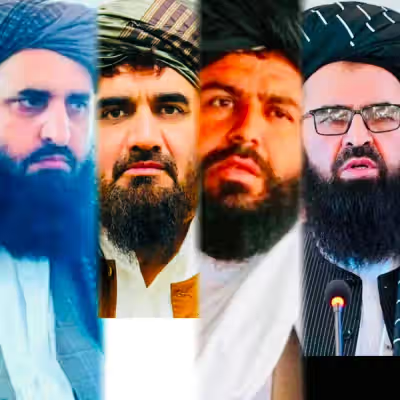

Zabihullah Mujahid, the Taliban spokesperson, announced on Wednesday that they had discussed prisoner exchanges with representatives of the United States in Doha.
Mujahid said that the Taliban would release US citizens in exchange for the release of their forces from Guantanamo Bay.
Mujahid stated that the US must accept the group's conditions to free its citizens.
During a press conference in Kabul, he emphasised that just as US citizens are important to the United States, "our people" are important to the Taliban.
Two US citizens, a man and a woman, are currently held by the Taliban.
The Taliban arrested Ryan Corbett, a US citizen, in August 2022. US officials say he is being kept in solitary confinement and is in very poor health condition. Additionally, the Taliban detained an American woman last September.
The Taliban spokesperson did not specify who should be released from Guantanamo Bay in exchange for the US citizens.
Previously, a senior US official had said that the Taliban demanded the release of Muhammad Rahim al-Afghani in exchange for Ryan Corbett. Rahim al-Afghani has been imprisoned in Guantanamo since 2008.
Recently, the chairman of the House Foreign Affairs Committee urged Joe Biden to prioritise the release of Ryan Corbett.

The Indian Revenue Service has reported the arrest of four jewellers linked to the smuggling case involving Zakia Wardak, former Afghan Consul General in Mumbai, who attempted to smuggle 25 kilograms of gold.
Earlier this year, Wardak was detained at Mumbai International Airport with gold worth USD 2.2 million.
According to the Times of India, Rafiullah Kaliwal, an Afghan consulate employee in Mumbai, is also implicated in the case.
The investigation by the Indian Revenue Service revealed that Wardak met one of these jewellers in January 2024 to introduce Kaliwal to facilitate the cash sale of 200 kilograms of gold.
The agency disclosed that one of the detainees confessed to selling 300 kilograms of smuggled gold from January to April to clients referred by him.
Wardak's attempt to smuggle 25 kilograms of gold from Dubai to India was scheduled for April 25.
Following reports of her involvement in gold smuggling, Wardak resigned as Afghan Consul General in Mumbai.
Indian authorities clarified that Wardak was not arrested due to her diplomatic immunity. She was appointed during Ashraf Ghani's government and became the first Afghan female diplomat to serve under the Taliban.
Indian intelligence officials confirmed ongoing investigations, with efforts to apprehend key figures in the jewellery smuggling network underway.
According to Indian Revenue Service officials, their inquiries indicate that 300 kilograms of foreign-marked gold was smuggled into India in the first four months of this year.
Officials from the agency also suggested that Wardak might have smuggled gold bars into the country previously, selling them to jewellers.

Residents of Darayim district in Badakhshan province protested against the Taliban again on Wednesday, due to the destruction of poppy fields by the group.
Local residents told Afghanistan International that Taliban fighters fired at the protestors, injuring four people.
So far, Taliban officials have not commented on the incident.
Videos sent by locals to Afghanistan International show protestors chanting slogans against the Taliban leader.
Protestors claimed that the Taliban responded to local protests with gunfire. In the videos received, gunfire can be heard.
They said that the Taliban entered the area with considerable force.
This is not the first time residents of Darayim have protested. Previously, clashes between the Taliban and farmers in Darayim and Argo district of Badakhshan, resulted in several protestors being killed.
The protests by these residents prompted the Taliban to send a delegation led by Fasihuddin Fitrat, the group's Chief of Staff of army, to Badakhshan to prevent the protests from spreading.
However, locals stated they would not stop protesting until non-native Taliban members left Badakhshan.
Previously, local residents had accused the Taliban of entering people's homes and harassing them.

Rosemary DiCarlo, the UN Under-Secretary-General, has emphasised that human rights and girls' education in Afghanistan are not merely domestic issues, given the country's international obligations.
Previously, Taliban spokesperson Zabihullah Mujahid had said that girls' education is a domestic matter.
On Tuesday, at a press conference concluding the third Doha meeting on Afghanistan, DiCarlo clarified this in response to a question.
She explained that the issue is not solely domestic, as Afghanistan has signed several international treaties, conventions, and agreements focusing on human and civil rights.
She noted that it does not matter if the government changes, as the country has committed to these agreements as a nation. DiCarlo emphasised that the matter is not internal, and the UN has made this clear.
She also highlighted that the ban on women's employment under Taliban control is detrimental to the country's economy, as it sidelines 50 percent of the population.
She added that discussions on the private sector cannot proceed without the inclusion of women. Furthermore, in matters of drug production and consumption, women's issues must be addressed since they are involved in both areas.
DiCarlo underscored these points at the end of the Doha meeting, noting that due to Taliban opposition, she could not invite women's rights advocates and civil activists to the main talks.
Although the UN invited several women to participate in the meeting's side discussions, some, including former Afghan Women's Affairs Minister Habiba Sarabi, declined the invitation.
Afghan civil and women's rights activists boycotted the meeting altogether. However, DiCarlo mentioned that she spoke with eight civil and women's rights activists on the sidelines, though their names were not disclosed.
The Taliban have banned women's employment and girls' education beyond the sixth grade, ignoring both domestic and international protests on this issue.
Taliban officials have repeatedly emphasised that girls' education and women's employment are domestic matters and that the group will address these issues in their own way and within the framework of their interpretation of Sharia.

Vasily Nebenzya, the Russian ambassador to the United Nations, has said that the Taliban justifies its policies towards Afghan women and girls with Islamic principles, but they are "not Islamic”.
On Monday, the Russian ambassador stated at the United Nations that Moscow discussed issues concerning Afghan women and girls with the Taliban, but the group has its own views about women and girls, which he does not agree with.
Nebenzya said that the reality is that they are dealing with the Taliban in Afghanistan, and that the group justifies its policies towards women and girls based on Islamic norms that are actually not Islamic.
The Russian ambassador said that the Taliban do not listen to the leaders and heads of Islamic countries who want to explain to them the rights of women and girls in Islam. He said, "That is the point. That is the problem."
The Taliban have asked world countries to refrain from commenting on women's education and employment in Afghanistan, as they consider it interference in Afghanistan's internal affairs.
Zabihullah Mujahid, Taliban’s spokesperson, warned countries at the third Doha meeting that reopening girls' schools would create a crisis in the country again. However, he did not explain his point.
According to statistics from the previous government's Ministry of Education, before the government's collapse, at least 36 percent of the millions of students in Afghanistan were girls.