Taliban Largest Illegal Arms Dealer In The World, Says Trump

Former US President Donald Trump has labeled the Taliban as the largest illegal arms dealer in the world.

Former US President Donald Trump has labeled the Taliban as the largest illegal arms dealer in the world.
On Monday, Trump criticised the current US President Joe Biden's policies toward the Taliban during a public conversation on X Spaces. The Republican presidential candidate for the upcoming US election called the transfer of Afghanistan's funds to the Taliban the greatest folly in US history.
Trump was apparently referring to Afghanistan's assets in the US, which are currently held in a Swiss bank under the supervision of the Afghanistan Trust Fund and are not accessible to the Taliban.
He has previously claimed that the Biden administration left behind US military equipment worth approximately $85 billion in Afghanistan, which has since fallen into the hands of the Taliban.
At the Republican National Convention, where Trump officially accepted the party's nomination for the election, he stated that the Taliban has become the world's largest dealer of US weapons by selling these arms.
The former US president did not specify which countries or groups the Taliban is allegedly selling the weapons to. However, there have been previous reports of US weapons from the Afghan National Army and Security Forces being spotted in Pakistan, Kashmir, and even Palestine.
US forces withdrew from Afghanistan in 2021 following the signing of the Doha Agreement. This agreement was signed by Trump's administration with the Taliban but was implemented during Biden's presidency.
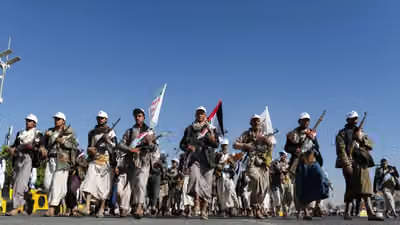

Abdul Mateen Qani, the spokesperson for the Taliban's Ministry of Interior, announced that the group's border forces "destroyed" two Pakistani border posts during a clash with Pakistani border guards in Torkham.
Qani stated that during this confrontation, a woman and two children were killed due to gunfire from the Pakistani border guards.
On Monday night, he wrote on X social media platform that the clash occurred at noon in Torkham after Pakistani border forces opened fire on Taliban border forces.
Qani did not provide an explanation for the cause of the clash. However, earlier, the Taliban-controlled Bakhtar News Agency reported, citing Taliban officials, that Taliban members were working on expanding a security post near the border when Pakistani forces opened fire.
Meanwhile, local sources told Afghanistan International on Monday that following the clash between Taliban and Pakistani border forces in the Momand Dara district of Nangarhar, "a woman and her three sons were killed”.
Apparently, they lost their lives after a mortar hit their home in this district.

Ronald Neumann, the former US Ambassador to Afghanistan, believes that Washington has not forgiven Sirajuddin Haqqani, Taliban’s Minister of Interior, who has a 10-million bounty placed on him.
Neumann said that it’s likely that the US wants to take a forward-looking approach regarding Haqqani.
The Haqqani network, led by Taliban’s current interior minister, was responsible for deadly attacks during the war with the US and the Afghan government. In 2012, the US designated this network as a terrorist group.
Additionally, the US set a $10 million reward for information leading to the capture of Sirajuddin Haqqani. This reward is still listed on the US Department of Justice website.
However, the US agreed to Haqqani's travel to Saudi Arabia and the United Arab Emirates. In June, Haqqani was permitted to travel to the UAE to participate in a security and reconciliation meeting.
On Monday, Neumann told Afghanistan International that the US has not forgiven the Taliban’s interior minister, but the general perception in the US is to move forward.
The former US Ambassador to Afghanistan stated that Haqqani may not be moderate, but is more pragmatic compared to the Taliban in Kandahar.

The Taliban's Supreme Court announced that judicial authorities in Maidan Wardak province publicly flogged two individuals on Monday, August 12, for engaging in sexual relations.
According to the court's statement, each person received 39 lashes and was sentenced to 13 years of imprisonment.
The statement also mentioned that several Taliban officials and people were present during the punishment.
The Supreme Court did not disclose the identities of the individuals.
The Taliban frequently report public floggings, sometimes several times a week or even daily. In the past week, nearly 10 people have been flogged for various charges in Kandahar, Kabul, and other provinces.
Human rights organisations and the United Nations have repeatedly called on the Taliban to cease public corporal punishment. However, such practices continue under the group's rule in Afghanistan.

A group of women’s rights activists in Takhar took to the streets on Monday, August 12, to protest against the Taliban’s policies.
During the march, the protestors chanted slogans denouncing "gender apartheid," declaring that the Taliban cannot silence women’s voices through the use of force.
This demonstration was held close on the heels of the third anniversary of the Taliban’s takeover of Kabul.
Identifying themselves as members of the "New Thought Movement," the women’s rights activists marched through the streets of Taloqan, the provincial capital, under the banner of "Women, Life, Freedom”.
The protestors accused the Taliban of enforcing gender apartheid in Afghanistan and called on other women to stand up for their rights against the group.
Meanwhile, Taliban officials are preparing to commemorate August 15 as the day of their "victory over the US occupation and its allies”.
Women’s rights movements, both within Afghanistan and internationally, have issued statements ahead of August 15, marking the third anniversary of the Taliban’s return to power, describing it as the "darkest day in Afghanistan’s modern history”.

Rawadari, a human rights organisation, has reported that in the first half of this year, 239 individuals were killed in targeted suicide and explosive attacks or through deliberate and extrajudicial executions.
The report, published on Monday, indicates that the victims included former government employees, women, children, tribal elders, and Taliban opponents. Additionally, at least 128 others were injured across 30 provinces in Afghanistan.
The report reveals that among those killed, 178 were men, 44 were children, and 17 were women.
Rawadari noted a 28.8% decrease in such incidents compared to the same period last year, which saw 516 cases. However, the organisation attributes this decline to severe restrictions on information access and the Taliban's efforts to conceal targeted, suspicious, and extrajudicial killings.
The report suggests that the ruling group employs force, intimidation, and fear to suppress information about these incidents.
Civilian Casualties in Explosive and Suicide Attacks
The report highlights that in the first half of 2024, targeted explosive and suicide attacks resulted in the deaths of at least 34 civilians and injuries to 35 others in Kabul, Kandahar, Nimroz, and Bamiyan provinces. This represents a 73.8% decrease from the 111 civilian deaths recorded during the same period last year.
However, landmine explosions and leftover war explosives killed 49 civilians and injured 56 others in the first half of this year, marking a 66.6% increase from the previous year.
Targeted, Mysterious, and Extrajudicial Killings
Rawadari reported that in the first six months of this year, at least 193 individuals, including 181 men, nine women, and three children, were deliberately and extrajudicially killed or injured by the Taliban or unknown assailants. This represents a 43.5% decrease from the previous year.
The report identifies the perpetrators as "the Taliban and unknown armed individuals" but notes that the Taliban often attributes these killings to "unknown armed individuals”.
Over the past three years, the Taliban has not provided any information on legal actions taken against those responsible. Additionally, the Taliban has used force, intimidation, and threats to prevent the dissemination of information about these extrajudicial killings.
The report also reveals that at least 51 former government employees and their family members were targeted in extrajudicial killings or injuries in the first half of this year, a slight decrease from 55 cases last year.
Rawadari criticised the Taliban for failing to adhere to its "general amnesty" decree, instead using it to target former government personnel. The organisation also reported that four civilians were killed this year on charges of collaborating with opposing groups.
Increase in Arbitrary Detentions
In the first six months of this year, Rawadari reported that at least 614 people, including 33 women, were arbitrarily and illegally detained, more than doubling the 222 cases recorded during the same period last year.
The organisation condemned the Taliban for disregarding international human rights standards and legal procedures in its widespread practice of arbitrary detention. The detained include former government employees, Taliban opponents, civil activists, and journalists.
Violations of Human Dignity
Rawadari noted that the Taliban has extensively violated human dignity, including acts of torture and mistreatment of prisoners.
The report emphasises the lack of access for human rights organisations to Taliban prisons, which restricts the ability to obtain specific statistics.
Released prisoners have been threatened against disclosing details about their treatment in detention.
In the first half of this year, 12 people reportedly died in Taliban-controlled prisons due to severe torture, with at least 10 others hospitalised for similar reasons—a 20% increase from the previous year.
The report highlights the absence of independent oversight and mechanisms for addressing the human rights of prisoners in Taliban-controlled facilities.
Increased Restrictions on Women and Girls
The report details that the Taliban has not only banned girls above the sixth grade from attending school and universities but has also engaged in broader discrimination and repression against women and girls.
At least 13 educational centres, including online schools, providing opportunities for girls above the sixth grade were closed in the first half of the year. Additionally, 82 managers and students from these centres were detained.
Rawadari noted that the Taliban's policies have resulted in widespread human rights violations, including the exclusion of vulnerable ethnic and religious groups from equal access to government services and national resources.
The organisation called for active and effective involvement from the international community to address the deteriorating human rights situation in Afghanistan.
Rawadari urged the Taliban to adhere to international agreements and cease further violations of Afghan citizens' fundamental rights.