UN Reports 30% Increase In Opium Production In Afghanistan
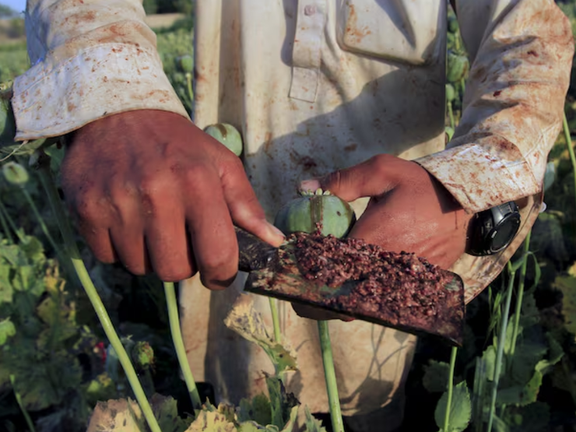
The United Nations Office on Drugs and Crime (UNODC) announced that opium production in Afghanistan has increased by 30% in 2024 as compared to the previous year.
The United Nations Office on Drugs and Crime (UNODC) announced that opium production in Afghanistan has increased by 30% in 2024 as compared to the previous year.
According to the statistics of this office, contrary to the orders of the Taliban leader, 433 tons of opium had been produced in Afghanistan this year.
The United Nations Office on Drugs and Crime (UNODC) on Wednesday (November 27) published a report saying that the value of the opium crop in 2024 is approximately $260 million, an increase of 130% as compared to the previous year.
The office said that despite a 30 percent increase in opium production in 2024, it showed a 93 percent decrease when compared to 2022, before the issuance of a decree banning the cultivation and production of narcotics by Taliban leader Mullah Hibatullah.
The report states that poppy production and cultivation have been transferred from the southwestern provinces of Afghanistan to the northeastern provinces of the country. The office said that two-thirds of opium production took place in the northeastern provinces.
"International efforts must be coordinated to ensure that this reduction is not replaced by the production of dangerous synthetic drugs such as methamphetamine in Afghanistan or the region," said Ghada Waly, executive director of UNODC.
Waly called for help for poppy-dependent rural communities to turn to cost-effective legal and economic alternatives.
The office had reported last month that poppy cultivation in 2024 increased by 19% compared to the previous year. The United Nations had said that the area of poppy cultivation last year was 10,800 hectares, and this figure has reached 12,800 hectares this year.
Last month's report by the United Nations Office on Drugs and Crime (UNODC) also stated that poppy cultivation has grown in the northeastern regions of Afghanistan, and the price of dry opium has reached about $730 per kilogram.

The Special Inspector General for Afghanistan Reconstruction (SIGAR) wrote in a report that attacks by opposition fronts do not pose a serious threat to the Taliban, and that the group has been able to maintain its military dominance in Afghanistan.
He predicted that the Taliban would likely be able to maintain this advantage for at least the next 12 months.
In a report to the US Congress, the US inspector general assessed the situation in Afghanistan during the months of July to September. The report was published on Monday, November 26.
The report also emphasised that the Afghanistan Freedom Front and the National Resistance Front, despite their attacks, have not yet posed a serious threat to the Taliban.
‘Doubts About Taliban's Ability To Confront ISIS’
According to the inspector general's report, ISIS-K has been able to increase its cross-border threats and become a regional and global threat. The report expressed doubts about the Taliban's ability to confront ISIS-K.
According to the US inspector general's report, ISIS-K has about 2,000 members, and despite pressure from the Taliban, the group is expanding its influence and strength.
‘ISIS-K Attacks On The Rise In Europe’
ISIS-K is using facilitation networks in Afghanistan and Turkiye to transport troops to Europe, the US inspector general said. The group's simpler, but more frequent attacks are expected to increase in Europe over the next year.
The report explains that one of the main factors behind ISIS-K's success in carrying out transnational attacks is access to weapons, level of military training, ability to evade counterterrorism measures, and identification of effective targets.
ISIS-K targets Afghans and citizens of Central Asian countries who have migrated to Europe or are planning to travel to Europe for asylum.
The US inspector general's report indicates that the group derives part of its financial resources from the main branch of ISIS and has recently switched to using international aid and cryptocurrencies.
‘Al-Qaeda's Strategic Patience’
The US inspector general also reported that al-Qaeda in Afghanistan continues to operate without attracting attention. According to the report, after the US withdrawal in 2021, Taliban leaders may have decided to follow the peace agreement with the US in Doha in 2020 and not allow al-Qaeda to carry out cross-border attacks.
However, the report suggests that some prominent al-Qaeda figures have recently traveled to Afghanistan, which may be a sign of training, recruitment, and reorganisation activities.
The report also raised concerns about cooperation between al-Qaeda and the TTP. According to the report, this cooperation could pose a threat beyond the region. The US inspector general's report states that al-Qaeda has exercised "strategic patience" in its relations with the Taliban.
According to the report, the United States continues to pressure the Taliban to secure the rights of women and girls and will not normalise its relations with the Taliban until these rights are restored.
The US State Department stressed that the Taliban have not fulfilled their promises in August 2021 to respect the rights of women and girls and have returned to the repressive policies they pursued in the 1990s.
"Although the Taliban is sensitive to international criticism, there is no sign of a willingness to change its domestic policies under international pressure," the report shows.
‘Regional Concerns’
According to the report, the countries of the region are concerned about the situation in Afghanistan. Despite maintaining diplomatic relations with the Taliban, these countries are concerned about the expansion of terrorist groups in Afghanistan. The countries of the region have called on the Taliban to fight terrorist groups in a tangible way.
Pakistan accuses the Taliban of supporting the Tehreek-e-Taliban Pakistan (TTP). Islamabad says that Afghan soil is being used against the country. The Islamic Republic is afraid of the activities of ISIS and Jaish al-Adl on its borders. However, the Taliban has stressed that Afghanistan's soil will not be used against the countries of the region and the world.
The US Inspector General serves as the coordinator of surveillance reports and assessments related to the country's security and defence operations.
Tarig Ali Bakheet, the Special Representative of the Organisation of Islamic Cooperation (OIC) for Afghanistan discussed Afghanistan in a meeting with his British counterpart.
In order to address the economic, humanitarian and human rights challenges in Afghanistan, there is an "urgent need to increase the level of engagement with the Taliban", they said.
The Organisation of Islamic Cooperation (OIC) said in a statement that the OIC's Special Representative met with British Special Representative for Afghanistan Andy McCoubrey on Monday at the OIC headquarters in Jeddah.
The two officials discussed the situation in Afghanistan and key issues at the last Doha meeting.
The third Doha meeting, which was held on June 30 and July 1 of this year, was attended by representatives of international community, as well as a delegation from the Taliban group in Qatar, and discussed supporting the private sector and more cooperation of the world to fight drugs in Afghanistan.
Representatives of the Organisation of Islamic Cooperation (OIC) and the United Kingdom called for increased engagement with the Taliban to resolve economic and humanitarian problems in Afghanistan.
A Chinese delegation has traveled to Kandahar to discuss Islamabad's concerns about the Tehreek-e-Taliban Pakistan (TTP) with the Afghan Taliban leadership, sources said.
According to sources, Islamabad wants to put pressure on the Taliban's decision-making authority through China to prevent the TTP's operations in Khyber Pakhtunkhwa.
The six-member delegation of Chinese diplomats is scheduled to meet with Mullah Shirin, the Taliban's governor in Kandahar.
A reliable source told Afghanistan International that the delegation arrived in Kandahar on Monday (November 26) and first met with Taliban spokesman Zabihullah Mujahid. "The delegation will meet with (Mawlawi Shirin), the governor of Kandahar. The main topic of this meeting is the Tehreek-e-Taliban Pakistan (TTP)," said the source.
According to the source, the Chinese delegation wants to meet with Taliban leader Hibatullah Akhundzada and share Islamabad and Beijing's concerns about the Pakistani Taliban, but the Taliban leader does not want to meet with the delegation.
The Taliban has not yet commented on the delegation's visit to Kandahar.
The Chinese delegation, headed by the country's special representative for Afghanistan affairs, recently held talks with the Taliban's defence and interior ministers in Kabul. It is said that the visit of the Chinese delegation to Kandahar was arranged by Mullah Yaqoob, the Taliban's defence minister.
Recently, Yue Xiaoyong, China's special envoy for Afghanistan, traveled to Islamabad and then to Kabul, where he met with Taliban officials and emphasised on the need to improve relations between Kabul, Islamabad and Beijing.
Pakistani media reported that Islamabad had shared "convincing evidence" about the sanctuaries of the Tehreek-e-Taliban Pakistan (TTP) and other groups on Afghan soil with China's special envoy for Afghanistan.
Recent attacks by Baloch separatists on Chinese and Pakistani targets in more than 10 districts of Balochistan, Karachi and Khyber Pakhtunkhwa has Pakistan concerned about the cooperation of TTP militants and Baloch separatists. Pakistani officials believe the recent attacks by Baloch separatists are different from the group's previous attacks and are deadlier than its traditional war tactics decades ago.
"It seems that Islamabad, through the Chinese, wants to encourage the leadership and decision-making authority of the Taliban government to prevent the expansion of Pakistani militants' operations in the tribal areas during the army's operations against Baloch separatists in Balochistan," a source familiar with Balochistan affairs told Afghanistan International.
The Pakistani military is concerned that if an operation is launched against Baloch militants in Balochistan, the Pakistani Taliban and other armed groups will increase their attacks in Waziristan and the tribal areas to seize these areas.
According to the source, in August 2022, after the assassination of Pakistani Taliban commander Aftabullah Dawar, who was known as Yasser Tipaki, Pakistani security agencies paid more attention to Kandahar and Nimroz. The Gul Bahadur Group (TTP) has said that the ISI was involved in the assassination of the group's commander.
Twenty female speakers of parliaments from around the world published an article in Le Monde newspaper reaffirming their commitment to support the rights of Afghan women and girls in the field of education.
In an open letter, 158 French senators have also called for the recognition of gender apartheid in Afghanistan.
Roberta Metsola of the European Parliament and Yaël Braun-Pivet of France; Nancy Pelosi, former Speaker of the US House of Representatives; Francina Armengol of Spain, and Carolina Siqueira of Angola are among the authors of this article.
The article reads in part, "Afghanistan today is the only country that has banned the education of girls over the age of 12 and women. Young Afghan girls should not be deprived of their universal and fundamental rights."
These women have considered the Taliban's latest decree banning women's voices as "the last nail in the coffin of women's freedoms”. The article added that according to the decree, women are prohibited from leaving the house without a male escort, their voices cannot be heard in public places, or even read poetry. In the article, female politicians ask, "What is their crime? Being a woman. What is their sin?"
In their article, the speakers of the parliaments of 20 countries pledged that they will not leave Afghan women alone.
Meanwhile, on the occasion of the International Day for the Elimination of Violence against Women on November 25, 158 French senators on Monday expressed concern over the situation of women in Afghanistan and condemned "gender apartheid" against them.
In an open letter published on the initiative of Dominique Vérien, the head of the French Senate's delegation of women's rights, they wrote that Afghan women have been deprived of all their rights under the rule of an "authoritarian regime".
In their letter, the senators called the Taliban's actions against women in Afghanistan a "gender-based crime against humanity" and condemned it.
In their letter to the international community and the United Nations, the 158 senators wrote that "the Taliban have carried out the first gender apartheid in modern human history before our eyes”.
In another part of the letter, it is stated that "Afghan women, who have been deprived of their faces, are now deprived of even having a voice and do not have the right to have their voices heard”.
The senators called on all political groups in the French parliament and the United Nations to "in no way legitimise an institutionalised system of repression that leads to the exclusion of women”.
They also called on other European countries to recognise the persecution of women as a "gender-based crime against humanity".
Human rights activists said that the Taliban has established gender apartheid in Afghanistan by imposing sweeping restrictions on women and banning women's education and work.
Human rights organisations have considered the Taliban's actions against Afghan women as a clear example of gender discrimination.
Women in Afghanistan under the Taliban's rule are not allowed to go to parks, sports clubs, and beauty salons, and are not allowed to leave the house without a male companion.
The United Nations Mission in Afghanistan (UNAMA) has released its three-year report on the state of media freedom in Afghanistan.
According to the report, the Taliban confirmed the jamming of broadcasts of the Afghanistan International Network satellite and called the activities of the exiled media "illegal”.
A UNAMA report released on Tuesday (November 26) said that the Taliban had violated freedom of expression and media by interfering in the content of domestic media broadcasts and activities.
‘Detention And Torture Of Journalists’
UNAMA said that during the three years of the Taliban's rule in Afghanistan, it has recorded human rights violations that have affected 336 journalists and media workers.
UNAMA said that the Taliban had arbitrarily detained 249 journalists during this period. The United Nations has also documented 130 cases of torture and ill-treatment and 75 cases of threats against journalists.
According to the UNAMA report, before the Taliban's takeover of Afghanistan, about 543 media outlets and 10,790 media workers were active in the country, but only three months after the group's takeover, 43% of media outlets were blocked and the number of media workers was reduced to 4,360.
In the report, which examined the situation and media freedom in Afghanistan from 15 August 2021 to September 2024, UNAMA admitted that some human rights violations were not included in the report due to lack of verification. The United Nations has said that the violations of human rights and freedom of expression may be higher.
The report shows that the Taliban's Law for the Promotion of Virtue has had a negative impact on the activities of media and journalists, and has imposed restrictions on the content of publications, the clothing of women journalists, and the publication of images and photos.
UNAMA also said that the Taliban considers the activities of Afghan media in exile "illegal", which has led to severe restrictions on the internal staff of these media outlets in Afghanistan.
Referring to the Taliban's jamming of the broadcasts of Afghanistan International satellite, UNAMA said that the group has also imposed restrictions on other exiled media outlets in Afghanistan.
According to the UNAMA report, in addition to the Taliban's Ministry of Information and Culture, the Taliban's Ministry of Virtue and Intelligence Directorate also interfered in the work of the media. UNAMA has confirmed that the Media and Access to Information Law is under "Sharia-compliant" review.
The report also shows that the members of the Commission to Investigate Media Violations are mainly members of the Taliban, including the group's Intelligence Directorate and the Ministry of Virtue Promotion, and that no women are members of the commission.
UNAMA has published the Taliban's reaction in the appendix to its report. The Taliban's Foreign Ministry has said that broadcasting media from abroad should be legal for the people of Afghanistan. The group said that most of the media that currently broadcast from abroad do not have a licence from the group's Ministry of Information and Culture. The Taliban said that these media outlets are "considered illegal and their activities are prohibited”.
The Taliban has denied any violations of the rights of journalists and media.
UNAMA has called on the Taliban to refrain from threatening and arbitrarily detaining journalists and to lift restrictive measures against women journalists.
In recent months, the Taliban government has tried to disrupt Afghanistan International's satellite broadcasts by sending extensive disruptive frequencies. Afghanistan International called the attack a violation of press freedom and introduced a new satellite frequency to ensure its audience's continued access to free news and information.