Taliban Publicly Flogs Woman & Four Men In Kapisa
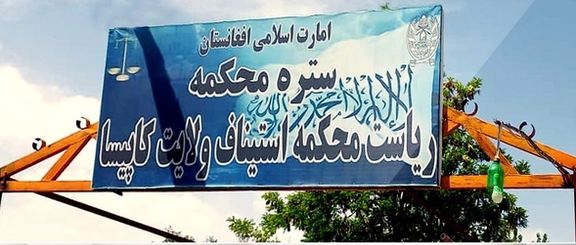
The Taliban's Supreme Court announced that it had flogged five people, including a woman, on charges of extramarital affairs and same-sex relations.
The Taliban's Supreme Court announced that it had flogged five people, including a woman, on charges of extramarital affairs and same-sex relations.
The court wrote that the defendants were sentenced to 20-39 lashes. They have also been sentenced to one to two years in prison.
On Saturday, December 7, the Taliban's Supreme Court wrote that the defendants were flogged in the presence of representatives of government institutions, court clients, and the general public.
According to the Taliban's Supreme Court newsletters, the group has punished nearly 20 people with public flogging in the past week alone.
Despite the objections of international organisations to corporal punishment and torture of defendants, the Taliban has continued to punish them with flogging. The group considers the flogging of defendants in public to be an order of "Islamic law”.

The United Kingdom has stated that the Taliban's recent decision to ban medical education for Afghan women and girls is deeply concerning and called for a global consensus against the Taliban's restrictive decisions.
The country described the Taliban's new decision as a "horrific violation of basic human rights”.
In a statement on Friday, the British government said that Afghanistan is "the only country that imposes such restrictive policies on girls' education".
"The recent decision is a tragic setback," the statement said.
Last week, the Taliban leader issued a decree closing all higher and semi-higher medical education institutions to girls. Mullah Hibatullah's decision has been met with widespread international reactions.
The British government called the Taliban's policies against women "oppressive" and warned of the long-term, threatening and serious consequences of this decision on the health and lives of people, especially women and girls.
The UK called on the Taliban to lift the ban and urged the international community to remain "united in their "resolute opposition to the Taliban's continued restrictions".
The British government stressed that it is "committed to its lobbying efforts in this regard" and called on other countries to make this issue a priority.
"We will continue to engage with the women and girls of Afghanistan, as well as the diaspora in the UK, on this issue," the statement said.
Earlier, a British MP also condemned the Taliban leader's decision, describing it as "immoral" and "short-sighted”.
The Taliban-controlled Da Afghanistan Breshna Sherkat (DABS) announced the extension of the contract to buy electricity from Turkmenistan until 2025.
The company wrote in a statement that according to the contract, Turkmenistan's electricity will be imported to Afghanistan through four routes: Andkhoy, Aqina, Badghis and Torghundi in Herat.
According to the statement published on Friday, December 7, the contract was signed during the visit of DABS chairman Abdul Bari Omar to Turkmenistan.
Afghanistan is not self-sufficient in electricity production and imports more than 70 percent of its electricity needs from Uzbekistan, Turkmenistan, Tajikistan and Iran.
A delegation of DABS in a meeting with officials of the Turkmenistan Electric Power Company appreciated the country's cooperation in importing electricity to Afghanistan.
Local sources said that the Taliban's intelligence agency has banned guests from staying overnight in hotels and inns near Kabul's "Green Zone".
According to sources, the Taliban's intelligence agency has announced that the ban was carried out for security reasons.
According to local sources, Taliban officials in the group's intelligence department have not provided further explanations about the reasons for the ban.
Bilal Sarwari, a journalist, also announced the ban in Kabul's Green Zone on his X social platform account.
In a photo he posted on his social media page, there is a sign in the corridor of one of the inns, "For security reasons, guests cannot spend the night in rented rooms."
Before the Taliban's takeover of Afghanistan, the Kabul Protected Area, known as the "Green Zone", was home to embassies of foreign countries, including the US embassy, and the offices of international institutions and organisations.
The Presidential Palace, Ministries of Defence, Interior, and Foreign Affairs were also located in this area.
Médecins Sans Frontières (MSF) or Doctors Without Borders has said that the Taliban's decision to ban women's education in medical institutions threatens Afghanistan's health system and will have serious consequences for women's health.
The Taliban's move is another step to exclude women from public and professional life, the organisation said.
The organisation added that the small number of female health workers in Afghanistan has currently affected access to healthcare in the country, especially due to the separation of male and female hospital wards. The Taliban's new ban has further restricted access to quality healthcare.
"There is no health system without educated female medical staff," said Médecins Sans Frontières (MSF) representative in Afghanistan, Mickael Le Paih, on Friday, December 6.
He added that more than 41 percent of the organisation's medical staff in Afghanistan are women.
Le Paih also stressed that the Taliban's new decision deprives women of access to education and the provision of impartial health services.
The organisation said that the medical needs in Afghanistan are enormous and that more women need to be trained to take care of them.
Restrictions imposed by the Taliban in Afghanistan over the past three years have significantly reduced access to medical education for women, Médecins Sans Frontières (MSF) said in the statement.
At the maternity centre in Khost province, which is one of the busiest maternity centres in the world, it is challenging to fill essential positions such as nurses and obstetricians and gynecologists, the statement added. The organisation reported that from January to June 2024, it helped 22,300 deliveries.
The World Health Organisation (WHO) has emphasised that in order to provide essential health services to all people, these services must be provided by all genders.
Médecins Sans Frontières (MSF) has said it will continue to defend women's right to access medical education and education in general in Afghanistan.
The medical needs in Afghanistan are enormous, and to meet them, more training of women's medical staff is necessary.
Médecins Sans Frontières (MSF) is an international non-profit organisation that provides medical and humanitarian services in crisis areas.
Karim Khan, the chief prosecutor of the International Criminal Court (ICC), met with a number of members of the Afghan Women's Coalition.
The International Criminal Court (ICC) said that the Office of the Prosecutor, in cooperation with victims and civil society, has prioritised action on "gender-based crimes in Afghanistan”.
The ICC on Friday, December 6, released a video of Karim Khan's meeting with members of the Afghan Women's Coalition on social media platform X.
The statement said that Prosecutor Karim Khan, along with the victims and civil society, has prioritised action on gender-based crimes in Afghanistan.
Khan expressed hope that the decisions of the Hague court would "alleviate some of the pain of Afghan women".
Referring to human rights violations in Afghanistan this week, Karim Khan said that he would soon apply for an arrest warrant for those involved in human rights violations.
Recently, Chile, Costa Rica, Spain, France, Luxembourg, and Mexico referred the case of Afghanistan, especially the violation of women's rights in this country, to the International Criminal Court in The Hague. The International Criminal Court also confirmed that it had received the case.
The court is also expected to issue arrest warrants for some Taliban leaders involved in "systematic violence" against women and "the prevailing gender apartheid in Afghanistan".
In a meeting with Afghan women activists in The Hague, Karim Khan once again referred to the countries' requests, saying, "Soon you will hear news about your country”.
Human rights activist Horia Musadiq was quoted as saying that the chief prosecutor of the Hague court said, "He hopes that the court's decisions can alleviate some of the pain and suffering of the Afghan people, especially Afghan women, and that those responsible for the crimes will be brought to justice."
The Hague prosecutor has refused to name the Taliban, but the group has a case that Karim Khan and his team are handling because of its policies that have completely deprived Afghan women of their rights.
Past Crimes
On Thursday, a number of Afghan activists met with Karim Khan. Horia Musadiq, one of the participants, told Afghanistan International that during the meeting, she called for an investigation into the crimes and violence of the past 20 years.
She said that in order to investigate the crimes committed over the past 20 years, whether by the Taliban or by NATO and US forces in Afghanistan, a special tribunal should be established similar to the war crimes tribunal in the former Yugoslavia.
Fereshta Abbasi, Afghanistan researcher at Human Rights Watch, also posted a photo of Afghan women activists meeting with Karim Khan at the International Criminal Court (ICC) headquarters in The Hague on Thursday, and wrote, "The prosecutor announced that he would soon request an arrest warrant."
Afghan women's activists are in the corridors of the criminal court seeking to hold the perpetrators of serious crimes in Afghanistan accountable, she said.
Despite repeated calls by the international community, human rights organizations, and especially Afghan women to lift restrictions imposed on women in Afghanistan, the Taliban has increased these restrictions over the past three years.
After banning girls from studying above the sixth grade, the Taliban banned the education of girls and women in higher education centres and universities, and in the latest move, closed the only remaining educational institution, namely medical institutes, to girls.