Monument In Danger Of Collapse: UNESCO Official Visits Minar-e-Jam
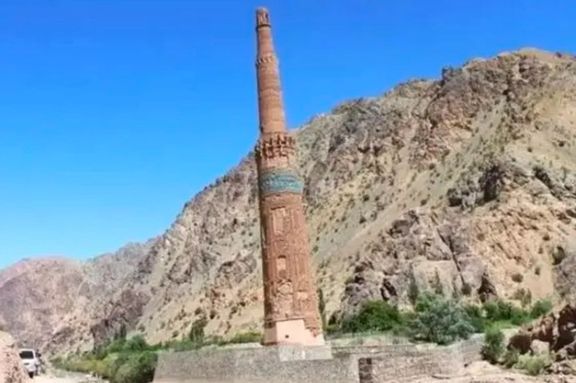
The Taliban-controlled Bakhtar News Agency reported that Patricia McPhillips, head of UNESCO's office in Afghanistan, visited Minar-e-Jam in Ghor Province.

The Taliban-controlled Bakhtar News Agency reported that Patricia McPhillips, head of UNESCO's office in Afghanistan, visited Minar-e-Jam in Ghor Province.
Regarding the protection of the monument, which is in danger of collapse, McPhillips said that efforts are underway to attract funding.
According to the report, McPhillips stressed on the need to protect the monument.
McPhillips has said that a new bridge will be built for tourists to pass over the Hari-rud river near Minar-e-Jam.
The minaret, which is considered a masterpiece of the Ghurid civilisation, was included on the UNESCO World Heritage List in 2002, however, the lack of sufficient attention in its restoration over the past two decades has led to repeated warnings about the possibility of its collapse.


The Taliban’s Supreme Court has announced that a woman and two men were publicly flogged in the Khuram wa Sarbagh district of Samangan province, accused of “illicit relations” and fleeing from home.
According to the court, the accused were each subjected to 39 lashes and sentenced to prison terms ranging from 10 months to 2 years. In a statement released on Sunday, the Taliban’s Supreme Court noted that the flogging took place in the presence of local officials, court attendees, and members of the public.
Separately, the court reported another public flogging in Kunduz province on Saturday, where three individuals accused of “same-sex relations” were each subjected to 39 lashes. They were also sentenced to imprisonment ranging from 4 to 7 years.
Despite widespread condemnation from international human rights organisations regarding the use of corporal punishment and torture, the Taliban continue to carry out public floggings, claiming these practices align with “Islamic Sharia law.”
The Taliban’s resurgence in Afghanistan has seen an increase in public punishments, raising concerns over human rights violations and the erosion of judicial fairness.

Local sources have confirmed that approximately 35 workers remain trapped under rubble following a mine collapse in the Dara-i Sufi Payin district of Samangan province, Afghanistan.
The incident occurred on the evening of Saturday in the Safid Khak area. Rescue teams have been dispatched to the site, but no updates on their progress have been provided so far.
Domestic media outlets have shared images of ongoing rescue efforts, highlighting the challenges faced by emergency responders.
The Taliban-controlled Bakhtar News Agency also confirmed the incident, citing local officials. According to their reports, the mine collapsed while workers were still inside.
Conflicting accounts have emerged regarding the number of individuals trapped, with some sources reporting 35 miners, while others estimate the figure to exceed 40.

The Taliban-controlled Bakhtar News Agency has reported that the Herat-Torghundi Highway in western Afghanistan has been closed to traffic due to heavy snowfall.
Local Taliban officials have advised residents in certain districts to avoid travelling to Herat. According to their statement, the highway was blocked on Sunday, 15 December, in the Baqarchar area and remains closed to transportation.
Taliban authorities in Herat have announced that efforts are underway to clear the highway and restore traffic flow. Meanwhile, the Taliban’s police command in Herat issued a notice urging residents of the Ghorian, Khushki Kuhna, Rabat Sangi, and Torghundi districts to refrain from travelling towards Herat until further notice.
Heavy snowfall during winter frequently results in road closures and, in some cases, fatalities across the region.

The Taliban’s Ministry of Commerce and Industry has announced a significant increase in coal exports, revealing that approximately 654,000 tonnes of coal were exported over the past eight months to Pakistan, China, Iran, India, and Türkiye.
The total value of these exports reportedly exceeds $605 million.
In November 2023, the Taliban administration stated that 1,000 tonnes of coal are extracted daily in northern Afghanistan and sold to traders.
However, critics have denounced the unregulated and excessive extraction of coal, along with its low-cost export, as a form of “plundering” Afghanistan’s valuable underground resources.

Mehdi Bakhshi, the Prosecutor General of Kerman, Iran, has announced that 1,788 undocumented Afghan migrants have been arrested and deported from the province over the past three days.
Bakhshi underscored that employing undocumented Afghans in Kerman is deemed a “crime.” The deportations were carried out as part of a plan titled “Enhancing Social Security,” which aims to bolster public safety, according to a report by the IRNA news agency on Sunday.
The judicial official reiterated that residency in Iran must be obtained through legal means, warning that violators would face punitive action and deportation.
While Iran receives international assistance, particularly from the United Nations, for hosting Afghan migrants, Iranian officials assert that the aid is insufficient. They have called for increased foreign funding to address the growing burden.
In recent months, Iran has intensified the deportation of Afghan migrants, with reports suggesting that thousands of Afghans are expelled from the country every week. According to Afghanistan International, some Afghans with valid visas and residency permits have also been detained and deported by Iranian authorities.
Iran has announced plans to deport two million Afghan migrants by the end of the current year, marking a significant escalation in its immigration enforcement efforts.