American Adult Film Star Tours Afghanistan Under Taliban Rule

Whitney Wright, a well-known American adult film actress, has journeyed to Afghanistan, which is currently governed by the Taliban.

Whitney Wright, a well-known American adult film actress, has journeyed to Afghanistan, which is currently governed by the Taliban.
On Friday, Wright posted photographs from Kabul and Herat on her social media accounts, showcasing various scenes from these cities. The images feature Ariana Airlines, a tiled rooftop in Herat, a shopfront, and several vehicles, though Wright herself does not appear in any of the pictures.
Afghanistan International reached out to Wright to enquire about the precise timing and purpose of her visit but has yet to receive a reply.
The Taliban, likewise, has remained silent on the matter.
Despite the Taliban's restrictive policies towards Afghan women, the group has extended numerous accommodations to foreign male and female tourists, seemingly to promote a "positive image" of their regime globally.
Notably, earlier reports highlighted intimate photographs of Taliban members alongside Chinese female tourists, which had previously captured public attention.
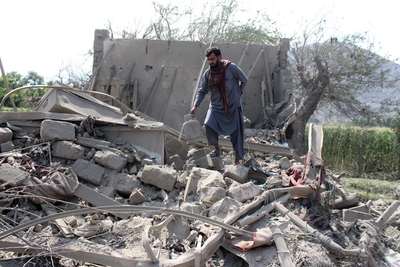
The police chief of Khyber Pakhtunkhwa province has confirmed that Maulana Hamidul Haq Haqqani, head of the Haqqania Madrassa in Akora Khattak, has died in hospital from severe injuries sustained in an explosion.
The blast occurred on Friday during Friday prayers at the Haqqania Madrassa, killing at least five people and injuring several others. Hamidul Haq Haqqani, son of the late Maulana Samiul Haq Haqqani, was the primary target of the attack.
As of now, no group has claimed responsibility for the bombing.
Pakistani President Asif Ali Zardari and Prime Minister Shehbaz Sharif strongly condemned the attack, offering condolences to the victims’ families and calling for swift action to identify and punish the perpetrators.
Situated about 60 miles from the Afghanistan border, the Haqqania Madrassa has long been associated with the Taliban. The madrassa has trained numerous Taliban leaders, and its officials have previously expressed pride in the group’s control over Afghanistan.
Hamidul Haq Haqqani, often referred to as the “spiritual father of the Taliban,” had openly urged the former Afghan government to surrender so the Taliban could implement Sharia law. The previous Afghan administration had called on Pakistan to shut down the madrassa due to its promotion of extremist ideologies.
Following the Taliban’s return to power in 2021, senior Taliban officials visited the Haqqania Madrassa and met with its religious leaders.
In early 2024, Hamidul Haq Haqqani led a delegation of Pakistani clerics to Kabul, where they met with Taliban officials, including Maulawi Abdul Kabir, then the Taliban’s Deputy Prime Minister for Political Affairs. Reliable sources confirmed that Abdul Kabir pledged financial support to the madrassa. A memorandum from his office instructed the Taliban’s Ministry of Finance to transfer seven million Afghanis to the madrassa’s account.
Reacting to Hamidul Haq Haqqani’s death, Rahmatullah Nabil, former head of Afghanistan’s intelligence agency, described him as “a human being in the guise of the devil,” adding, “He and his father were both merchants of death!”

The Taliban governor’s office in Jowzjan has announced that the group’s court in Sheberghan city publicly flogged 13 people, including five women.
According to the statement, the individuals received between 29 and 39 lashes, though no details were provided regarding their alleged offences. The punishment was carried out in the presence of local Taliban officials, court attendees, and the public.
Within the past week, the Taliban’s Supreme Court has publicly punished at least 39 people, including eight women, across Afghanistan.
Human rights organisations have repeatedly condemned such corporal punishments, describing them as a violation of fundamental rights. Amnesty International and Human Rights Watch have classified these acts as torture and inhumane treatment, arguing that they contravene Afghanistan’s international obligations.
Rights groups and the United Nations have urged the Taliban to uphold fair trial standards and abolish punishments that violate human dignity. The UN has also expressed growing concern over the Taliban’s increasing use of corporal punishment.

The BBC has responded to accusations that it made large payments to the Taliban, potentially breaching UK and US sanctions, stating that its transactions with Taliban-controlled national television do not violate any sanctions laws.
In a statement to Afghanistan International, the BBC clarified that UK sanctions apply only to specific individuals and entities within the Taliban, not to all Afghan institutions, such as Radio Television Afghanistan (RTA).
The UK-based investigative news outlet UnHerd reported on Wednesday that the BBC had made substantial payments to the Taliban, raising concerns about possible sanctions violations. The report accused the broadcaster of compromising professional journalism standards to appease the Taliban.
However, the BBC refuted these claims, asserting that its professional integrity remains intact. It stated that payments made were solely for renting space at the national television station to facilitate FM radio broadcasts, ensuring the delivery of “independent and impartial news” across Afghanistan.
The broadcaster also emphasised that it has stringent measures in place to prevent sanctions violations. According to the BBC, UK sanctions do not apply to the Taliban as a whole but rather to specific individuals and organisations.
Responding to allegations that Sirajuddin Haqqani, the Taliban’s Interior Minister, and Mohammad Yousuf Ahmadi, head of Afghanistan’s national broadcaster, are on the sanctions list, the BBC explained that a public entity led by a sanctioned individual is not automatically subject to restrictions.
The BBC stated that its rental payments for FM network operations in Afghanistan were necessary and that it had only rented a small space within the national broadcaster’s premises to house its equipment. It further clarified that security coverage included in the rental agreement was incidental.
The broadcaster reiterated that Afghanistan’s national television network is not subject to UK sanctions.
The BBC also addressed another claim from UnHerd, which reported that Jacky Martens, the BBC’s South Asia Bureau Chief, met with Sirajuddin Haqqani in Kabul in 2022. The BBC stated that it is standard practice for senior BBC managers to engage with political leaders and officials worldwide, including members of the Taliban administration.
In response to UnHerd’s assertion that the BBC had stopped broadcasting Western music to avoid Taliban censorship, the organisation clarified that dedicated music programmes for its Afghan service were discontinued over a decade ago. However, it confirmed that its Nawroz 1403 programme, recorded in London, was broadcast across its radio, television, and digital platforms.
The BBC confirmed that it signed a memorandum of understanding with RTA to continue operations in Afghanistan but insisted that it does not provide any financial support, training, or equipment through BBC Media Action.
The broadcaster acknowledged that, like any organisation operating in Afghanistan, it is required to pay taxes and legal fees such as vehicle registration and permits. However, it stressed that these payments are standard legal obligations and do not amount to a violation of international sanctions.

The Torkham border crossing has remained shut for the seventh consecutive day, halting all movement of goods and people.
The Associated Press reported that over 5,000 trucks carrying perishable goods, including fruits and vegetables, are stranded, awaiting the reopening of the crossing.
Pakistani officials estimate that the prolonged closure has resulted in approximately $12 million in losses for traders. The disruption has severely impacted transportation networks, leaving both traders and travellers in limbo.
Pakistan closed the Torkham crossing last Friday following a dispute over the installation of a signboard by Pakistani authorities and the subsequent construction of a Taliban security checkpoint.
Despite multiple rounds of negotiations between Taliban and Pakistani border officials, no agreement has been reached, and the crossing remains closed.

The Economist Intelligence Unit (EIU), in its annual Democracy Index 2024 report, has ranked Afghanistan as the most authoritarian country in the world, placing it last among 167 nations.
The report, published by the research division of The Economist magazine, awarded Afghanistan a score of just 0.25 out of 10, highlighting the extreme repression under Taliban rule.
According to the report, Afghanistan is now more oppressive than Myanmar and North Korea, which follow closely in the rankings. The Taliban administration is classified in the “authoritarian” category, with no electoral governance, political participation, or civil liberties.
The EIU, a research institution with over 75 years of experience, provides political and economic analysis to governments, corporations, and financial institutions. With a network of 400 analysts, it assesses complex geopolitical and economic situations worldwide.
Afghanistan Ranks Last in the 2024 Democracy Index
Afghanistan’s position at the bottom of the rankings reflects its status as the most closed and repressive regime in the world. Unlike North Korea and Myanmar, which have structured governance systems, the Taliban rule without a constitution, relying solely on rigid religious decrees. Under their rule, freedoms of speech, political participation, and women’s rights have been completely eliminated. Girls’ education, women’s employment, and minority rights are also strictly banned.
Breakdown of Afghanistan’s Democracy Index Score
Electoral Process and Pluralism
Afghanistan, along with Sudan, Syria, the Central African Republic, Turkmenistan, and Laos, scored zero in this category, indicating a complete absence of credible electoral processes.
Government Functioning
Afghanistan, Sudan, Syria, and Myanmar also scored zero in terms of governance efficiency, transparency, and accountability. Laos (2.86) and North Korea (2.50) scored slightly higher, as their authoritarian systems operate in a more structured manner.
Political Participation
Afghanistan is the only country in the report to receive a 0.00 in political participation, reflecting a complete lack of citizen engagement in governance, even among elites or groups close to the Taliban.
Political Culture
In the political culture index, which assesses public support for democratic values, Afghanistan scored 1.25. This highlights the Taliban’s rigid ideological control. In contrast, Turkmenistan (5.00) and Sudan (5.63) scored higher, indicating that some segments of their populations still lean towards democratic ideals, despite authoritarian rule.
Civil Liberties
The civil liberties index, which evaluates freedom of speech, assembly, and the rights of women and minorities, awarded Afghanistan a score of zero, placing it alongside Syria, Myanmar, and North Korea. This confirms the absolute suppression of social and civil freedoms under Taliban rule.
The Democracy Index 2024 serves as yet another warning about the severe restrictions imposed by the Taliban, reinforcing their status as the most repressive regime in the world today.
