• العربية
  • پښتو
  • فارسی
Brand
  • Afghanistan
  • Sport
  • Markets
  • Afghanistan
  • Sport
  • Markets
  • Theme
  • Language
    • العربية
    • پښتو
    • فارسی
  • Afghanistan
  • Sport
  • Markets
All rights reserved for Volant Media UK Limited
volant media logo

Pakistan Expels 90 Afghans As Deportation Push Intensifies

Apr 2, 2025, 12:29 GMT+1

Pakistani officials confirmed on Tuesday that 90 Afghan migrants were arrested in Islamabad and Rawalpindi and deported via the Torkham border. Of those expelled, 77 held Afghan Citizen Cards (ACC), while 13 lacked legal residency documents.
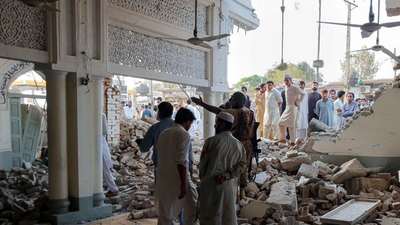
Authorities noted this action was distinct from the formal expulsion process, set to begin once temporary migrant camps are operational.

The temporary repatriation camp in Landi Kotal, Khyber Pakhtunkhwa, remains shut due to Eid holidays. A Pakistan’s immigration authority told Afghanistan International on Tuesday that the forced deportation of undocumented Afghan migrants had officially started, with arrests occurring nationwide. In this initial phase, only those without valid residency papers are being targeted.

The Associated Press, citing government documents, previously reported that Pakistan delayed the forced repatriation of Afghan migrants until 10 April due to Eid al-Fitr. The report added that Islamabad plans to deport three million Afghans this year.

Amid the crackdown, the Taliban’s consul in Karachi met Sindh’s Chief Minister on Tuesday, pressing for an end to police harassment of Afghan migrants with legal residency documents. The Taliban have consistently urged a dignified return for Afghan migrants, but Pakistani authorities have rejected these pleas, continuing with widespread arrests and deportations.

Most Viewed

Arrests & Killings Of Former Afghan Forces Continue, Says UN
1

Arrests & Killings Of Former Afghan Forces Continue, Says UN

2

Taliban To Put TOLOnews Journalists On Trial

3

Taliban Beat Shia Cleric In Kabul After Marriage Dispute, Say Sources

4

Attack On Pakistani Police Centre Was Not Planned In Afghanistan, Says Taliban

5

Taliban & Pakistan Prepared To Work Together For Peace & Security, Says China

•
•
•

More Stories

Taliban Left Out As Pezeshkian Calls 11 Leaders For Eid, Nowruz

Apr 2, 2025, 11:16 GMT+1

Iranian media report that President Masoud Pezeshkian has engaged with leaders of 11 neighbouring and Muslim countries in the first 12 days of the Hijri solar year 1404 (March–April 2025) to mark Nowruz and Eid al-Fitr.

Notably, no Taliban officials were included in these discussions.

On Wednesday, IRNA news agency stated that Pezeshkian’s calls aimed to bolster ties with friendly, neighbouring, and allied nations in the face of threats and pressure from “bullying and arrogant enemies.”

Over the past 12 days, he spoke with the leaders of Uzbekistan, Iraq, Tajikistan, Algeria, Turkmenistan, Pakistan, Qatar, Egypt, Oman, Malaysia, and Türkiye, according to the agency.


Taliban Eyes Stronger Russia Ties After Terror Label Move

Apr 2, 2025, 10:12 GMT+1

Zabihullah Mujahid, the Taliban’s spokesperson, hailed Russia’s proposal to suspend its terrorist designation as a “necessary and important step” towards bolstering Afghanistan-Russia ties.

Speaking on Tuesday to TASS news agency, Mujahid expressed optimism, stating that such measures enhance relations between the two nations and are highly valued by the Taliban.

The move follows a formal request from Russia’s Prosecutor General’s Office to the Supreme Court to temporarily lift the Taliban’s status as a banned organisation, with a hearing scheduled for 17 April, according to state news agency RIA Novosti. This shift in policy stems from a law signed by President Vladimir Putin on 28 December 2024, which permits judicial bodies to conditionally suspend terrorist designations upon a request from the Prosecutor General or their deputy, subject to court approval. Leonid Slutsky, head of the State Duma’s Committee on International Affairs, noted that the legislation paves the way for official engagement with the Taliban.

Suhail Shaheen, head of the Taliban’s political office and ambassador to Qatar, told RIA Novosti that the anticipated suspension benefits both countries by removing barriers to cooperation. He expressed hope that, once the ban is lifted, delegations would travel between Kabul and Moscow to explore collaborative opportunities.

Russia first labelled the Taliban a terrorist group in 2003, rendering official interactions illegal. However, Moscow’s stance has evolved in recent years, with diplomatic engagement increasing. Before the Taliban regained power in 2021, Russia hosted several Afghan peace talks under the Moscow Format, marking the group’s initial media appearances.

The decision coincides with the Taliban’s broader diplomatic outreach, including efforts to formalise ties with the United States. Recently, a senior US delegation visited Kabul to discuss bilateral relations and the release of American hostages. The Taliban, seeking to reopen its embassy in Washington, subsequently freed two American hostages “as a goodwill gesture to Trump,” according to group statements.

Iran, Taliban To Open Consulates In Farah, Birjand For Trade Boost

Apr 2, 2025, 09:20 GMT+1

Iran and the Taliban plan to establish consulates in Farah and Birjand to boost trade and economic ties, according to Mohammad Reza Hashemi, Governor of South Khorasan, as reported by IRNA.

Hashemi stated that these consulates could pave the way for enhanced cooperation across various sectors.

He noted that, under directives from Iran’s President and Interior Ministry, border provinces have been granted greater authority to strengthen economic relations with neighbouring countries, particularly Afghanistan under Taliban control.

Hashemi highlighted South Khorasan’s strategic advantage, sharing Iran’s longest border with Afghanistan and hosting four border markets. He said, “South Khorasan, with its extensive border and four markets, holds immense potential for expanding trade with Afghanistan.” He added that approximately 95 percent of the province’s exports go to Afghanistan, making the border a key economic asset.

Looking ahead to 2025, Hashemi outlined plans to reopen and activate the Yazdān, Mil 73, and Dukuhana border markets. To address traders’ challenges, he announced initiatives including meetings with Taliban officials, joint cooperation committees with Farah province, completion of the Mil 78 transit route, exhibitions to showcase collaboration opportunities, and efforts to establish a joint Iran-Afghanistan chamber of commerce. He also prioritised increasing staffing and extending border operations to 24 hours to facilitate trade.

Iran currently operates consulates in Herat, Balkh, Kandahar, and Nangarhar. The planned Farah consulate comes amid earlier concerns from Iranian sources about the presence of anti-Iran militants, notably Jaish al-Adl, in the border provinces of Farah and Nimroz. Some Iranian journalists have claimed that individuals linked to Jaish al-Adl hold government positions in these areas.

Iran’s Foreign Minister recently stressed that border provinces must elevate their engagement with the Taliban. Iran remains the Taliban’s largest economic partner in Afghanistan, with bilateral trade valued at around $4 billion.

Around 12,000 Afghans Imprisoned Abroad, Says Taliban Refugees Ministry

Apr 1, 2025, 17:42 GMT+1

Approximately 12,000 Afghan citizens are currently imprisoned in Pakistan, Iran, and Türkiye, according to Abdul Motalib Haqqani, spokesperson for the Taliban’s Ministry of Refugees and Repatriation.

Speaking on Tuesday, 1 April, in an interview with Taliban-controlled Radio Television Afghanistan, Haqqani stated that more than 4,000 Afghan detainees were released from Iranian and Pakistani prisons over the past year.

He reported that between March 2024 and March 2025, thousands of Afghan nationals were repatriated from various countries. Of the estimated 12,000 still imprisoned abroad, around 8,000 are held in Iran, approximately 3,000 in Pakistan, and between 500 to 1,000 in Türkiye.

Haqqani noted that last year alone, 3,000 Afghan prisoners were released from Pakistan, while 1,350 were freed from detention centres in the Islamic Republic of Iran and returned to Afghanistan.

Officials from the Taliban’s Ministry of Refugees and Repatriation also claimed that they have made full preparations to facilitate the return of Afghan nationals from countries across the region.

Taliban authorities assert that since their return to power in August 2021, nearly five million Afghans have returned to the country, including both voluntary returnees and those deported.

While exact figures on Afghan detainees abroad remain difficult to verify, Iranian officials have previously confirmed the high number of Afghan nationals held in their prisons. In 2023, Askar Jalalian, Iran’s Deputy Minister of Justice, reported that around 8,000 foreign nationals were imprisoned in Iran—most of them Afghan citizens.

In August 2023, the Taliban announced that following negotiations with the Iranian government, 4,000 Afghan prisoners had been transferred from Iranian custody to Afghanistan.

Uzbek President Reaffirms Support for Engagement with the Taliban

Apr 1, 2025, 15:38 GMT+1

Uzbek President Shavkat Mirziyoyev has reiterated his government’s strategic and pragmatic approach towards Afghanistan, reaffirming Uzbekistan’s policy of engagement with the Taliban as both necessary and forward-looking.

In an interview with Euronews, President Mirziyoyev responded to questions about Uzbekistan’s active diplomatic and economic engagement with the Taliban, distinguishing his country’s approach from that of many others which have remained hesitant or distant.

“Uzbekistan’s approach to Afghanistan has always been pragmatic and strategically oriented toward the long term,” he said. “We have never isolated or turned away from our neighbour.”

He noted that many who initially opposed Tashkent’s stance on engaging with the Taliban have since come to recognise its validity.

Mirziyoyev stressed that the development and stability of Afghanistan are impossible without constructive collaboration with its neighbours. He also stated that he had long doubted the sustainability of the previous Afghan government, citing its lack of control over the entire country, failure to engage with opposition forces, absence of an inclusive political framework, and widespread corruption.

The Uzbek president acknowledged the Taliban’s efforts in bringing a degree of stability to Afghanistan and in directing national resources toward infrastructure development, including the construction of airports, railway networks, and improvements in water and energy infrastructure. He also pointed to a reduction in drug cultivation and production as another area of progress.

“Afghanistan should be viewed through the lens of emerging strategic opportunities,” Mirziyoyev said. “It is critically important to integrate Afghanistan into global economic processes, including through the implementation of infrastructure projects on its territory.”

He reaffirmed Uzbekistan’s willingness to work with the European Union and other international partners to promote a constructive agenda aimed at supporting Afghanistan’s recovery.

“I am convinced that stabilising the situation in Afghanistan and supporting its reconstruction are in the common interests of Central Asian countries and the European Union,” he added.