• العربية
  • پښتو
  • فارسی
Brand
  • Afghanistan
  • Sport
  • Markets
  • Afghanistan
  • Sport
  • Markets
  • Theme
  • Language
    • العربية
    • پښتو
    • فارسی
  • Afghanistan
  • Sport
  • Markets
All rights reserved for Volant Media UK Limited
volant media logo

Economic Exchanges With Afghanistan Will Expand, Says Iranian Deputy FM

Apr 13, 2025, 10:32 GMT+1

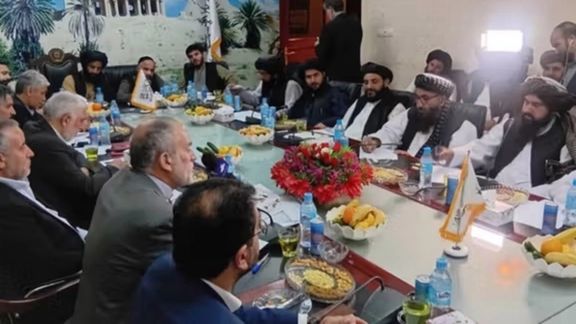
Rasool Mohajer, Iran’s Deputy Foreign Minister, has expressed optimism about deepening economic ties with Afghanistan during a high-level visit to Farah province, following earlier meetings in Herat with senior Taliban officials and local business leaders.

The Iranian Embassy in Kabul confirmed the delegation’s arrival in Farah on Saturday, noting that discussions were held with the provincial governor and representatives from the private sector.

Speaking to reporters, Mohajer described the visit as “highly significant” and emphasised Iran’s commitment to enhancing cooperation between its South Khorasan province and Afghanistan’s Farah province.

“We encourage the private sector in South Khorasan to prepare for expanded cooperation, building on the excellent proposals shared during this visit,” he said. “This will lay a strong foundation for deeper economic and regional ties.”

The Iranian delegation included senior officials such as Mohammadreza Bahrami, Director General for South Asia at the Foreign Ministry, the Deputy Minister of Roads and Urban Development, and the Governor of South Khorasan. In Herat, the delegation toured the Herat Industrial Town, the Khaf-Herat railway project, and Roznak Station, while holding technical and economic discussions with Taliban officials.

During meetings in Farah, the two sides focused on expanding cross-border cooperation in infrastructure, energy transmission, railway connectivity, and trade. According to Bahrami, both parties reached joint decisions to bolster regional integration and economic collaboration.

The Iranian team also inspected an ongoing road construction project linking Farah to the Mahirood border crossing in South Khorasan. Once completed, the road is expected to enhance the capacity of the East-West trade corridor and improve Afghanistan’s access to Iranian and regional markets. Alireza Bikdeli, acting head of Iran’s diplomatic mission in Kabul, announced that the project is scheduled for completion in 2025-2026.

This visit highlights Tehran’s strategy to strengthen engagement with Afghanistan’s border provinces, even as the Taliban government remains unrecognised internationally. As part of this initiative, Iran plans to open a consulate in Farah, while the Taliban are expected to establish a diplomatic presence in Birjand, the capital of South Khorasan.

Bilateral trade between Iran and Taliban-controlled Afghanistan has surged in recent years. Iranian officials report that formal trade volumes have reached nearly $4 billion annually, reflecting a marked increase in economic and political coordination between the two countries.
Most Viewed

Nearly 23,000 Militants Operating In Afghanistan, Says Russian Security Chief
1

Nearly 23,000 Militants Operating In Afghanistan, Says Russian Security Chief

2

Taliban Issue New Family Law Rules On Marriage & Divorce

3

Afghanistan Instability Is A Direct Regional Security Threat, Says Russia

4

UN Funding Should Support Trump Policy Goals, Says US

5

Pakistan Dismisses Taliban Denial Over Bannu Police Attack

•
•
•

More Stories

Taliban Publicly Flog 13 Individuals In Khost & Jowzjan

Apr 13, 2025, 09:30 GMT+1

The Taliban’s Supreme Court has announced that 13 individuals were publicly flogged in the provinces of Khost and Jowzjan following verdicts issued by the group’s primary courts.

In Darzab district of Jowzjan, two women were sentenced to 39 lashes each after being accused of extramarital affairs and fleeing their homes. The court also handed down additional sentences of three years’ imprisonment for both women.

Meanwhile, in Khost province, the Taliban court convicted two men and one woman of engaging in extramarital sexual relations, and a further six men and two women of so-called “illicit relationships.” All received corporal punishment ranging from 35 to 39 lashes.

According to a statement released by the Taliban’s Supreme Court on Saturday, 13 April, the floggings were carried out in public, with local Taliban officials and members of the community in attendance.

The court did not provide any information regarding the judicial process or whether the accused had access to legal counsel. Human rights organisations have repeatedly condemned the Taliban’s use of corporal punishment, citing serious concerns over the absence of due process and fair trial standards under the group’s rule.

Despite ongoing international criticism, the Taliban continue to impose harsh punishments, often in public, as part of their strict interpretation of Islamic law.

Earlier, on Friday, 11 April, the Taliban publicly executed four men in separate locations across Afghanistan. According to the Supreme Court, two were executed in Qala-e-Naw, the capital of Badghis province; one in Zaranj, the capital of Nimruz; and another in the capital of Farah province. These executions, like the floggings, were carried out without transparent legal proceedings, drawing condemnation from global rights groups.

Taliban’s Haqqani Reappears In Kabul, Meets Refugee Minister On Return Plans

Apr 12, 2025, 16:39 GMT+1

Taliban Interior Minister Sirajuddin Haqqani has resurfaced in Kabul after an extended absence, holding a meeting with Abdul Kabir, the group’s Minister of Refugees and Repatriation, to coordinate preparations for the return of Afghan refugees.

According to a statement issued by the Ministry of Refugees on Saturday, the meeting focused on logistical and security planning for the reintegration and relocation of returnees. Kabir reportedly urged Haqqani to deploy security forces in support of the process to ensure safe and orderly returns.

Haqqani’s return to public duties follows at least a two-month absence from his office, with the Taliban’s Ministry of Interior providing no official explanation for his prolonged disappearance. However, reports of internal tensions between Haqqani and Taliban supreme leader Hibatullah Akhundzada have fuelled speculation about his diminished role within the administration.

Kabir stated that preparations for the return and resettlement of refugees have now been finalised across all provinces and at major border crossings, signalling a nationwide effort to manage the influx of returning Afghans.

Retirees Urge Taliban To Pay Pensions Instead Of Funding Pakistani Madrasas

Apr 12, 2025, 14:17 GMT+1

A large group of retired government employees gathered outside the pension office in Kabul on Saturday, once again demanding that the Taliban pay their long-overdue pensions.

One protester criticised the group’s financial priorities, urging the Taliban to stop allocating millions of dollars to religious seminaries in Pakistan and instead focus on fulfilling their domestic obligations.

“For four years, we’ve been passed from one office to another with no real action,” one retiree said in an audio message sent to Afghanistan International. He claimed that a decree issued four months ago by Taliban supreme leader Hibatullah Akhundzada, intended to resolve the pension crisis, has yet to yield any results.

“The poor retirees are dying off. Those who remain have no bread to eat,” he added, highlighting the severe impact of the Taliban’s inaction amid rising living costs and economic hardship.

Retirees also complained about soaring electricity prices, contrasting their financial struggles with reports that the Taliban are donating millions to foreign religious institutions. According to sources close to the Taliban leadership, Akhundzada has directed the group’s finance minister and central bank governor to allocate $9 million to Pakistani madrasas in the new fiscal year’s budget.

The reports come as the Taliban reportedly instruct all ministries to cut staffing levels by 12 per cent due to a budget shortfall, raising further questions about the group’s financial management.

Since seizing control of Kabul in August 2021, the Taliban have suspended monthly pension payments to retired civil servants. In December 2024, Akhundzada issued a directive calling for the creation of special courts to review pension cases and ensure payments in accordance with Sharia and the law.

Four months later, however, the process remains stalled, leaving thousands of retirees in financial limbo.

Taliban Hosts Turkish Clerics In Northern Jowzjan Province

Apr 12, 2025, 13:28 GMT+1

The Taliban-appointed governor’s office in Jowzjan province has announced the arrival of a delegation of Turkish clerics in Sheberghan, aimed at fostering stronger ties between religious scholars from Afghanistan and Turkiye.

In an official statement, the Taliban said the Turkish delegation was taken to visit two prominent places in the region: Abu Sulaimani Jowzjani seminary and Dasht-e Leili. The latter holds deep symbolic significance for the Taliban, as it is believed to be the site of mass graves containing the remains of Taliban fighters killed in the 1990s.

In November 2024, the Taliban revealed plans to fence off the Dasht-e Leili grave site and build a mosque on the grounds, framing the move as a tribute to what they call “martyrs.” The group continues to accuse forces loyal to the National Islamic Movement of Afghanistan, then commanded by Abdul Rashid Dostum—now in exile in Turkiye—of responsibility for the so-called Dasht-e Leili massacre, allegations that Dostum has consistently denied.

The Turkish clerical delegation also met with Gol Haidar Shafaq, the Taliban-appointed governor of Jowzjan, to discuss avenues for enhancing religious cooperation between the two nations.

Governor Shafaq described the visit as a meaningful step toward reinforcing Islamic values and strengthening religious and diplomatic ties between Afghanistan and Turkiye.

CSTO Chief, Tajik President Discuss Strengthening Afghan Border Security

Apr 12, 2025, 11:26 GMT+1

Imangali Tasmagambetov, Secretary-General of the Collective Security Treaty Organisation (CSTO), met with Emomali Rahmon, President of Tajikistan, on Friday, 11 April, in Dushanbe to discuss measures aimed at enhancing border security with Afghanistan.

According to a statement released by the CSTO, the discussions focused in particular on the Targeted Interstate Programme — a joint initiative by CSTO member states designed to strengthen the security of Tajikistan’s southern border. The border with Afghanistan is considered a critical front in regional counterterrorism and stability efforts.

During his visit, Tasmagambetov also held separate talks with Emomali Sobirzoda, Tajikistan’s newly appointed Minister of Defence, to further address security collaboration.

The CSTO Secretary-General had earlier announced that the border reinforcement initiative would begin in 2025 and would consist of specific strategic measures aimed at safeguarding the interests and security of CSTO member countries. The programme is structured in three phases and will be implemented over a five-year period.

In parallel with these high-level talks, joint Russian-Tajik military exercises were conducted near the Afghan border in recent days. The drills, held at a military training ground in Tajikistan, focused on combat readiness and counterterrorism operations in mountainous terrain. The Russian Ministry of Defence reported that the exercise involved the deployment of Orlan-10 drones, tanks, artillery units, and Mi-24 attack helicopters.