Nearly 500 Afghan Migrant Families Returned From Iran, Pakistan, Says Taliban
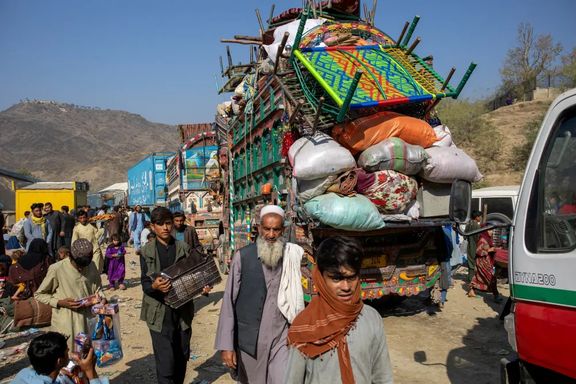
The Taliban-controlled Bakhtar News Agency reported on Monday that 480 Afghan migrant families have returned from Iran and Pakistan within the past 24 hours.

The Taliban-controlled Bakhtar News Agency reported on Monday that 480 Afghan migrant families have returned from Iran and Pakistan within the past 24 hours.
According to the report, the families were repatriated through several key border crossings, including Torkham, Spin Boldak, Angoor Ada, Bahramcha, Pul-e-Abrisham, and Islam Qala.
Both the Islamic Republic of Iran and Pakistan have been detaining and deporting undocumented Afghan migrants for several months, a process that continues despite diplomatic engagements.
Mihyung Park, head of the International Organization for Migration (IOM) in Afghanistan, previously warned that the country is now experiencing a second wave of mass returns from Iran and Pakistan.
In an earlier statement, the Taliban’s Ministry of Foreign Affairs noted that during a meeting between Taliban foreign minister Amir Khan Muttaqi and Iranian President Masoud Pezeshkian, the two sides discussed bilateral relations and the ongoing situation of Afghan migrants. Similar discussions have reportedly taken place with Mohammad Sadiq, Pakistan’s special envoy for Afghanistan.
However, the Taliban’s continued reporting of daily deportations suggests that these diplomatic efforts have had minimal impact on the ongoing expulsions of Afghan nationals by both neighbouring countries.


General Jalaluddin Yaftali, former commander of the 203rd Army Corps, has urged the people of Badakhshan to prepare for what he described as a “historic battle” to expel the Taliban from the province.
The call comes as clashes intensify between Taliban forces and local farmers over the destruction of poppy fields in the province.
Yaftali strongly criticised the Taliban’s “highly ethnocentric leadership” and accused the group of deepening ethnic divisions across Afghanistan. He claimed this discriminatory approach was a key reason for the population to stand up against Taliban rule.
Local sources told Afghanistan International on Sunday that armed confrontations erupted in Farghamanch village, Jurm district of Badakhshan, as Taliban forces attempted to eradicate poppy fields. According to the sources, owners of the fields allegedly supported by local Taliban members engaged in a gunfight with Taliban officials tasked with enforcement.
Although Yaftali did not directly comment on the recent clashes, he denounced the Taliban for widespread ethnic discrimination and accused the group of betraying Islamic principles.
“The Taliban came to power under the pretext of defending religion, but they neither had nor have any connection to the true values of Islam,” he said. “Justice is a pillar of Islam, yet the Taliban have oppressed other ethnic groups and shown no mercy even to free-minded Pashtuns.”
Yaftali also condemned the Taliban for “plundering Badakhshan’s mines,” illegal land seizures, and sidelining local professionals in provincial administration.
“All of their actions are aimed at creating deep ethnic divisions, which will have disastrous long-term consequences for the people of Afghanistan,” he warned.
The Taliban have officially banned poppy cultivation across Afghanistan, but enforcement has led to repeated violent incidents especially in Badakhshan, where resistance from farmers has been particularly fierce. In contrast, poppy cultivation reportedly continues with less interference in provinces such as Helmand.
Badakhshan holds strategic importance for the Taliban, not only as one of the few northern provinces where the group maintains a substantial presence, but also as the home province of Qari Fasihuddin, the Taliban’s Chief of Army Staff. Its rich mining resources are also critical to the Taliban’s efforts to reduce reliance on foreign aid through resource extraction.
Addressing former members of the Afghan security forces, Yaftali called on them to prepare for resistance. He also issued an appeal to Badakhshani Taliban members, urging them to surrender and promising no retribution if they abandon the “tyrannical regime of the Taliban.”
“Do not remain as human shields,” he said, calling on local fighters to reject the leadership’s divisive agenda.

Karim Khurram, former chief of staff to President Hamid Karzai, warned on Sunday that Afghanistan risks becoming the latest arena for global power rivalry unless it forges national consensus and rebuilds legitimate institutions.
Posting on X, Khurram likened the country’s current impasse to a “time bomb” ready to explode.
“The 21st century is the century of US-China rivalry, just as the 20th century saw US-Soviet competition, and the 19th century witnessed British-Russian contest,” he wrote on 25 May. He argued that China now stands as America’s principal challenger and that successive US administrations from Obama through Trump to Biden have pursued a consistent strategic stance towards Beijing, differing only in tone.
Khurram recalled President Obama’s observation that the US-China relationship would define the century. He said that Afghanistan, buffeted by great-power conflicts in previous centuries, again faces a similar fate owing to its strategic location and that Afghans have historically been pawns, not players, in those rivalries.
He contended that if Afghanistan had maintained active international engagement and preserved its legitimacy, it might have leveraged today’s global competition to its advantage. Instead, suspension from global institutions and severe domestic disunity have left the country vulnerable.
Khurram cautioned that growing isolation among citizens threatens to detonate the “time bomb” he described. He identified the nation’s lack of scientific capacity, economic weakness and absence of a credible defence as critical barriers preventing Afghanistan from asserting itself in 21st-century geopolitics.

The United Nations Office for the Coordination of Humanitarian Affairs (OCHA) has warned that humanitarian operations in Afghanistan remain severely hampered by Taliban interference, particularly affecting women aid workers and beneficiaries.
In its April report, released on Sunday, 25 May, OCHA recorded 60 access-related incidents across central, southern and western regions, an 11 percent increase over March. Eighteen percent of these incidents involved gender-based restrictions.
The obstacles documented included direct meddling in operational planning, diversion of aid, delays in document approval, interference in logistics and recruitment, and explicit curbs on women’s participation. As a result, 35 humanitarian activities were temporarily suspended during the month.
OCHA noted that 73 percent of all the 44 cases of access incidents were attributable to Taliban authorities. Violence against aid personnel also rose, with seven arrests, 29 threats or verbal assaults, and four outright movement bans. Restrictions on women’s roles in aid delivery jumped by 38 percent compared to March.
The Taliban have further demanded sensitive data, including beneficiary lists, undermining humanitarian neutrality. OCHA continues to publish monthly updates detailing these challenges, underscoring the urgent need for unfettered access to protect vulnerable populations.

The United Nations World Food Programme (WFP) has appealed for $555 million to support Afghanistan’s most vulnerable families through August.
The UN agency warned that nearly four years after the Taliban’s return to power the country’s economy is collapsing and hunger now threatens one-third of the population.
In a statement issued on Sunday, 25 May, the WFP said it faces a funding shortfall that limits its ability to reach only six million people, leaving more than eight million Afghans without life-saving assistance.
The agency highlighted that two thirds of female-headed households struggle to meet basic nutritional needs, a situation exacerbated by Taliban-imposed restrictions on women’s education and public participation.
“The climate crisis has further damaged farmland and homes across many regions,” the WFP noted, stressing that sudden floods and severe droughts now put millions more livelihoods at risk.
Without the requested funds, the WFP warned, millions of Afghans will go without adequate food, deepening the humanitarian emergency in a nation already beset by conflict and economic hardship.

The Taliban has dismissed the Organisation of Turkic States’ plea for an inclusive Afghan government as an internal affair.
Spokesperson Zabihullah Mujahid said on Saturday that “the wishes and suggestions of our people will be taken into consideration,” but insisted that Afghans alone must resolve domestic issues.
In their 21 May statement, the OTS leaders representing Azerbaijan, Kazakhstan, Kyrgyzstan, Türkiye and Uzbekistan had urged Kabul to form a government reflecting Afghanistan’s ethnic diversity and to strengthen coordination against terrorism. They described the country’s Turkic communities as a “unique bridge” to the wider Turkic world.
Mujahid did not address inclusivity directly, instead calling on other nations to fulfil their responsibilities through economic support. He reaffirmed the Taliban’s desire for strong diplomatic and trade ties with Turkic-speaking states and stated that Afghan territory would not be used to threaten any country.
Despite repeated international appeals from the UN, regional powers and Western governments, the Taliban have so far appointed an all-male administration drawn exclusively from their own ranks, ignoring demands for broader representation.