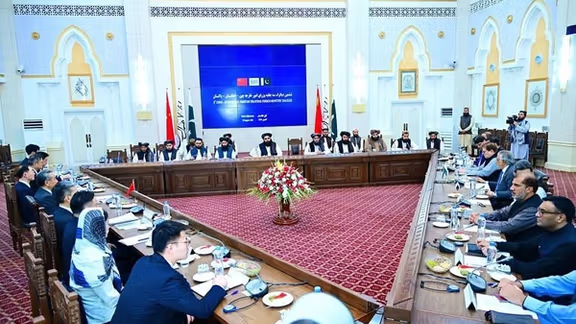
China, Pak & Taliban Pledge Joint Fight Against Militants In Kabul Talks

China, Pakistan and Afghanistan’s Taliban government have pledged to step up joint efforts against militant groups during high-level talks in Kabul, officials said Wednesday.

China, Pakistan and Afghanistan’s Taliban government have pledged to step up joint efforts against militant groups during high-level talks in Kabul, officials said Wednesday.
Mohammad Sadiq, Pakistan’s special envoy for Afghanistan, announced that the foreign ministers of the three sides agreed to cooperate against Tehreek-e-Taliban Pakistan (TTP), Baloch separatists and China’s Uyghur militant groups. All three factions are believed to have ties with the Afghan Taliban, though the group denies their presence inside Afghanistan.
Sadiq said the trilateral meeting focused on strengthening security, economic and political cooperation. Taliban officials confirmed the ministers discussed bilateral relations and common threats.
The ministers also emphasised closer collaboration in trade, transit, regional development, health, education, culture and counter-narcotics. They voiced support for extending the China–Pakistan Economic Corridor (CPEC) into Afghanistan.
Chinese Foreign Minister Wang Yi said Beijing sought to deepen trust with Afghanistan and expand cooperation in trade and agriculture. He urged the Taliban to take stronger action against militant groups, stressing that security was essential for economic initiatives to succeed.
According to the Taliban foreign ministry, Wang also said China would take “practical steps” this year to begin developing Afghanistan’s mining sector.
Taliban’s pledge against their own allies
Pakistan’s envoy said the three sides committed “to strengthen joint efforts against terrorist organisations including TTP, BLA, ETIM and other regional and international terrorist outfits.”
Islamabad has long voiced concerns over the presence of TTP militants in Afghanistan and accused the Taliban of sheltering its opponents. Following a deadly attack on the Jaffar Express train in Balochistan, Pakistan accused the Taliban of colluding with India to support Baloch separatists, who claimed responsibility.
China, meanwhile, has pressed the Taliban to address Beijing’s security concerns, particularly regarding the East Turkestan Islamic Movement (ETIM).
The Taliban maintain, however, that Afghan soil poses no threat to any country.

Taliban leader Hibatullah Akhundzada has reportedly told cabinet members that women should be barred not only from modern education but also from attending religious schools, sources told Afghanistan International.
Two Taliban ministers said Akhundzada made the remarks at a cabinet meeting two weeks ago, arguing that women’s attendance at religious schools had “no religious legitimacy.” He cited the era of Islam’s third caliph, when women were barred from going to mosques, as precedent.
Another minister confirmed the comments, saying Akhundzada’s stance has disheartened many in the cabinet. A source in Kandahar said none of the ministers present dared to oppose the supreme leader’s view.
“Until today, no cabinet member has had the courage to present reasons or arguments against the Sheikh’s opinion,” the source said.
The reported remarks have fuelled frustration and quiet dissent among senior Taliban officials. Two ministers told Afghanistan International that many had expected schools to reopen for girls this year, but Akhundzada now considers even religious education for women impermissible.
“This position is in clear contradiction with Quranic verses and the Prophet’s sayings. Religious education is obligatory for all Muslims, both men and women,” one minister said.
A Taliban official warned that if the restrictions continue, Afghanistan risks sliding back into conflict. “If the situation goes on like this, Afghanistan will once again become a battleground of warlords, and the religious and historical responsibility will lie on Hibatullah’s shoulders,” the official said.
The Taliban have already barred women and girls from secondary schools, universities and private education centres. Observers say extending the prohibition to religious schooling could trigger a new wave of domestic and international backlash against the group.

Chinese Foreign Minister Wang Yi, in a meeting with Taliban Prime Minister Mullah Hassan Akhund, expressed hope that the group would “understand and pay special attention” to Beijing’s security concerns.
According to the Taliban, Wang assured the group of China’s readiness to cooperate on both economic and security matters.
The Taliban’s office said Wang stressed that Beijing had been “sincere and steadfast” in its friendship with Afghanistan and remained prepared to strengthen ties in key areas. He added that enhanced security cooperation would pave the way for Afghanistan’s progress.
“We have a shared future and want Asian countries, especially Afghanistan, to take steps towards modernisation,” Wang was quoted as saying. Referring to historic ties, he described China and Afghanistan as “good friends.”
The senior Chinese diplomat also said Beijing respected Afghanistan’s independence and the choices of its people, adding that he believed Afghans had chosen the right path. He noted he was the only foreign minister from a permanent member of the UN Security Council to have visited Afghanistan twice under Taliban rule, calling this a sign of “friendship and sincerity.”
In response, Mullah Hassan Akhund sought to reassure China, saying: “Tell the president of China that no security threat will arise from Afghan soil towards China or any other country.” He pledged the Taliban would not allow Afghanistan to be used as a base to harm others.
The Taliban prime minister also thanked Beijing for its “positive positions, support and cooperation” in international forums, adding that China had consistently played a constructive role in global development. He called on Beijing to continue its efforts to support the Taliban’s position within the international community.
Wang Yi’s meeting with Mullah Hassan Akhund took place during his visit to Kabul for a trilateral summit with Taliban and Pakistani officials. The Taliban Foreign Ministry earlier said the gathering would focus on strengthening political, economic and regional cooperation.

The Taliban said Wednesday that its foreign minister, Amir Khan Muttaqi, has proposed creating a joint technical commission with China to expand economic cooperation.
Muttaqi made the request during talks in Kabul with Chinese Foreign Minister Wang Yi, held on the sidelines of a trilateral summit with Pakistan.
The Taliban Foreign Ministry said the meeting covered transit cooperation, banking ties, and efforts to balance trade. Muttaqi described China as a “good commercial partner” and expressed hope that trade between the two countries would grow significantly in the near future. He also assured that Afghan soil would not be used against neighbouring states.
According to the Taliban, Wang Yi said Beijing views relations with Afghanistan as developing and highlighted the importance of expanding cooperation in multiple sectors. He added that China is working with Taliban authorities to boost exports, remove barriers to Afghan agricultural products, and integrate Afghanistan into regional transit projects.
The Taliban statement said Wang pledged Chinese support for Afghanistan’s economy and promised practical steps this year on mining projects, including surveying and extraction of mineral resources.
The trilateral talks in Kabul also brought together Pakistan’s foreign minister, Ishaq Dar, who separately met Muttaqi to discuss bilateral issues. A Taliban spokesperson earlier said the three-way meeting would focus on strengthening political, economic, and regional cooperation.

Civil organisations representing Afghanistan’s Turkic communities say the Taliban have demolished the statue of renowned poet and scholar Alisher Navai in Mazar-e-Sharif.
They condemned the act as part of what they described as the Taliban’s ongoing “anti-cultural and identity-erasing” agenda.
In a joint statement issued Wednesday, 20 organisations said the demolition was “a blatant attack on the collective memory of the people and a part of Afghanistan’s shared identity.” They warned that the destruction of cultural symbols and historical heritage was harming the country’s history and diversity.
The groups urged UNESCO, international cultural institutions, and human rights defenders to take urgent steps to protect Afghanistan’s heritage.
Alisher Navai, a prominent poet, scholar and politician of the Timurid era, had been commemorated with the statue about 17 years ago by the municipality of Mazar-e-Sharif.
Reports of partial damage to the statue had surfaced earlier, but local activists said it has now been destroyed completely. Taliban officials have not commented.
The demolition has sparked strong reactions on social media. Abdulhanan Arslan, an Uzbek literature professor at Kabul University, described the act as “unfair” and called for transparency.
Over the past four years, the Taliban have repeatedly removed monuments and images of mujahideen leaders and other urban symbols across the country.

Coinciding with the fourth anniversary of the Taliban’s return to power, the Afghanistan War Commission in the US Congress released its second report on the United States’ 20-year war in Afghanistan.
US officials emphasised that the roots of failure in the war lay in strategic weaknesses rather than tactical shortcomings.
The Afghanistan War Commission is an independent body established by the US Congress in 2021.
Dependency of Afghan Institutions
According to the report, despite US policy promoting the independence of Afghan institutions, they remained overly dependent. This outcome contradicted Washington’s stated plan. The Commission noted that US financial, technical, and security assistance was delivered through mechanisms that, whether intentionally or not, fostered dependency within Afghan institutions. Yet, US policy had identified Afghan self-reliance as a key condition for ending the war.
The report added that capacity-building methods, often relying on parallel delivery systems led by contractors, US agencies, and military units, sidestepped Afghan officials. This approach may have weakened Afghanistan’s sovereignty and contributed to lasting institutional fragility.
The Commission is examining how, with the beginning of the US troop withdrawal, this institutional dependency affected the situation. According to the report, the same reliance was evident in Afghanistan’s security institutions, which depended on external support systems and lacked the ability to operate independently.
As peace talks in Doha began, the US gradually reduced support to Afghan security forces, undermining their ability to confront the Taliban.
The Late Start of Peace Talks
The report also addressed the failure of peace negotiations. Talks with the Taliban, it said, began far too late, only after the US had already minimised its troop presence. By then, Washington no longer had the leverage needed to pressure the Taliban.
The report recalled that in the early years of the war, the US viewed the Taliban and al-Qaeda as inseparable. It pointed to missed opportunities to engage the Taliban after their removal from power.
Overall, US policy in Afghanistan was described as ambiguous: the US initially invaded to fight terrorism and destroy al-Qaeda but soon shifted to state-building. At first, Afghans welcomed US involvement, but over time dissatisfaction grew.
Pakistan’s Double Standard
Citing former Afghan and US officials, the report highlighted Pakistan’s double standard. While Islamabad cooperated by opening transit routes for US forces and suppressing al-Qaeda, it consistently denied the existence of Taliban sanctuaries on its soil throughout the 20-year US presence. This undercut counterterrorism efforts and thwarted international objectives in Afghanistan.
The Commission referenced President Joe Biden’s justification for the US withdrawal, questioning: if the US could ensure its security without a military presence in Afghanistan and prevent another 9/11-style attack, why did it support the Afghan government for two decades?
According to the report, the decision to withdraw eroded Afghan forces’ confidence, emboldened the Taliban, and, with Ashraf Ghani’s flight, allowed the Taliban to seize Kabul without firing a shot.
After deciding to withdraw fully, Biden stated that the threat from Afghan soil had been neutralised, arguing that the US could pre-empt threats without maintaining troops in the country.
Afghan and US Perspectives
The Commission interviewed dozens of former Afghan and US officials. Afghans told the Commission that in the early years, the international presence created hope for training and progress, but this optimism later faded. They believe the US avoided key steps to sustain the Afghan state, especially by failing to pressure Pakistan, which used the Taliban as a proxy force.
They added that after 9/11, US policy viewed Afghanistan as an “ungoverned space” and overlooked existing local governance structures, such as community councils, in favour of a centralised model. Early Afghan optimism was replaced with the perception of “America’s war,” as dependency deepened. Deeper issues, such as national identity, political Islam, and governance models, were never meaningfully addressed. Reforms often catered more to international optics than Afghan needs, ignoring local experiences, especially in areas like women’s rights.
Conflicting Priorities
According to the report, military priorities often clashed with the missions of USAID and the State Department, undermining a whole-of-government approach. Within the Department of Defense and among allies, the lack of a unified command structure, unclear end goals, and contradictory missions, ranging from counterinsurgency to counterterrorism, allowed regional commanders to shape priorities more than any coherent top-down strategy.
Political Division and Fragility
The report also addressed corruption, political disunity, and public discontent. The 2014 presidential election sowed division and doubts about the legitimacy of the future government, prompting significant US diplomatic intervention.
Highlighting the ambiguity of US policy, the report noted that while the United States reduced both its military and civilian presence, it simultaneously signed agreements pledging long-term support to Afghanistan. Some US civilian and military officials said that in the United States the mission in Afghanistan was either never fully understood or forgotten.
Systemic Corruption
The report stated that corruption and impunity became defining features of the post-Taliban government, fuelling widespread public discontent. Civilian casualties from US night raids and airstrikes further inflamed anger.
For two decades, Afghanistan ranked among the most corrupt countries in the world.
Douglas Lute, a former US official, said: “I believe the roots of our failure in Afghanistan lay at the strategic level, not at the tactical level where our troops, intelligence officers, diplomats, and development officers on the ground sacrificed in the toughest conditions.”
David Sedney, former Deputy Assistant Secretary of Defense for Afghanistan, Pakistan, and Central Asia, said: “We sought an Afghanistan that would not be a home for terror, one where Americans and our allies would be safer, and in which the Afghan people would have the future they deserved.
He added: “For why we failed there is no simple, easily identifiable answer. There is no single villain. There is no one policy error, which, if gotten right, would have led to success.”
Terror Groups Regrouping
Four years after the US withdrawal, according to independent international organisations, Afghanistan has once again become a safe haven for terrorist groups. Recently, UN experts warned that ISIS-Khorasan poses a serious threat to the US and Europe. Al-Qaeda, the Taliban’s ally and the original cause of America’s 20-year war in Afghanistan, is attempting to regroup and revive itself.