Taliban Flog Three Women, Four Men In Afghanistan’s Badakhshan Province

The Taliban said Sunday they flogged three women and four men in Badakhshan province after convicting them of having extramarital relations.

The Taliban said Sunday they flogged three women and four men in Badakhshan province after convicting them of having extramarital relations.
The group’s court announced the defendants were each sentenced to between one and two and a half years in prison and 39 lashes. The punishments, it said, were issued by a primary court in Badakhshan and approved by the Taliban’s Supreme Court before being carried out on Sunday.
According to the statement, the floggings took place in the presence of local Taliban officials.
The Taliban consider corporal punishment part of enforcing Islamic Sharia law. In the past week alone, nearly 20 men and women across Afghanistan have been flogged on various charges.
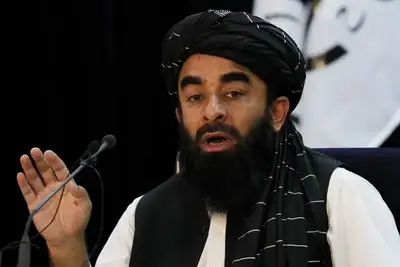

The Taliban said Monday that at least 622 people were killed and more than 1,500 injured after a 6.0-magnitude earthquake struck the eastern provinces of Kunar and Nangarhar overnight.
Abdul Mateen Qani, spokesperson for the Taliban’s Interior Ministry, said 610 people died in Kunar and 12 in Nangarhar. He reported 1,300 injuries in Kunar and 255 in Nangarhar.
The US Geological Survey said the quake hit southeastern Afghanistan early Monday, followed by two aftershocks. The first registered 4.5 magnitude and the second 5.2, both centred in Nangarhar province.
Earthquakes are common in Afghanistan, where poor infrastructure and weak emergency response systems often lead to high casualty figures.

A former CIA officer has posted photos of Taliban officials’ wives from diplomatic passports, launching a campaign to protest the group’s restrictions on women’s photographs in Afghanistan.
Sarah Adams, who served with the US intelligence agency, said the campaign called “Taliban Housewives” was a response to the Taliban’s new ruling on women’s images in national identity documents. She argued that if Afghan women are denied photos in official records, Taliban wives should not have theirs in passports or marriage certificates.
Earlier this week, reports suggested Taliban leader Hibatullah Akhundzada had issued an oral decree banning photos of women in identity and official documents.
Adams published images of wives of Taliban diplomats posted in Russia, Iran, Kazakhstan and Quetta, Pakistan. She criticised governments for allowing the Taliban to run official missions abroad while Afghan women remain confined at home.
“These women are not innocent bystanders,” she wrote, stressing they travel freely with their husbands while Afghan women are stripped of basic rights. Adams said she would continue releasing photos until the Taliban reversed its restrictions.
On Thursday, the Taliban’s Dar al-Ifta, its religious authority, ruled that including women’s photos in identity cards would be optional. It said photos were mandatory only for Afghan women living abroad, while for those inside Afghanistan the practice was “contrary to Sharia.”
The Taliban-run National Statistics and Information Authority had earlier insisted photos were essential for verifying identity, preventing fraud and meeting international standards. Its proposal to make photos compulsory was reportedly rejected by the Taliban’s leadership.

The United Nations Security Council will hold a meeting on Afghanistan in September, where Roza Otunbayeva, the UN secretary-general’s special representative, is expected to deliver her final report before the end of her mandate.
A civil society representative and the UN human rights commissioner are also scheduled to brief the Council.
The Council said Afghanistan’s human rights situation remains dire, particularly for women and girls. It cited UNAMA’s most recent report, which documented cases of arbitrary arrests of women and highlighted systematic abuses by the Taliban.
Independent UN experts on 14 August urged the international community to reject the Taliban’s authoritarian rule and resist efforts to normalise its regime. Richard Bennett, the UN special rapporteur for human rights situation in Afghanistan, said the Taliban have used the justice system to suppress women, girls and LGBTQ+ people.
The Council noted that the International Criminal Court has issued arrest warrants for Taliban leader Hibatullah Akhundzada and Abdul Hakim Haqqani, the group’s chief justice, on charges of crimes against humanity for gender-based persecution. UN Women has also warned that Afghan women are on the verge of being completely erased from public life.
The humanitarian crisis remains severe. The Council said 22.9 million Afghans, more than half the population, are expected to need aid this year, while 12.6 million faced crisis or emergency levels of food insecurity between March and April. It added that deportations from Iran and Pakistan have worsened conditions, with the International Organization for Migration reporting more than 1.5 million returns so far in 2025.
The Council also noted the Taliban’s efforts to end isolation, citing Russia’s recognition of the group and a recent trilateral meeting in Kabul with the foreign ministers of China and Pakistan. It stressed that UNAMA and participants in the Doha process are working on a roadmap for political engagement with the Taliban, though members warned that the group’s refusal to meet international commitments, especially on women’s rights, remains a central obstacle.
The Council reiterated concern about terrorism threats from Afghanistan. While all members voiced support for a peaceful, inclusive Afghanistan free of terrorism, the United States, Britain and France maintained that the Taliban must comply with international norms before gaining legitimacy or development assistance.

The Taliban have ruled that photos of women on national identity cards will be optional, a decision that has drawn sharp criticism from women’s rights activists who say it strips Afghan women of basic recognition and equality.
In a decree issued by the group’s Dar al-Ifta, the Taliban’s religious authority, officials said photos would be mandatory only for Afghan women living abroad or travelling overseas for medical care. For women inside Afghanistan, the body declared that attaching photos to ID cards was “contrary to Sharia.”
The decision overrides earlier plans by the Taliban-run National Statistics and Information Authority, which had sought to make photos compulsory to verify identity, prevent fraud, ease travel and comply with international standards. The agency had set out 11 justifications for photos, but religious scholars dismissed 10 of them as “un-Islamic.”
Dar al-Ifta said for legal matters it was sufficient to include a woman’s name along with the names of her father and grandfather, as well as her address. It argued that international travel already required passports and visas, making ID cards unnecessary for that purpose.
“Placing a photo without a Sharia need is not permitted, whether full-length or just the face,” the decree stated. Women, however, may still choose to include their photo voluntarily.
The ruling triggered strong criticism from rights groups. On social media, users urged the international community not to remain silent. Activists said the Taliban’s decision represents another rollback of women’s rights, four years after the group barred girls from secondary schools and universities.
Protesting women have demanded that identity documents be issued without gender-based restrictions or discrimination.

Taliban leader Hibatullah Akhundzada has approved a law banning poets from criticising his decrees or writing love poetry, further tightening restrictions on free expression in Afghanistan.
The Ministry of Justice said Saturday the new legislation, published in the official gazette, sets out 13 articles regulating poetry gatherings. The law prohibits any criticism of Akhundzada’s orders and decisions and bars verses praising “boys and girls” or encouraging friendship between them. It also demands poetry be free of “worldly love, improper desires and inappropriate emotions.”
The Ministry of Information and Culture will enforce the law, with oversight committees to be established in Kabul and provincial centres. Each committee will include representatives from the ministry, the Taliban’s virtue and vice authority and the Ulema Council. They will be tasked with vetting poetry and speeches for compliance.
Violators, including poets, speakers and organisers, will face punishment “in accordance with Sharia,” the ministry said.
The law also declares feminism, communism, democracy and nationalism as “un-Islamic” and bans poets from referring to them. In its preamble, it instructs poets to use their work to defend Islam and interpret Sharia law. All provisions are addressed to “brother poets,” effectively excluding women.
The move follows earlier restrictions on literary gatherings. In June, Akhundzada issued directives on poetry events after the Taliban cancelled festivals in Parwan and Nangarhar provinces and arrested poets accused of writing critical verses.
Human rights groups say the new rules mark a return to the Taliban’s hard-line cultural policies of the 1990s and are part of broader efforts to curb civil liberties, silence critics and impose the group’s interpretation of Islam on Afghan society.