Earthquake Death Toll In Kunar Tops 1400, Say Taliban
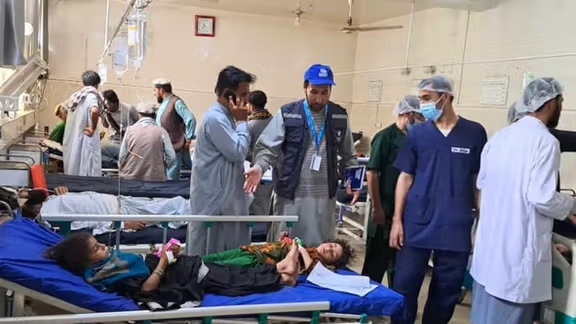
The Taliban said Tuesday that the death toll from the earthquake in Kunar province has risen to 1,411, with more than 3,000 others injured and over 5,000 homes destroyed.
The Taliban said Tuesday that the death toll from the earthquake in Kunar province has risen to 1,411, with more than 3,000 others injured and over 5,000 homes destroyed.
Taliban spokesperson Zabihullah Mujahid wrote on X that the fatalities were reported in the districts of Nurgal, Suki, Chapa Dara, Pech Dara and Asadabad.
Hamdullah Fitrat, deputy Taliban spokesperson, said rescue operations are continuing across all quake-hit areas. “In areas where aircraft could not land, dozens of commando forces were airlifted in to pull the wounded from under the rubble and move them to safe locations,” he said.
Fitrat added that special camps have been set up in several districts of Kunar to provide emergency assistance to survivors. He said two centres near the disaster site are also coordinating the transfer of the wounded, the burial of victims and the rescue of those still trapped.

At least six pregnant women have died in Kunar province since the recent earthquake due to a shortage of female health workers and limited medical facilities, local sources told Afghanistan International.
The sources said that despite broad promises of assistance, initial aid particularly medical support has yet to reach quake-hit areas, leaving residents in dire need.
They added that people in villages and affected parts of Chawkay district are facing a severe shortage of drinking water that requires urgent attention.
Although some rescue teams are working in the area, the widespread destruction and a lack of personnel mean many bodies and injured people remain trapped under the rubble, the sources said.
Hours after the deadly earthquake struck eastern Afghanistan on Sunday evening, a Taliban Foreign Ministry spokesman admitted in an interview with Reuters that no government has yet expressed readiness to send rescue and relief teams.
As casualties mounted, particularly in Kunar, which bore the brunt of the disaster, the United Arab Emirates announced late Monday that it had dispatched a search-and-rescue team along with relief aid to eastern Afghanistan.
Russia, which maintains close ties with the Taliban, said it is considering the group’s request for assistance to quake victims.
Search-and-rescue teams are essential to reduce casualties and save people who are drawing their last breaths under the rubble of their collapsed mud houses while waiting for rescuers.
In videos released from the districts of Nurgal, Watapur and Chapa Dara in Kunar, people can be seen trying to pull out relatives and neighbours from under the rubble using shovels, hand tools and even pieces of wood, with no sign of international rescue teams.
The United Nations has warned that casualties in quake-affected areas could rise in the coming hours. The Taliban government must persuade countries with close ties to them to send their rescue teams. However, those countries have so far limited their response to messages of condolence and the delivery of relief supplies.
It appears that some of the earthquake victims will fall prey to the Taliban’s strained and hostile relations with the world.
Solidarity, but Not With the Taliban
Major earthquakes in other countries often spark waves of solidarity and practical aid from both near and far, from allies and adversaries alike. In Pakistan’s devastating 2005 quake, which killed 19,000 people, India extended a hand of help to its bitter foe. However, Pervez Musharraf, Pakistan’s military ruler, declined the offer due to political sensitivities, despite thanking India.
This time, India has limited its response to sending relief supplies and has left the Taliban to manage the massive rescue operation in eastern Afghanistan on their own.
In the powerful 2023 earthquake in Türkiye, a wide wave of international assistance was launched. In the very first hours, Azerbaijan, India and Pakistan sent their rescue forces to Türkiye. The United States later joined with more than 200 specialists and sniffer dogs. France, Britain and Italy dispatched rescue teams and medical equipment. Other countries, including Russia, China, Malaysia and the United Arab Emirates, also had a physical presence on the ground and assisted in searching for survivors under the rubble.
In other earthquakes too, the physical presence of foreign teams has been an inseparable part of operations. In Nepal’s 2015 quake, dozens of countries, including India, China and the United States, sent forces and equipment. In Pakistan and Iran, international teams have also intervened repeatedly, and in Haiti’s 2010 earthquake, more than 20,000 foreign troops were deployed.
Global Response to the Afghanistan Quake
International reaction to the eastern Afghanistan earthquake has so far been mostly limited to statements and small amounts of aid.
China’s Foreign Ministry spokesperson said Beijing was ready to help “based on Afghanistan’s needs and within its capacity.” India announced it had delivered 1,000 tents to Kabul and sent 15 tonnes of food to Kunar, promising more aid to follow.
In the United States, the State Department reacted only by posting a condolence message on the social media platform X, without any mention of aid. Notably, all messages expressed solidarity with the people of Afghanistan but made no reference to a government called the Taliban or, as they call themselves, the “Islamic Emirate.”
United Nations Secretary-General António Guterres said the UN offices in Afghanistan were ready to help victims and had allocated $5 million to relief operations in eastern Afghanistan.
The UN and its partner agencies are expected to launch an emergency appeal for Afghanistan’s quake victims. This comes at a time when aid agencies are facing budget shortfalls. Humanitarian assistance for Afghanistan this year has dropped to $767 million, compared with $3.8 billion in 2022.
Frustration among donor countries with the Taliban’s human rights abuses is one of the main reasons for the world’s reduced attention to Afghanistan. The Taliban have officially banned female staff from working in international humanitarian organisations. In recent months, even female UN employees have been threatened with death.
The Taliban, however, insist that international aid should not be tied to human rights conditions in Afghanistan. The group’s foreign minister has described this international stance, particularly from Western countries, as “mixing politics with humanitarian aid.”
Cuts in aid have made relief efforts in eastern Afghanistan more difficult.
In the Vatican, Pope Leo XIV sent a condolence message to the people of Afghanistan and prayed for the victims.
This is not the first time an Afghan earthquake has struck under such conditions. In 2022, a 6.1-magnitude quake in Paktika killed more than 1,000 people, with international aid at the time also very limited.
When an earthquake hit Herat on 7 October 2023, killing more than 1,400 people, the situation was no better. Only a team from the Iranian Red Crescent, with search-and-rescue equipment, crossed the border to the quake site.
The Herat quake occurred on the same day Hamas launched its attack on Israel, which led to the Gaza war. Analysts said the global focus on that event overshadowed attention to quake victims in Herat.
What Are the Obstacles?
In December 2021, the UN Security Council passed Resolution 2615, stating that the delivery of humanitarian aid to Afghanistan does not violate sanctions. A year later, in December 2022, the council adopted Resolution 2664, creating permanent exemptions for humanitarian aid under all sanction regimes to ensure life-saving assistance is not blocked.
Thus, there is no legal barrier to any country’s participation in relief efforts for eastern Afghanistan. Yet, beyond this, many countries have avoided even minimal engagement with the Taliban due to their widespread human rights abuses and lack of change in behaviour. The absence of diplomatic ties, in itself, complicates the dispatch of relief teams to Taliban-controlled Afghanistan.
According to international disaster response law guidelines adopted in 2007 by the International Federation of Red Cross and Red Crescent Societies, the entry of search-and-rescue teams requires specific mechanisms: immediate visa issuance, customs exemptions and hosting structures within the very first hours.
In addition, several countries classify the Taliban as a terrorist group and, under their domestic laws, cannot channel aid through the Taliban government.
While the lack of international recognition of the Taliban does not in itself block relief, it appears to slow and weaken administrative and coordination processes, creating obstacles to deploying international rescue teams.
The International Federation of Red Cross has emphasised in its recommendations that countries must have clear laws and procedures for accepting foreign aid, something that, under Taliban rule, does not currently exist.
Meanwhile, Taliban domestic policies have had a direct impact on relief efforts. Since December 2022, the group has banned women from working in NGOs and international organisations, a move that has disrupted or halted many aid programmes.
According to UN Security Council Resolution 1325 on Women, Peace and Security, the active and equal participation of women at all levels of crisis response and post-disaster management is essential. The resolution makes clear that rescue and relief operations are not limited to men, and women’s presence is vital in areas such as needs assessments and assisting vulnerable families.
The UN Office for the Coordination of Humanitarian Affairs (OCHA) has also stressed that restrictions on women’s participation are a serious obstacle to aid delivery. It seems that many international teams and even governments are reluctant to send relief missions without female staff.
At the same time, many countries and international organisations are concerned about the safety of their teams in Afghanistan. Attacks by Islamic State Khorasan, lack of security guarantees, and the absence of insurance and logistical support in Afghanistan make the deployment of international teams high-risk.
What Have the Taliban Done?
Domestically, with no international forces present, the Taliban have often had to respond with limited resources. The group’s prime minister has formed a special committee, allocating 100 million Afghanis for relief efforts, with more funds promised if necessary.
The Taliban’s ministries of interior, defence and public health, along with provincial governors and disaster management offices, were involved from the first day in evacuating the wounded and recovering bodies. More than 40 flights have been carried out from Nangarhar airport, transferring hundreds of people to hospitals.
The Taliban’s Defence Ministry said its rescue teams and military aircraft have been active in quake-hit areas. It reported 83 helicopter flights so far, transferring more than 1,000 wounded.
Other reports indicate that the Defence Ministry, in addition to dispatching rescue teams, has sent several doctors and around 800 kilograms of medical supplies on special flights to Kunar province.
The Taliban have strained relations with the media, often punishing outlets for critical reporting. Journalists’ limited access to quake-hit areas has meant there is little clear information on Taliban rescue operations. The images released by the Taliban have mostly focused on the use of helicopters to transfer the wounded and affected people.
The group has yet to release any images of its rescue teams and their equipment, nor has it provided public reports on relief centres or assistance procedures for quake victims.
The World Health Organization said a deadly earthquake in eastern Afghanistan has directly affected more than 12,000 people and warned of rising health risks, including a high threat of disease outbreaks.
The quake struck the provinces of Kunar, Nangarhar and Laghman, damaging or blocking major highways, including sections of the Jalalabad–Kunar road and access routes to the districts of Nurgal and Sawkay, the agency said.
The WHO reported that about 800 people have been hospitalised in three facilities, with at least 240 in critical condition. It also warned of widespread trauma and severe psychological stress, urging immediate mental health support for survivors.
As part of its response, the organisation has delivered more than 23 tonnes of medicines and medical supplies to quake-hit areas. Three mobile health teams are also operating on the ground, it said.
The WHO cited blocked roads, continuing aftershocks and the remoteness of affected communities as major obstacles to aid delivery. It appealed for urgent and significant funding to expand relief operations and meet survivors’ immediate needs.
The Taliban announced a sweeping reshuffle of senior officials on Monday, with 10 appointments made on the orders of the group’s leader, Hibatullah Akhundzada.
Khairullah Khairkhwa was removed as minister of information and culture and appointed governor of Maidan Wardak province. He was replaced by Mawlawi Ahmad Haqqani, the former governor of Laghman, Taliban spokesman Zabihullah Mujahid said.
Qari Mohammad Bakhtiar Muaz, who previously served as governor of Maidan Wardak, was moved to Laghman, while Mullah Mohammad Hafez Mujahid, former deputy commander of the Central Army Corps 313, was named governor of Farah. Mawlawi Ghausuddin Rahbar, the former governor of Farah, was reassigned as deputy commander of the same corps.
Other appointments included Qari Mohammad Nasim Ezzat, a former brigade commander in the 205th Al-Badr Corps, as deputy governor of Jowzjan; Shir Ali Jundallah, a former Kabul security official, as Taliban police chief in Paktia; and Mullah Abdul Shakur Baryali, another former brigade commander, as head of the 2nd Infantry Brigade of the 205th Al-Badr Corps.
Mawlawi Nooruddin, a former Taliban deputy in Jowzjan, was named commander of the 1st Infantry Brigade of the 209th Al-Fath Corps. Mawlawi Mohammad Omar Mukhlis, previously police chief in Paktia, was appointed head of Kabul’s 3rd security district.
Since seizing power on Aug. 15, 2021, the Taliban have removed many professional civil servants and replaced them with clerics, most of whom were educated in religious schools in Pakistan.
Analysts note that outright dismissals of senior Taliban figures are rare. Instead, officials are frequently shifted between posts, ensuring they remain within the group’s governing structure.
The Taliban have set three main criteria for state employment: a history of fighting against the former Afghan government and foreign forces, religious education, and past membership in the movement.
Many skilled Afghans, including former government employees, civil society activists, journalists, and rights advocates, have left the country since the Taliban takeover.
After a reduction in US aid, the Taliban cut about 20 percent of the civil service, a move observers say mainly targeted former government workers. Most dismissals occurred in the security sector, where Taliban leaders said they had replaced former personnel with their own fighters.
The Taliban said Monday that at least 800 people have been killed and 2,500 others injured after a powerful overnight earthquake struck several eastern provinces.
Taliban spokesman Zabihullah Mujahid said the majority of the victims were in Kunar province. In Nangarhar, 12 people were confirmed dead and 255 others wounded, he said. Another 64 people were injured in Laghman and Nuristan provinces. In neighbouring Panjshir, five houses were destroyed, though no casualties were reported.
Mujahid warned that the death toll could rise as rescue teams gain access to remote areas. Entire villages in Kunar have been flattened, he said, and updated figures are still coming in.
The Taliban leadership has ordered government agencies to rush aid to affected areas, mobilising resources for burials and medical treatment. Mujahid also urged international relief organisations to help respond to what he called a “major humanitarian crisis.”