• العربية
  • پښتو
  • فارسی
Brand
  • Afghanistan
  • Sport
  • Markets
  • Afghanistan
  • Sport
  • Markets
  • Theme
  • Language
    • العربية
    • پښتو
    • فارسی
  • Afghanistan
  • Sport
  • Markets
All rights reserved for Volant Media UK Limited
volant media logo

Taliban Torture Carried Out By Both Male & Female Jailers, Say Ex-Detainees
Sep 7, 2025, 14:32 GMT+1

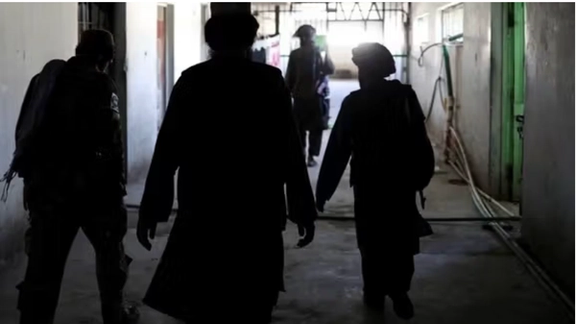
Former Afghan detainees have described harrowing abuse inside Taliban prisons, saying both male and female jailers were equally brutal in carrying out torture.

A woman and a man who were detained about two years ago in Kabul and Parwan told Afghanistan International they endured severe beatings and other forms of abuse in Taliban intelligence facilities.

Julia Parsi, a women’s and human rights activist, said she was arrested outside her home in Kabul on 27 September 2023 by Taliban members using unmarked vehicles. Speaking during a discussion on the social media platform X, she said she was targeted “for seeking justice for Afghan women.”

Parsi said she was blindfolded and beaten while being pressured to hand over her phone password. At the Taliban intelligence agency's prison, she said, seven female officers insulted and assaulted her before seizing control of her social media accounts. She spent 41 days in solitary confinement and later learned that her teenage son had also been detained solely because of his connection to her.

“The Taliban women were even more cruel than the men,” she said, adding that she was threatened with the arrest of her daughters unless she complied. She described further torture, including being doused with water, hung from the ceiling, suffocated with plastic bags and having her head forced into buckets of water.

Parsi was released after three months and later fled Afghanistan.

Another former prisoner, who gave his name as Sohrab Shomal, said he was jailed for a year after being accused of belonging to the National Resistance Front. He said Taliban interrogators pulled out his toenails and tortured him with electric shocks, beatings, suffocation and sleep deprivation.

“They had no evidence of my membership,” he said. “Anyone who refused to confess was tortured more.”
He said some detainees accused of “sodomy” or of planning to travel to Palestine were spared torture, while political prisoners were systematically abused.

International rights groups have repeatedly raised alarm about conditions in Taliban prisons. The World Organisation Against Torture said in a recent report that torture is systematic, with victims including political opponents, women activists, and ethnic and religious minorities. The group said methods include beatings, electric shocks, burning with hot irons, prolonged solitary confinement and psychological abuse.

An earlier Afghanistan International investigation documented at least 31 types of torture in Taliban-run intelligence prisons, ranging from hanging and confinement in cages to sexual violence and threats against detainees’ families.

Taliban detainees are held for rebellion, links to foreign media, contacts with Islamic State or resistance groups, or ties to the former security forces

Most Viewed

Taliban Minister Meets Shia Figures, Says All Sects Are Respected
1

Taliban Minister Meets Shia Figures, Says All Sects Are Respected

2

Central Asian Security Hinges On Stability In Afghanistan, Says Kyrgyz President

3

Gold Mine Tensions Escalate As Taliban Arrest Commanders’ Relatives

4

Russia-Afghanistan Trade Reaches $500 Million, Says Deputy PM Overchuk

5

Iran Plans To Broaden Energy & Water Cooperation With Taliban

•
•
•

More Stories

Taliban, Iranian Officials Hold Talks On Border Cooperation

Sep 7, 2025, 11:51 GMT+1

Taliban officials said Saturday that a delegation met with Iranian counterparts at the Milak border crossing in Nimroz province to discuss border cooperation and transit.

According to the Taliban governor’s office in Nimroz, the two sides agreed to allow fuel tankers to cross in both directions and to keep the border crossing open for transit traffic. Topics including trade, transit, visas for Afghan travellers and measures to curb smuggling were also discussed.

The Iranian Embassy in Kabul earlier said Alireza Bikdeli, Tehran’s chargé d’affaires in Kabul, met with Noorullah Noori, the Taliban’s minister for borders, ethnicities and tribes, to discuss “border cooperation.” The Taliban ministry later said the talks also addressed “mutual trust.”

In a statement, the ministry said Bikdeli signalled Iran’s interest in expanding political ties with the Taliban. “The government of Iran respects all neighbouring countries, especially Afghanistan, and seeks to further strengthen its political, economic and friendly relations with Afghanistan,” he was quoted as saying.

Bikdeli also pledged “continued cooperation” with the Taliban, according to the statement.

Taliban Rejects Elections As Un-Islamic, Says NRF Leader

Sep 7, 2025, 10:40 GMT+1

Ahmad Massoud, leader of the National Resistance Front, said Taliban Foreign Minister Amir Khan Muttaqi told him during talks in 2022 that elections “have no place in Islam.”

Massoud disclosed the exchange on Saturday in a discussion on the social media platform X. He said Muttaqi had urged him to end resistance against the Taliban and return to Kabul following the group’s takeover.

The meeting took place in Tehran shortly after the fall of Kabul, when armed resistance against the Taliban began. Sources at the time told Afghanistan International that Iran’s Revolutionary Guard Corps had invited Muttaqi to Tehran and facilitated the talks with resistance leaders.

Massoud said he challenged Muttaqi’s rejection of elections, telling participants that if his view were correct, then Islamic countries such as Iran “must not have realised their actions were un-Islamic.”

In January 2022, Muttaqi also met in Iran with former jihadi commander Ismail Khan, Massoud and other Afghan figures. After the talks, he returned to Kabul and said resistance leaders could safely return home.

Massoud has consistently stressed the Afghan people’s right to elect their leaders. In a recent interview with Afghanistan International, he said he would be prepared to negotiate with the Taliban if the group accepted principles of elections, peace and justice.

Since seizing power, the Taliban has abolished Afghanistan’s constitution and dismantled democratic and electoral institutions. The group has ruled under its strict interpretation of Islamic law for the past four years.

Opponents of the Taliban and Western governments describe the movement’s rule as autocratic and illegitimate, with decision-making concentrated in the hands of senior leaders, particularly supreme leader Hibatullah Akhundzada.

Qatar Establishes Air Corridor To Deliver Aid To Afghanistan Earthquake Victims

Sep 7, 2025, 09:54 GMT+1

The Qatari government has announced the launch of an air corridor to deliver humanitarian assistance to victims of the recent earthquake in Afghanistan.

The Foreign Ministry said the initiative was created under the directive of Emir Sheikh Tamim bin Hamad Al Thani.

According to the ministry, Qatar’s armed forces, in coordination with the Foreign Ministry and the Internal Security Force (Lekhwiya), have begun transporting emergency relief supplies to Afghanistan.

On Thursday, the Minister of Interior and commander of Lekhwiya said that Qatar’s International Search and Rescue Group had started its mission to support the Afghan people.

A video released by the Foreign Ministry showed that the operation includes the deployment of field hospitals, emergency food and medical supplies, shelter materials provided by the Qatar Fund for Development, and international search and rescue teams from Lekhwiya equipped with full gear.

Taliban Sign Deal To Generate 10,000 Megawatts Of Power

Sep 6, 2025, 18:01 GMT+1

Afghanistan’s state-owned electricity company, Breshna, now under Taliban control, said Saturday it has signed agreements with private firms to generate 9,407 megawatts of power.

The signing ceremony, held at Kabul’s Intercontinental Hotel, was attended by the energy ministers of Uzbekistan and Turkmenistan and the head of Tajikistan’s electricity company.

The office of Abdul Ghani Baradar, the Taliban’s deputy prime minister, said work on projects agreed with Uzbekistan also began Saturday.

According to Breshna, the projects include boosting the capacity of the 500-kilovolt Surkhan–Pul-e-Khumri transmission line, expanding the Dasht-e-Alwan and Arghandi substations, and extending the 220-kilovolt line to the Sheikh Mesri substation in Nangarhar.

Afghanistan imports most of its electricity, primarily from Uzbekistan, Tajikistan and Iran. The reliance has led to shortages and lengthy power cuts, particularly in some seasons. Four years into Taliban rule and despite repeated promises, shortages persist, with some areas receiving electricity for only 12 hours a day.

Taliban Arrests Sufi Leader Ibrahim Gailani & Followers In Afghanistan

Sep 6, 2025, 14:50 GMT+1

The Taliban’s Ministry of the Propagation of Virtue and Prevention of Vice announced Friday that it had arrested Sufi leader Ibrahim Gailani, a senior figure in the Qadiri order, along with several of his followers.

Saif Khyber, a ministry spokesperson, accused Gailani of “misusing Sufism” and said the group was carrying out “practices contrary to Sharia under the cover of religion.”

The ministry said it was responsible for the “intellectual and ideological reform of society” to prevent the spread of “false ideas and misguided beliefs.” In a statement, it added: “Every faithful Muslim is obliged to protect society from practices that contradict the principles of Sharia and the Hanafi school of jurisprudence.” The statement also claimed that Afghanistan is an Islamic country where all citizens are Muslims and followers of the Hanafi school.

That assertion does not reflect the country’s religious diversity. Afghanistan is also home to Shia Muslims, Ismailis, and Hindu and Sikh minorities. Since returning to power in August 2021, the Taliban has revoked official recognition of other faiths and sects.

Khyber published a letter on his social media account on X, bearing Gailani’s signature, in which he pledged not to engage in “acts of vice” and to align his conduct with Sharia. The letter stated Gilani would “have no right to complain” if he violated the pledge. It is unclear whether he was released after signing the letter.

The ministry warned it would not allow the “misuse of religion or Sufism” for acts deemed contrary to Islamic law.

Over the past four years, the Taliban has cracked down on individuals accused of following Salafism or holding beliefs that contradict its ideology. In some regions, residents have reported being forced to convert.

Who is Ibrahim Gilani?

Sayed Mohammad Ibrahim Gailani, known as Pir Ibrahim Baba, is the nephew of Pir Sayed Ahmad Gailani, former head of the Qadiri Sufi order. His lineage traces back to the prominent Sufi Abdul Qadir Gailani, founder of the Qadiri order.

Sayed Ahmad Gailani, a former jihadist leader, served as head of the High Peace Council during Afghanistan’s National Unity Government before his death in January 2017.

The Taliban previously detained Ibrahim Gailani in July 2022 in Paktia province.