Taliban Publicly Flogs 18 People In Kabul & Paktia
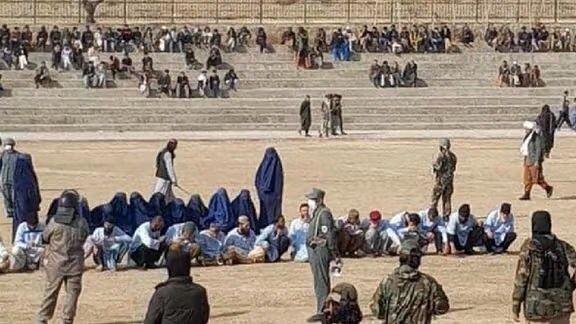
The Taliban’s Supreme Court says 15 people in Kabul have been flogged on charges of selling and trafficking narcotics, while three others in Paktia were flogged for using counterfeit currency.
The Taliban’s Supreme Court says 15 people in Kabul have been flogged on charges of selling and trafficking narcotics, while three others in Paktia were flogged for using counterfeit currency.
The individuals received between 10 and 39 lashes, in addition to prison terms ranging from six months to four years.
In a statement issued Thursday, the Supreme Court said the Kabul Primary Court for Counter-Narcotics had flogged 15 defendants accused of selling and trafficking tablet-k, alcohol and hashish.
In a separate statement, the court said three people were flogged by the Janikhel district primary court in Paktia province for “using counterfeit money.”
Data compiled by Afghanistan International shows that at least 53 people across the country have been flogged over the past week on various charges.
The Taliban continue to carry out corporal punishments despite repeated objections from international organizations that regard flogging and other physical penalties as forms of torture.
The Taliban say public flogging constitutes the implementation of Islamic Sharia.

The Taliban say Afghanistan–Pakistan trade routes will reopen only if Islamabad provides firm guarantees that the crossings will no longer be used for political or economic pressure.
Zabihullah Mujahid, the Taliban’s spokesperson, wrote on X on Thursday, 4 December, that the administration had decided the routes would reopen only after receiving “strong guarantees” from Pakistan. He said these guarantees must ensure the passages will not be closed “for political pressure, illegal misuse or coercion of the people,” and that the rights of traders and citizens on both sides will be protected.
Mujahid accused Pakistan of “illegally” shutting trade and transit routes and using them as a tool of political and economic leverage. He acknowledged that the closure of the crossings had caused serious harm to the population, but said Afghanistan is currently meeting its needs through other countries.
His remarks come nearly 50 days after border crossings were closed following deadly clashes between Taliban forces and Pakistani troops.
Meanwhile, Pakistani media, quoting Tahir Andrabi, spokesperson for Pakistan’s Ministry of Foreign Affairs, reported on Thursday that the border has been partially reopened for the movement of UN humanitarian aid. Commercial trade with Afghanistan, however, remains suspended.
Recently, Taliban Energy and Water Minister Abdul Latif Mansour said Pakistan’s fruit season had begun and Islamabad was seeking to reopen the crossings to export its produce to Afghanistan. He argued that Pakistan had closed the borders during Afghanistan’s fruit season, and that the Taliban should now keep the gates closed in response.
According to SIGAR, from 2002 to mid-2021 the United States allocated approximately $144.7 billion for Afghanistan’s reconstruction, of which an estimated $26–29 billion was lost to waste, fraud and abuse.
The report says SIGAR identified 1,327 instances of waste, fraud and abuse in US assistance programmes, 93 percent of which were categorised as waste.
It noted that from 2009 to August 2025, the organisation issued nearly 900 performance and financial audits, evaluations, inspections, warning letters and other reports. Across these reviews, SIGAR recorded around 1,911 cases of “control weaknesses.”
SIGAR investigators also assisted in securing the convictions of 171 individuals in the United States and Afghanistan, resulting in $1.7 billion in criminal fines, asset forfeitures, civil settlements, recoveries and savings for the US government.
Taliban Foreign Minister Amir Khan Muttaqi has accused Pakistan of attempting to advance what he described as “mysterious projects” in Afghanistan, alleging that Islamabad seeks to topple the Taliban by exerting economic pressure.
Speaking on Wednesday at a meeting with pro-Taliban media activists in Kabul, Muttaqi said Pakistan was using “pretexts” to justify such measures and claimed the Taliban also had the right to defend themselves. He asserted that Pakistan had issues “with all internal political groups and figures, and with the exception of one country with all of its neighbours.”
Relocating the ‘Tribal Brothers’
Muttaqi said the Taliban administration had, over the past four years, moved Waziristani migrants away from border areas and deployed hundreds of new checkpoints to address Pakistan’s concerns. He reiterated that Islamabad’s demands were “not practical and not acceptable.” He has previously said Pakistan asked the Taliban to relocate TTP members deeper into Afghanistan.
The Taliban deny the presence of the Tehreek-e-Taliban Pakistan inside Afghanistan but acknowledge the presence of Waziristani migrants, whom they say entered before the Taliban returned to power.
Responding to Pakistan’s claims about the difficulty and cost of securing the rugged frontier, Muttaqi said Islamabad should secure its own border if it believed it had the technology and infrastructure.
Last week, Pakistan’s military spokesperson, Ahmed Sharif Chaudhry, described border control as extremely challenging and expensive.
Muttaqi insisted the Taliban had established nationwide security, claiming they had eliminated ISIS and other groups, and said Pakistan should do the same. He described Pakistan’s TTP problem as “two decades old” and its Baloch insurgency as “rooted in its founding,” arguing that both stem from Islamabad’s internal policy failures.
A ‘Misguided’ Strategy
Muttaqi criticised Pakistan’s closure of border crossings, saying Islamabad believed the Taliban administration would collapse and trigger public unrest. He insisted the closures had no impact, claiming Afghanistan received food and essential goods through other countries.
He said he raised Pakistan’s airstrikes and border closures during the ECO foreign ministers’ meeting, prompting Pakistan’s foreign minister, Ishaq Dar, to object that economic discussions should not become political. Muttaqi said he responded that border closures and restrictions on traders were inherently economic issues.
‘Fragmented’ Decision-Making in Pakistan
Muttaqi said Pakistan’s “fragmented decision-making” had hindered negotiations, claiming Ishaq Dar must obtain approval from both the prime minister and the army chief.
He asserted that in the dispute with Pakistan, “the entire Afghan population” supported the Taliban and that no political, religious, or business leader had opposed their position. Some Afghan political figures, however, have recently argued that the Taliban’s conflict with Pakistan is not a conflict on behalf of the Afghan people.
Pakistani officials have repeatedly emphasised what they call the Taliban administration’s “lack of legitimacy” and accuse it of violating the rights of ethnic and religious minorities.
‘Relations With India Are Our Right’
Addressing Pakistan’s allegations of Indian interference in Afghanistan, Muttaqi said Afghanistan’s relations with India were “political and economic.” He said Pakistan objected to his visits to Delhi and Deoband, but added that Afghanistan was an independent state with the right to pursue independent diplomatic ties.
He noted that Pakistan itself maintains an embassy in Delhi and conducts trade with India, arguing that Islamabad criticises the Taliban for actions it engages in itself. He said the Taliban’s policy toward India “is not against anyone.”
Ties between the Taliban and India have expanded significantly in recent years. As tensions between the Taliban and Pakistan have grown, senior Taliban officials, including foreign and trade ministers, have travelled to Delhi. The Taliban have sought to shift Afghanistan’s pharmaceutical supply chain from Pakistan to India and have reached agreements with New Delhi on expanding transit and trade through Iran’s Chabahar Port.
Three Afghan sources and two Pakistani officials, including one based in Istanbul, told Reuters that a meeting between Taliban and Pakistani representatives was held in Saudi Arabia.
According to the report, both sides agreed to uphold the ceasefire and continue talks aimed at reducing tensions.
Previous efforts by Pakistani and Taliban officials to reach peace and end border tensions in Qatar and Turkiye have failed, and this meeting represents the latest attempt to defuse friction between the two neighbours.
A senior Taliban official told Reuters that they are ready to hold more meetings to achieve a positive result. Pakistani officials said Islamabad was represented in the talks by a delegation including members of the army, intelligence agencies, and the foreign ministry.
Pakistan’s foreign ministry and military, as well as Taliban and Saudi spokespersons, did not respond to Reuters’ requests for comment.
Islamabad claims militants based in Afghanistan have carried out attacks inside Pakistan and that Kabul has not responded effectively to repeated requests to act against them. The Taliban reject these allegations.
In October, both sides agreed to a ceasefire during talks in Doha, but a second round of negotiations held last month in Istanbul ended without a long-term agreement. Islamabad insists Kabul must commit to taking action against anti-Pakistan militants.
Families of ten Afghan migrants killed by Iranian border forces say the Islamic Republic returned their bodies only after keeping them “hidden for about 24 days.”
They condemned what they described as the “inhumane” treatment of the victims and called on international organisations and the Taliban to launch an investigation.
Bakhtar News Agency, run by the Taliban, reported on Wednesday that the migrants were from the Zer Koh and Shindand districts of Herat province. Relatives said the men were shot without warning while attempting to cross into Iran in search of work.
Taliban officials said the incident occurred on 13 November, when the group was travelling toward the border and came under fire from Iranian forces.
Families of the victims held a gathering in Herat demanding justice and accountability from Iran. They said they had gathered evidence and documentation from the site and urged national and international bodies to investigate and hold those responsible to account. They also asked the Taliban administration to pursue the matter diplomatically with Tehran.
The Taliban governor’s office in Herat said the families’ complaints had been registered and would be referred to the relevant authorities for follow-up.
The reports follow comments from Mohammad Nasim Badri, spokesperson for the Taliban police in Farah province, who said at least ten Afghan migrants were killed by Iranian border guards while attempting to enter Iran “illegally” via the Sheikh Abu Nasr Farahi crossing.
Iran has not issued any statement on the latest incident.
Human rights groups have documented several previous cases of deadly force against Afghan migrants by Iranian border units. Last year, Hal Vash, a rights organisation monitoring Sistan and Baluchestan, reported that Iranian forces opened fire on a group of 300 Afghan migrants in the Kalagan area. At the time, the Taliban said two people were killed and several wounded were sent back to Afghanistan.
In 2020, Iranian border guards in Herat’s Gulran district allegedly beat and pushed dozens of Afghan migrants into a river. Officials of Afghanistan’s former government said 18 people died in that incident.