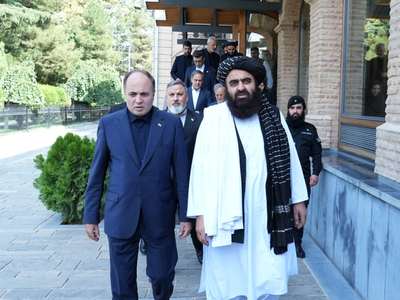
Speaking on Wednesday at a meeting with pro-Taliban media activists in Kabul, Muttaqi said Pakistan was using “pretexts” to justify such measures and claimed the Taliban also had the right to defend themselves. He asserted that Pakistan had issues “with all internal political groups and figures, and with the exception of one country with all of its neighbours.”
Relocating the ‘Tribal Brothers’
Muttaqi said the Taliban administration had, over the past four years, moved Waziristani migrants away from border areas and deployed hundreds of new checkpoints to address Pakistan’s concerns. He reiterated that Islamabad’s demands were “not practical and not acceptable.” He has previously said Pakistan asked the Taliban to relocate TTP members deeper into Afghanistan.
The Taliban deny the presence of the Tehreek-e-Taliban Pakistan inside Afghanistan but acknowledge the presence of Waziristani migrants, whom they say entered before the Taliban returned to power.
Responding to Pakistan’s claims about the difficulty and cost of securing the rugged frontier, Muttaqi said Islamabad should secure its own border if it believed it had the technology and infrastructure.
Last week, Pakistan’s military spokesperson, Ahmed Sharif Chaudhry, described border control as extremely challenging and expensive.
Muttaqi insisted the Taliban had established nationwide security, claiming they had eliminated ISIS and other groups, and said Pakistan should do the same. He described Pakistan’s TTP problem as “two decades old” and its Baloch insurgency as “rooted in its founding,” arguing that both stem from Islamabad’s internal policy failures.
A ‘Misguided’ Strategy
Muttaqi criticised Pakistan’s closure of border crossings, saying Islamabad believed the Taliban administration would collapse and trigger public unrest. He insisted the closures had no impact, claiming Afghanistan received food and essential goods through other countries.
He said he raised Pakistan’s airstrikes and border closures during the ECO foreign ministers’ meeting, prompting Pakistan’s foreign minister, Ishaq Dar, to object that economic discussions should not become political. Muttaqi said he responded that border closures and restrictions on traders were inherently economic issues.
‘Fragmented’ Decision-Making in Pakistan
Muttaqi said Pakistan’s “fragmented decision-making” had hindered negotiations, claiming Ishaq Dar must obtain approval from both the prime minister and the army chief.
He asserted that in the dispute with Pakistan, “the entire Afghan population” supported the Taliban and that no political, religious, or business leader had opposed their position. Some Afghan political figures, however, have recently argued that the Taliban’s conflict with Pakistan is not a conflict on behalf of the Afghan people.
Pakistani officials have repeatedly emphasised what they call the Taliban administration’s “lack of legitimacy” and accuse it of violating the rights of ethnic and religious minorities.
‘Relations With India Are Our Right’
Addressing Pakistan’s allegations of Indian interference in Afghanistan, Muttaqi said Afghanistan’s relations with India were “political and economic.” He said Pakistan objected to his visits to Delhi and Deoband, but added that Afghanistan was an independent state with the right to pursue independent diplomatic ties.
He noted that Pakistan itself maintains an embassy in Delhi and conducts trade with India, arguing that Islamabad criticises the Taliban for actions it engages in itself. He said the Taliban’s policy toward India “is not against anyone.”
Ties between the Taliban and India have expanded significantly in recent years. As tensions between the Taliban and Pakistan have grown, senior Taliban officials, including foreign and trade ministers, have travelled to Delhi. The Taliban have sought to shift Afghanistan’s pharmaceutical supply chain from Pakistan to India and have reached agreements with New Delhi on expanding transit and trade through Iran’s Chabahar Port.