Seized 300 Defence Camera Technologies Bound For Iran, Says Taliban
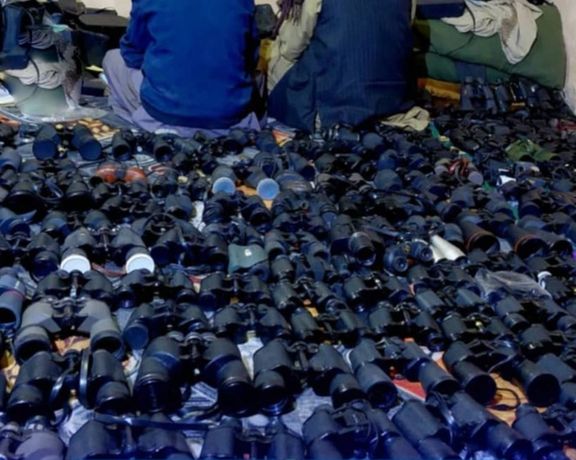
The Taliban Ministry of Interior said it has seized nearly 300 military cameras in Nimruz province, near the border with Iran.
The Taliban Ministry of Interior said it has seized nearly 300 military cameras in Nimruz province, near the border with Iran.
The group also said that they arrested two people on suspicion of attempting to smuggle the equipment out of the country.
In a statement issued on Saturday, the ministry said at least 286 military cameras were discovered during an operation in Nimruz and were being transported in a passenger vehicle intended to cross into Iran.
The ministry said two suspects were detained in connection with the alleged smuggling attempt. Following preliminary investigations, the suspects were handed over to the Nimruz Counterterrorism Directorate for further questioning.
The Taliban did not provide additional details about the origin of the cameras or their intended use.

Taliban have informed female employees who have been barred from working and ordered to stay at home that their monthly payment of 5,000 afghanis will be discontinued.
According to sources within the Taliban Ministry of Finance, the Taliban plan to permanently dismiss these women and replace them with male members of their families.
Several female employees of the Ministry of Finance told Afghanistan International on Thursday, that after the ban on women’s employment was imposed, they had continued to receive a monthly payment of 5,000 afghanis. They said authorities have now decided to remove them from their posts entirely.
The women criticised the decision, warning that female breadwinners would face severe economic hardship if the payments are cut.
Sources said the move is part of a broader plan by the Taliban to eliminate positions previously allocated to women within the ministry and fill them with male staff.
The Taliban Ministry of Finance has not issued an official comment on the reported decision.
Last year, the ministry confirmed it was paying a monthly stipend of 5,000 afghanis to some female employees who had been forced to remain at home following restrictions on women’s employment.
Shehbaz Sharif, Pakistan’s prime minister, has again voiced concern over what he described as coordination and an alliance between the Afghan Taliban and the Tehreek-e-Taliban Pakistan (TTP).
He said that Pakistan’s enemies are supporting the Pakistani Taliban through Afghan territory.
Speaking on Friday at a meeting with religious scholars, Sharif said Pakistan’s long-standing wound of terrorism had reopened and that hostile forces were aiding the TTP via the Afghan Taliban.
He said that while Afghan Taliban representatives deny links with the TTP in direct talks, Islamabad possesses solid and documented evidence showing that resources and facilities are being provided to the group through Afghanistan.
Sharif described the alleged alliance between the Pakistani and Afghan Taliban as one of the most alarming consequences of the current situation, adding that just as Pakistan defeated militants in 2018, it would confront them again.
Referring to the armed forces, the prime minister said Pakistan’s military had consolidated its position as a major regional power and had delivered what he called a historic lesson to India last year. He also stressed the need for national unity and internal cohesion to address Pakistan’s security challenges.
The Afghan Taliban have consistently denied cooperating with the TTP. After clashes between the two sides and the failure of several rounds of talks mediated by Doha, Istanbul and Saudi Arabia, Taliban leaders, under pressure from those countries, said at a meeting in Kabul that they oppose the use of Afghan soil by foreign militants to attack other countries, without explicitly naming Pakistan.
Taliban spokesmen have also said individuals they describe as Waziristani migrants have been relocated from border areas to other parts of Afghanistan. The group denies an organised TTP presence in the country, describing the individuals as Pakistani migrants.
Pakistani officials, however, have repeatedly said such measures are insufficient and have called on the Afghan Taliban to provide clear, written guarantees to prevent militant attacks against Pakistan.
US Senator Jeanne Shaheen, a member of the Senate Foreign Relations Committee, said the planned closure of Camp As Sayliyah in Qatar would leave Afghan migrants housed at the facility exposed to danger and uncertainty.
Shaheen said turning away from Afghan partners who stood “shoulder to shoulder” with US forces under difficult conditions would amount to a major betrayal of American values. She added that such a move would undermine the United States’ ability to earn the trust and cooperation of its allies in times of need.
Earlier, Gregory Meeks, a Democratic member of the US House of Representatives, said President Donald Trump had informed Congress of his decision to shut down Camp As Sayliyah, which has served as a temporary holding facility for evacuated Afghans. According to Meeks, the camp is scheduled to close by the end of September.
In a statement issued on Thursday, January 15, Shaheen, the ranking member of the Senate Foreign Relations Committee, described the plan to close the Afghan migrant camp in Qatar as “deeply disappointing.” She said it was “shameful” for the United States to pressure its Afghan allies to return to life under Taliban rule.
The senator stressed that Afghans at the camp include women, children and individuals who risked their lives in service to the United States. She said the government’s plan would leave these at-risk refugees in limbo, without a clear path to secure resettlement.
Shaheen noted that the majority of Afghans living at Camp As Sayliyah have established pathways for resettlement to the United States and urged the government to honour its commitments and recognise their sacrifices.
She also called on both Democratic and Republican lawmakers to ensure that no Afghan at Camp As Sayliyah is “forced back to a life of persecution and torture.”
Afghan women who have been subjected to harassment and violence report that Taliban morality police in Herat have resumed aggressive inspections of women’s dress, and stopping.
They said that these forces interrogate and abuse females ranging in age from 12 to about 70 for wearing a local dress that’s not favoured by the Taliban in public.
The manto is a common form of outerwear in Herat, worn by many women instead of a burqa or other traditional garments. The Taliban have recently banned the garment in the city and now bar women from moving in public while wearing it. The style, also known as Arab dress or Arab hijab, is widely worn in several Islamic countries.
Sources told Afghanistan International on Thursday that Taliban morality police have deployed officers in busy areas including Pul-e Rangina, Cinema Square, Golha Square, Darb-e Iraq, Mostofiyat Square and other crowded parts of the city to monitor women’s hijab.
Reports of Violent Conduct
Eyewitnesses said Taliban officers have stopped public transport vehicles, taxis and rickshaws at several central locations, forcing women who are not wearing a Burqa or prayer veil to get out of vehicles.
One witness said a Taliban morality officer slapped a driver for transporting a woman wearing a manto.
Afghanistan International learned that on Wednesday, following disputes over hijab at Golha Square, several women were detained by the Taliban and taken to an undisclosed location. Another eyewitness said several women were also detained on Thursday, January 15.
Accounts From Residents
Most women who spoke to Afghanistan International said their hijab fully covered their bodies, yet they were still harassed.
One woman said: “Yesterday I was wearing full winter hijab, just without a prayer veil. They forced me off a public bus and did not allow any vehicle or taxi to take me. I was left stranded in Golha Square. When they finally allowed me to leave, I had to go into a side alley and return home by rickshaw.”
Another woman said: “Today I was in a vehicle with my brother. They stopped the vehicle and beat the driver in front of us for picking up women wearing manto. We were not detained, but they warned drivers not to transport women who wear manto.”
A man told Afghanistan International that Taliban officers stopped his 12-year-old daughter and told her she should not leave the house without a burqa. He said tensions escalated after he told them his daughter was only 12, and that he was detained for about half an hour. During that time, he said, he saw at least 15 other women being stopped.
A girl from Herat said she was accompanying her sister to a cardiac hospital when Taliban officers blocked their passage. Her sister, who was wearing a manto, was carrying medication. “Several morality police officers were stationed at the entrances of all alleys connected to Pul-e Rangina and Majidi Street and were not allowing women wearing manto to pass,” she said.
Another woman reported witnessing an argument between a woman of about 70 and Taliban officers. According to her account, the elderly woman shouted at men nearby: “Why are you indifferent in the face of the Taliban?”
Previous Restrictions
The Taliban have previously detained and beaten women in Herat, including some healthcare workers, for not wearing a burqa. Despite the restrictions, some women in the city continue to wear Arab style hijab and manto.
The Taliban have also banned the provision of government services to women without a burqa in Herat city and some surrounding districts. Videos received by Afghanistan International show Taliban morality police preventing women from entering the central hospital because they were not wearing a burqa.
Hibatullah Akhundzada, the Taliban leader, has repeatedly warned that internal divisions pose the greatest threat to the survival of the Islamic Emirate, stressing the need for unity and obedience within the group.
His repeated emphasis suggests Akhundzada does not see the Taliban’s potential collapse as the result of Western pressure or domestic opposition to his hardline policies, but rather as a consequence of internal discord.
The BBC World Service said it obtained an audio recording in which Akhundzada warns a gathering of Taliban officials that “the Emirate will collapse” if internal divisions persist. The recording relates to a speech delivered in January 2025 at a jihadi seminary in Kandahar.
Although the Taliban have consistently denied the existence of internal rifts, remarks by senior figures including Akhundzada himself and Sirajuddin Haqqani, the interior minister point to growing tensions within the group.
In one recent speech in Khost province, Haqqani said a government that rules through “fear and force” is not a genuine government, implicitly acknowledging the Taliban’s reliance on intimidation and violence. He urged members not to humiliate or denounce one another, saying effective governance requires trust and affection between rulers and the public.
A day later, Neda Mohammad Nadeem, the Taliban’s minister of higher education, warned that disobedience or opposition to Akhundzada would weaken the system. He said an Islamic system can have only one emir and that the existence of “multiple emirs” would lead to corruption and failure. Nadeem is widely regarded as one of Akhundzada’s closest allies in Kabul.
Kabul-Based vs Kandahar-Based Factions
Afghanistan International has previously reported extensively on internal Taliban divisions. In October 2025, sources said a nationwide internet shutdown was ordered by Akhundzada. After 48 hours of widespread disruption including the paralysis of public services and Taliban offices Prime Minister Hasan Akhund ordered internet access restored. One source described the episode as a direct confrontation between Kabul-based and Kandahar-based Taliban factions.
A recent BBC report confirmed that the prime minister ordered the restoration following pressure from Kabul-based ministers. The report described two competing camps within the Taliban: a Kabul-based group of ministers and senior officials favouring limited engagement with the outside world, and a Kandahar-based faction loyal to Akhundzada that prefers international isolation. Both support strict enforcement of Islamic law, but differ sharply on foreign relations and governance.
According to the report, the October 2025 decision to restore internet access reflected the very concern Akhundzada had voiced months earlier that certain individuals were threatening the unity of the Emirate.
A Reclusive Leader
People who have attended meetings with Akhundzada told the BBC he rarely speaks and often communicates through gestures, interpreted by a group of elderly clerics present. They said he covers his face including his eyes with a scarf even at large gatherings. Photographing him is banned, and only two images of the Taliban leader have ever been made public.
One Taliban official said meeting Akhundzada is extremely difficult, while another said ministers sometimes wait days or weeks for an audience. Kabul-based ministers have reportedly been instructed to travel to Kandahar only if they receive a formal invitation.
The BBC World Service said it interviewed around 100 people including current and former Taliban members, local sources, analysts and former diplomats for its report, published on Thursday, January 15, examining internal divisions within the Taliban.