Taliban Recruits Troops In Badakhshan & 10 Other Provinces

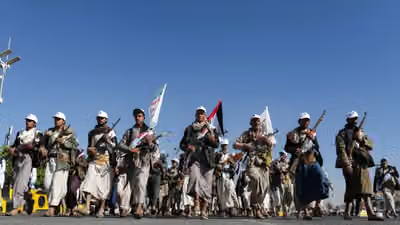
Amid increased military activity by opposition groups, the Taliban said on Sunday, 2 August, that it had recruited 547 new personnel across seven Afghan provinces.
Amid increased military activity by opposition groups, the Taliban said on Sunday, 2 August, that it had recruited 547 new personnel across seven Afghan provinces.
The group said recruitment was continuing in 11 provinces.
The media office of the Taliban army chief of staff said the newly recruited personnel had been sent to the Hazrat Abdullah bin Masoud Joint Combat Training Command for military and specialist training.
The Taliban has focused much of its recruitment drive on border provinces.
Recruitment is continuing in Kandahar, Badakhshan, Khost, Kunar, Logar, Zabul, Paktia, Paktika, Nuristan, Nangarhar and Nimroz.
Opposition groups have increased their activities across several parts of Afghanistan in recent weeks.
About two weeks earlier, the newly established Sepah-e Mihan Front briefly drove the Taliban from Yaftal district in Badakhshan.
The Afghanistan Freedom Front later engaged in direct clashes with the Taliban in Badakhshan’s Zebak district.
The National Resistance Front of Afghanistan has also claimed attacks against Taliban members in Kuran wa Munjan.
In another development, the United Front of Afghanistan, led by Sami Sadat, a former commander of Afghanistan’s special forces, announced the launch of military operations against the Taliban.
During the opening days of its operations, the front claimed attacks on Taliban members in Kandahar, Helmand and Badghis provinces.
Responding to the activities of opposition groups, Taliban spokesman Zabihullah Mujahid said the groups had existed previously but were now operating from outside Afghanistan.
He added that the Taliban would not allow them to expand their activities inside the country.
Taliban spokesman Zabihullah Mujahid says the group has suspended operations at some mines in Badakhshan while it reviews extraction guidelines, citing illegal mining, disorder and the seizure of mining sites.
Mujahid made the remarks in the second episode of the programme Government in the Mirror of the Press. He said the mining sector had previously faced problems including disorder, the seizure of mines and illegal extraction.
According to him, operations at some mines will remain suspended until new guidelines are finalised.
The Taliban halted mining activities in Badakhshan following increased unrest in the province. The Taliban leader had earlier ordered an end to what the group described as illegal mining.
The order directly threatened the economic interests of some local Taliban commanders and fuelled internal tensions. Control over mines has become a major source of disagreement between local Taliban figures in Badakhshan and the group’s leadership.
The ban on illegal mining led to weeks of tension between Juma Khan Fateh, a local Taliban commander who has been at odds with the group’s leadership, and senior Taliban officials. The dispute reportedly reached the point where both sides prepared for a possible armed confrontation.
Meanwhile, some mine workers in Badakhshan previously protested against the continued closure of mining sites by the Taliban.
The protesters said workshops belonging to low-income residents had remained closed for about a month, while operations linked to powerful individuals were continuing.
Mujahid said the Taliban’s Ministry of Mines and Petroleum would announce the new guidelines once they were finalised, and that mining would resume under revised laws and standards.
He also claimed that the Taliban had prevented unauthorised extraction and substandard excavation and had ended uncontrolled mining.
According to him, the measures were intended to protect mineral resources and ensure extraction was carried out in accordance with established standards.
Since returning to power, the Taliban has signed numerous mining contracts with domestic and foreign companies.
However, the management of mineral resources, efforts to prevent illegal extraction and the transparency of mining contracts remain widely debated issues in Afghanistan’s mining sector.
Unregulated mining has also drawn criticism from environmental experts.
As the fifth anniversary of the Taliban’s return approaches, Human Rights Watch says Afghanistan faces one of the world’s gravest human rights and humanitarian crises.
In a report published on Monday, 3 August, to mark the fifth anniversary of the Taliban’s return to power, Human Rights Watch said the group had violated citizens’ fundamental rights through sweeping restrictions, particularly those imposed on women and girls.
The organisation said women and girls remained barred from secondary and university education and faced extensive restrictions on employment, freedom of movement, freedom of expression and participation in public life.
The report said journalists, civil society activists and people considered critics of the Taliban continued to face threats, arbitrary detention and torture.
Human Rights Watch also said hundreds of former government security personnel had been subjected to revenge attacks and extrajudicial killings in recent years.
The organisation described Afghanistan’s humanitarian situation as critical, saying that after major reductions in international assistance, half of the country’s population now required food and medical aid.
According to the report, more than 3.7 million children in Afghanistan are suffering from acute malnutrition, while the country’s health system is struggling with severe shortages of resources.
The report also said the mass expulsion of Afghan migrants from Pakistan and Iran had deepened the humanitarian crisis, as many returnees lacked shelter, employment and sources of income.
Human Rights Watch added that armed clashes between the Taliban and Pakistan, as well as attacks by Islamic State Khorasan Province, had caused hundreds of civilian casualties in recent years.
Referring to arrest warrants issued for Taliban leaders by the International Criminal Court and the establishment of an independent UN accountability mechanism for Afghanistan in 2025, the organisation described the measures as important steps towards ending impunity for human rights violations.
Human Rights Watch said condemning Taliban policies alone was not enough.
It called on governments to increase pressure on the group to lift all restrictions imposed on women and girls, support international accountability processes, fund Afghanistan’s humanitarian programmes and end the forced deportation of Afghan refugees and migrants.
Residents of Badakhshan say Taliban forces opened fire on protesters in Yaftal-e Payeen district on Saturday, causing casualties. The exact number of dead and wounded remains unknown.
Videos received from Yaftal contain the sound of gunfire and show wounded people being taken from the scene.
Local residents said widespread Taliban abuse against the population was the main reason for the protest. The demonstration began after Taliban forces allegedly body-searched a woman in Yaftal market.
Protesters said the Taliban had deployed large numbers of forces to the district in recent weeks and carried out arbitrary arrests, house-to-house searches and intimidation of local residents.
Pressure on Yaftal residents intensified after the district was briefly seized on Friday morning, 17 July, by a newly established anti-Taliban group called the Sepah-e Mihan Front.
Sepah-e Mihan fighters disarmed Taliban forces, raised their flag over government buildings and later withdrew from the district.
Following the incident, the Taliban deployed a large number of forces to Lower Yaftal and began widespread arrests and house-to-house searches.
Residents said on Saturday, 1 August, that Taliban forces had harassed, beaten, insulted and humiliated local people.
During the demonstration, protesters demanded the removal of non-local Taliban forces from Badakhshan.
Badakhshan has experienced rising security tensions in recent weeks.
Several days after the fall of Yaftal-e Payeen, the Afghanistan Freedom Front engaged in direct clashes with the Taliban in Zebak district. The National Resistance Front, led by Ahmad Massoud, also said it had killed a Taliban member in Kuran wa Munjan in recent days.
Democratic anti-Taliban fronts are not the only groups challenging the Taliban in the province.
The Taliban in Badakhshan is also dealing with internal divisions and attacks by Islamic State Khorasan Province.
Four days earlier, on 27 July, Zabihullah Amiri, the Taliban’s director of information and culture in Badakhshan, was killed in an armed attack in Baharak district. Islamic State Khorasan claimed responsibility for the attack.
Pakistan’s military has rejected the UNAMA report that hundreds of Afghan civilians were killed or injured in its cross-border attacks, saying the report is baseless. A Pakistan army spokesperson said that it targeted only Tehreek-e-Taliban Pakistan sites.
Ahmed Sharif Chaudhry, the Pakistani army spokesperson, said in a news conference on Friday that the country’s forces had operated only against hideouts, training centres and infrastructure used by Tehreek-e-Taliban Pakistan between October 2025 and the end of June 2026.
He claimed that those killed in the attacks were members of armed groups and that the operations were carried out in self-defence to protect Pakistani citizens.
Chaudhry also questioned reports by UNAMA and Amnesty International, saying they were largely based on accounts from sources inside Afghanistan who, according to him, operate under restrictions on freedom of expression imposed by the Taliban administration.
He added that the reports had ignored deadly attacks by armed groups against Pakistan, as well as air strikes carried out by foreign forces during the war in Afghanistan.
The remarks came after UNAMA said in a new report that at least 499 civilians were killed and 1,216 others injured inside Afghanistan between October 2025 and the end of June 2026 as a result of air strikes, artillery attacks and border clashes between Pakistan and the Taliban.
The UN mission said many of the victims were women and children. In some cases, people who went to rescue the wounded were targeted in a second strike.
According to UNAMA, one of the deadliest incidents occurred in Paktia province on 28 June, when two consecutive attacks on a residential building killed at least 22 people, including five children, and injured 185 others.
UNAMA stressed that under international humanitarian law, all parties to the conflict are required to protect civilians and humanitarian workers and avoid attacks that could result in civilian casualties.
Pakistan has repeatedly accused the Afghan Taliban of providing safe haven to members of Tehreek-e-Taliban Pakistan, an allegation the Taliban has denied.
Islamabad, meanwhile, says its cross-border operations in Afghanistan will continue.
The World Bank says Afghanistan's trade has shifted sharply towards Central Asia and Iran after disruption along the Pakistan route. Central Asian corridors now handle 48 per cent of imports and Iran 46 per cent, while Pakistan's share has fallen to almost zero.
At the same time, India has become Afghanistan's largest export market, taking 33.6 per cent of its exports, while Iran has become its biggest source of imports, supplying 31.4 per cent.
In its July report, the World Bank said Afghanistan's economy continues to face structural challenges despite relatively stable domestic demand, higher domestic revenues and easing food inflation. It said rapid population growth, regional trade disruptions and heavy reliance on domestic revenues continue to weigh on the economy.
The bank said current economic growth has failed to keep pace with Afghanistan's rising population, particularly following the large-scale return of migrants. According to the report, real per capita income is around 5.6 per cent lower than before the Taliban returned to power, placing additional pressure on household living standards.
General Inflation Eases but Living Costs Remain Under Pressure
The World Bank said Afghanistan's annual inflation rate fell to 7.6 per cent in June 2026, down from 8 per cent in May.
It attributed the decline mainly to lower food prices during the agricultural harvest season and continued imports. Prices of vegetables, fresh and dried fruit, sugar and dried bread all fell. Food inflation declined by 1.6 per cent compared with the previous month and by 7.2 per cent compared with the same period last year.
However, core inflation, which excludes food and energy prices, increased to 8.3 per cent. The bank said rising housing, healthcare and transport costs continue to fuel inflationary pressures.
Afghani Weakens Against the US Dollar
According to the report, the Afghan afghani depreciated by 1.6 per cent against the US dollar in June compared with May, with the average exchange rate reaching AFN64.4 per dollar.
Despite the monthly decline, the afghani remained 8.3 per cent stronger than a year earlier.
The World Bank also reported a 4 per cent decline in the Real Effective Exchange Rate (REER), saying the weaker rate had slightly improved the competitiveness of Afghan exports in regional markets.
Trade Deficit Widens as Pakistan Border Closures Hit Exports
Afghanistan's trade deficit widened to 984.3 million US dollars in June, up 11 per cent from the previous month and 19 per cent higher than a year earlier.
Exports totalled 77.7 million US dollars during the month, down 2 per cent from May but up 19 per cent year-on-year.
The World Bank said prolonged border closures with Pakistan were a key reason behind weaker food exports and the complete halt of coal exports.
According to the report, Afghanistan's coal exports fell to almost zero, directly linked to the closure of trade routes through Pakistan.
By contrast, textile exports increased significantly, reaching 21.5 million US dollars in June. This represented a 67 per cent rise compared with the previous month and a 304 per cent increase from a year earlier. Most of these exports were shipped to China via Central Asia.
India remained Afghanistan's largest export destination with a 33.6 per cent share, followed by Iran, Uzbekistan and China.
Central Asia and Iran Become Afghanistan's Main Trade Corridors
Afghanistan's imports rose by 10 per cent in June compared with the previous month, reaching 1.062 billion US dollars.
Central Asian routes became the country's main import corridor, accounting for 48 per cent of imports in June, up from 41 per cent in May.
Iranian routes accounted for 46 per cent of imports, while trade through Pakistan remained at a very low level.
Iran supplied 31.4 per cent of Afghanistan's imports, followed by China, the United Arab Emirates, Uzbekistan and Kazakhstan.
The World Bank warned that Afghanistan's heavy dependence on a small number of trading partners and transit routes leaves its economy vulnerable to political and economic developments across the region.
Monthly Government Revenue Falls but Annual Collections Increase
According to the World Bank, the Taliban administration collected 17.3 billion afghanis in domestic revenue in June, a 37 per cent decline from the previous month.
The decrease was mainly attributed to unusually high revenue collected in May.
Nevertheless, total domestic revenue since the start of the 2026 fiscal year reached 64.5 billion afghanis, an increase of 8.7 per cent compared with the same period last year.
Tax revenue totalled 6.7 billion afghanis, customs revenue 2.8 billion afghanis and non-tax revenue 7.4 billion afghanis.
The World Bank warned that customs revenues remain vulnerable because of regional trade disruptions and ongoing border restrictions.
Security Remains the Taliban Administration's Largest Budget Item
Public spending by the Taliban administration totalled 17.5 billion afghanis in June, down 33.8 per cent from the previous month.
The security sector received 26.8 billion afghanis, accounting for 46.4 per cent of total government expenditure, making it the largest budget allocation.
Education received 10.2 billion afghanis, representing 17.6 per cent of total spending, followed by governance, economic affairs and private sector development, which received 5.9 billion afghanis, or 10.2 per cent.
In its conclusion, the World Bank said the shift of part of Afghanistan's trade towards Central Asian routes has strengthened the country's supply chain resilience. However, dependence on a limited number of transit routes, declining customs revenues and continuing regional tensions continue to leave the economy vulnerable.
The bank added that although some macroeconomic indicators, including lower inflation and higher domestic revenues, show signs of improvement, economic growth remains insufficient to offset population growth and improve living standards.