• العربية
  • پښتو
  • فارسی
Brand
  • Afghanistan
  • Sport
  • Analysis
  • Markets
  • Afghanistan
  • Sport
  • Analysis
  • Markets
  • Theme
  • Language
    • العربية
    • پښتو
    • فارسی
  • Afghanistan
  • Sport
  • Analysis
  • Markets
All rights reserved for Volant Media UK Limited
volant media logo

Kabul Wants To Normalise Relations With US, Says Taliban FM

Aug 31, 2026, 09:15 GMT+1

Taliban Foreign Minister Amir Khan Muttaqi says the group’s government wants to normalise relations with the United States and has urged Washington to abandon what he described as a confrontational approach towards the Taliban.

He said the two sides could shape their relationship based on mutual respect and shared interests.

In the interview with Japan’s Kyodo News, published on Saturday, 29 August, Muttaqi said the Taliban was currently seeking to expand relations with other countries and regarded formal recognition of its government as the next issue, rather than an immediate priority.

He urged the United States to reconsider its policy towards Afghanistan considering what he described as the reality of Taliban rule.

Russia remains the only country to have formally recognised the Taliban government. Western countries say the ban on girls’ education, restrictions on women’s employment and other human rights violations remain major obstacles to normalising relations with the Taliban.

Regional countries have also expanded contacts and cooperation with the Taliban without formally recognising its government. However, the Taliban has strengthened diplomatic ties with several of them and taken control of some Afghan embassies and consulates.

Asked about the future of girls’ education, Muttaqi did not provide a specific timetable for their return to secondary schools or universities.

In another part of the interview, Muttaqi described Afghanistan’s relations with Japan as historic and close and urged the Japanese government to facilitate the reopening of the Afghan embassy in Tokyo. He said the embassy suspended operations in February following a dispute over the acceptance of new Taliban diplomats.

The Taliban foreign minister has previously also called on the United States, in an interview with The New York Times, to invest in Afghanistan’s mines, dams and roads.

Explanation of Military Cooperation With Russia

Muttaqi said an agreement on military and technical cooperation signed between the Taliban and Russia in June was intended to support the repair and maintenance of Russian-made weapons.

He stressed that the cooperation was not directed against any specific country.

Asked about Russia’s war in Ukraine, Muttaqi declined to comment.

In another part of the interview, the Taliban foreign minister said the group’s government supported dialogue to resolve its disputes with Pakistan.

Most Viewed

Armed Opposition Steps Up Attacks On Taliban, Claims 50 In One Month
1

Armed Opposition Steps Up Attacks On Taliban, Claims 50 In One Month

•
•
•

More Stories

Armed Opposition Steps Up Attacks On Taliban, Claims 50 In One Month

Aug 29, 2026, 17:28 GMT+1
100%

Three anti-Taliban fronts carried out at least 50 attacks across Afghanistan over the past month. The Freedom Front, United Front and National Resistance Front claim the attacks left dozens dead and wounded.

Attacks by anti-Taliban fronts increased sharply in August, ahead of the fifth anniversary of the fall of Afghanistan. Their military strategy also shifted significantly during the month from guerrilla attacks towards more conventional front-line fighting.

A new phase of armed opposition began after the newly established Sepahiyan-e Mihan Front briefly took control of Yaftal district in Badakhshan on 17 July. Opposition fronts then intensified attacks against the Taliban from early August.

Afghanistan Freedom Front

Following heavy fighting between the Taliban and opposition forces in Zebak district of Badakhshan, Daoud Naji, head of the Afghanistan Freedom Front’s political committee, said on 24 July that the conflict had entered a new phase. He announced the start of front-line fighting between Freedom Front forces and the Taliban in Zebak.

Naji said that the decisive battle for liberation has entered a new phase; a battle whose end will be freedom and whose true winners will be the people of Afghanistan.

Between 23 July and 22 August, the Afghanistan Freedom Front claimed responsibility for 21 attacks against the Taliban in eight provinces. Its main focus over the past month was Zebak district in Badakhshan, but it also reported attacks in Baghlan, Kabul, Kandahar, Nangarhar, Faryab, Nuristan and Panjshir.

On Friday, 28 August, the Freedom Front said it had expanded its armed operations against the Taliban to eight provinces during the previous Afghan month and carried out at least 21 guerrilla and front-line operations. It claimed that at least 65 Taliban members were killed and about 90 others wounded.

United Front of Afghanistan

After announcing the start of its military operations against the Taliban, the United Front of Afghanistan carried out its first reported attack in Kandahar on 1 August.

By 20 August, the group had reported on X around 20 attacks against the Taliban in Kandahar, Helmand, Badghis, Ghor, Faryab and several other parts of Afghanistan. According to the group, dozens of Taliban fighters were killed.

During this period, the United Front also released videos that it said showed the bodies of Taliban forces in different areas.

The group, led by Sami Sadat, a former commander of Afghanistan’s special forces, announced on 1 August that it had begun military operations against the Taliban and other terrorist groups in Afghanistan.

National Resistance Front

Between 29 July and 29 August, the National Resistance Front reported nine attacks against the Taliban in different provinces. The group claimed that dozens of Taliban members were killed or wounded.

According to statements issued by the NRF during this period, its forces carried out attacks in Badakhshan, Kunduz, Herat and Baghlan.

On 13 August, the NRF said its forces killed Habib-ur-Rahman Mansour, the Taliban-appointed mayor of Faizabad, and his guards in a targeted attack.

In response, the Taliban killed Hasib Panjshiri, a senior NRF commander, and several of his companions in a clash in northern Salang on 20 August.

The recent increase in attacks by anti-Taliban groups comes as Taliban officials continue to insist that security has been established across Afghanistan.

Afghanistan International previously reported that anti-Taliban groups carried out at least 15 attacks on Taliban positions in nine provinces within one week. Analysts have cited growing public support for opposition forces and criticism of Taliban rule as factors behind the expansion of these attacks.

Another notable development is that attacks previously dominated by guerrilla tactics have increasingly shifted towards direct front-line confrontation. Badakhshan, particularly the districts of Zebak, Yaftal, Kishm and Yamgan, has become one of the main centres of the fighting.

The increase in opposition attacks comes as the Taliban, since returning to power in 2021, has repeatedly claimed to have established security throughout Afghanistan. Anti-Taliban fronts, however, say they will continue their armed campaign and have expanded operations to several provinces in recent months.

The Taliban has not officially commented on many of the attacks or claims made by opposition groups and has not confirmed the casualty figures they have reported.

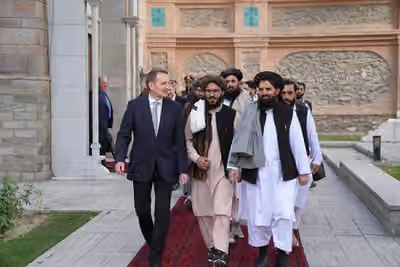
Uzbekistan Reaffirms Constructive Policy Towards Afghanistan

Aug 29, 2026, 16:46 GMT+1
100%

Uzbek President Shavkat Mirziyoyev said in a speech marking the country’s 35th independence anniversary that Tashkent would continue its constructive and resolute policy towards Afghanistan.

Mirziyoyev described Afghanistan as Uzbekistan’s close neighbour, but did not provide further details about the policy or specific plans concerning the Taliban administration.

The Uzbek president said his country’s foreign policy was based on good-neighbourly relations, strategic partnership and friendship with Central Asian states, adding that Tashkent was working to turn Uzbekistan into an important centre of international diplomacy.

He said Uzbekistan had expanded relations with various countries in recent years and now maintained diplomatic ties with nearly 170 states.

Mirziyoyev said Uzbekistan would continue its multilateral, measured and balanced foreign policy, with economic diplomacy remaining one of the country’s priorities.

He also announced that Uzbekistan would chair the Non-Aligned Movement for the first time from 2027 to 2029.

In another part of his speech, the Uzbek president highlighted the country’s economic achievements, saying annual foreign investment had risen from $2 billion to $3 billion to between $40 billion and $50 billion.

According to him, Uzbekistan’s gross domestic product is expected to reach $160 billion this year, while the country aims to attract $450 billion in foreign investment over the next 10 years.

Mirziyoyev also said the poverty rate in Uzbekistan had fallen from 35 per cent in 2017 to four per cent this year, with around 10 million people benefiting from improved living conditions.

The Uzbek president’s remarks on maintaining a constructive policy towards Afghanistan come as Tashkent has sought in recent years to expand economic and political ties with the Taliban administration and include Afghanistan in regional connectivity projects linking Central and South Asia.

Uzbekistan is among the Central Asian countries that, despite not formally recognising the Taliban, has established close practical and economic relations with the group.

Taliban-controlled Afghanistan is one of Tashkent’s most important economic partners. Trade between the two sides reached nearly $1 billion in the first six months of this year.

Border Concerns With Tajikistan Stem From False Information, Says Taliban

Aug 29, 2026, 14:22 GMT+1
100%

Taliban spokesman Zabihullah Mujahid has rejected concerns raised by the CSTO secretary-general over the Afghanistan-Tajikistan border, saying intelligence circles of some hostile countries may be spreading false information.

He said such information could create concern among regional countries and fuel tensions between Afghanistan and its neighbours.

The Taliban spokesman added: “The Taliban has repeatedly stressed that no threat to any other country originates from Afghan territory.” He also said Taliban forces had ensured security across Afghanistan and were “aware of all problems” in border areas.

Mujahid’s remarks came after Taalatbek Masadykov, secretary-general of the Collective Security Treaty Organization, expressed concern about the situation along the Afghanistan-Tajikistan border.

Masadykov told Russia’s state-run TASS news agency that the first shipments of weapons and equipment aimed at strengthening the Tajikistan-Afghanistan border would be delivered to Dushanbe this autumn.

Russia is taking the leading role in supplying the equipment.

Masadykov warned that any security incident along the border could have consequences beyond Tajikistan, potentially affecting other CSTO and Commonwealth of Independent States member countries.

According to him, CSTO member states have agreed on a list of lethal and non-lethal equipment needed by Tajikistan.

The equipment will be supplied under an interstate targeted programme designed to strengthen the Tajikistan-Afghanistan border.

Masadykov stressed the need to reinforce the border as quickly as possible, saying any security problem in the area could also affect other CSTO member states.

Security Concerns Along the Border

Masadykov said that during a recent visit to the region at the invitation of Tajik President Emomali Rahmon, he travelled along more than 700 kilometres of Tajikistan’s roughly 1,300-kilometre border with Afghanistan.

He was accompanied by the commander of Tajikistan’s border forces.

According to the CSTO secretary-general, Tajik border guards are working to secure the area but lack sufficient resources.

The CSTO Collective Security Council moved towards approving a five-year programme to strengthen the Tajikistan-Afghanistan border in late 2024. Implementation began last year.

Tajik authorities have said several attacks have been launched from Afghan territory into Tajikistan since November 2025.

Several civilians, including Chinese nationals, and Tajik border guards have been killed or wounded in the attacks.

Tajik officials have also said weapons and drugs were seized from the attackers and that some of the assailants were killed.

Fighting in Badakhshan

In recent months, Afghanistan’s northeastern Badakhshan province has seen an increase in armed clashes.

In recent weeks, Taliban forces and the Afghanistan Freedom Front have clashed several times in Zebak district.

In Yaftal district, fighters from the Sepahiyan-e Mihan Front briefly took control of the district centre. After they withdrew, the Taliban deployed additional forces to the area.

Tensions and clashes have also been reported in Nusay district between Taliban forces and men affiliated with Juma Khan Fateh, a local Taliban commander.

Two Taliban officials have also been assassinated in Badakhshan in less than a month. Islamic State Khorasan Province claimed responsibility for killing the Taliban’s information and culture chief, while the National Resistance Front claimed the killing of the Faizabad mayor.

Alongside armed Taliban opponents, the activities of regional extremist groups in Afghanistan remain another concern for Central Asian countries.

Islamic State Khorasan Province is also active in Afghanistan, and regional states have repeatedly warned about possible threats from armed groups operating from Afghan territory.

However, in his interview with TASS, Masadykov did not directly link the planned arms and equipment deliveries to Tajikistan with the recent fighting in Badakhshan.

Taliban Delegation Makes Confidential Visit To Germany Over Afghan Deportations

Aug 29, 2026, 12:05 GMT+1
100%

German media reported that a three-member Taliban delegation arrived in Berlin on Wednesday on a confidential visit. Germany’s Foreign Ministry confirmed the trip, saying it was linked to plans for further deportations of Afghan nationals.

After leaving Kabul, the Taliban delegation first travelled to Doha and then flew to Berlin after receiving 30-day visas from the German mission in Qatar.

According to German broadcaster NDR, members of the delegation are also expected to visit Afghanistan’s consulates in Bonn and Munich next week.

NDR reported that the delegation is currently based at the Afghan embassy in Berlin’s Grunewald district and is expected to remain in Germany for about three weeks.

The main purpose of the mission is reportedly to arrange the documents and technical requirements needed to carry out deportations of Afghan nationals more quickly. Germany’s Foreign Ministry said a technical support team had also entered the country for a short period to help establish these requirements.

This is not the first time Taliban representatives have travelled to Germany for consular work. Two Taliban consular officials also arrived in Germany last year.

According to NDR, one of them is now effectively running the Afghan embassy in Berlin, while the other is in charge of Afghanistan’s consulate in Bonn.

The German government has said their role is to provide consular services to Afghans living abroad and to facilitate the deportation of Afghan nationals, a measure also included in the coalition agreement of the German government.

However, an NDR investigation found that the two Taliban officials had additional tasks alongside their official duties, including removing Afghan diplomats appointed by the former government and bringing Afghanistan’s diplomatic missions in Germany into line with Taliban policy.

According to the investigation, they were also tasked with ensuring that the substantial revenues generated by the Afghan embassy in Berlin and the consulates in Bonn and Munich from issuing passports and official documents were transferred to Afghanistan while bypassing financial sanctions.

The latest Taliban delegation’s visit comes as the German government plans to increase deportation flights to Afghanistan and has expanded practical cooperation with the Taliban to carry out the process.

Initially, deportations were expected to focus on asylum seekers convicted of serious crimes. However, in the latest deportation flight, some Afghans without criminal records were also deported.

Iran Invites NRF Representative To Islamic Awakening Conference

Aug 28, 2026, 17:10 GMT+1
100%

Iran has invited Mawlawi Habibullah Hessam, a senior National Resistance Front member, and Jawad Salehi, a member of Afghanistan’s Shia Ulema Council, to a meeting of the Supreme Council of the World Assembly of Islamic Awakening in Tehran.

The meeting was held on Friday, 28 August, under the title “The Palestinian Issue in the Thought of the Martyred Imam of the Ummah”. Fars News Agency said 27 foreign guests from Afghanistan and other countries attended.

Mawlawi Habibullah Hessam heads the Ulema Council of the National Resistance Front, led by Ahmad Massoud. Before the fall of the former republic, he headed the Afghanistan Ulema Assembly and now lives in Iran.

Jawad Salehi is a member of Afghanistan’s Shia Ulema Council and director of the Risalat religious seminary in Kabul.

Iranian media said the Palestinian issue, recent developments involving Iran-backed groups in the Middle East and ways to support Palestinians were among the main topics discussed at the meeting.

Representatives from more than 20 countries, including Afghanistan, Pakistan, India, Russia, Turkiye, Iraq, Lebanon, Egypt, Syria, Yemen, Bahrain and Indonesia, attended.

The invitation to a senior member of the National Resistance Front comes despite Iran maintaining political, economic and diplomatic relations with the Taliban.

Officials from both sides have also held numerous visits and meetings in recent years. Despite those ties, Iran has not formally recognised the Taliban.

In July, Iran also invited Ahmad Massoud, leader of the National Resistance Front, and Mohammad Mohaqiq, leader of the People’s Islamic Unity Party of Afghanistan, to the farewell and funeral ceremonies for Ali Khamenei, Iran’s former supreme leader.

A Taliban delegation led by Mullah Abdul Ghani Baradar and including Amir Khan Muttaqi also attended the same ceremonies.

The event’s host referred to Ahmad Massoud and his companions as the high-level delegation of the Afghan resistance. It was the first official and public appearance of Taliban opposition leaders at an Iranian government ceremony in five years.

The invitation of Taliban opponents prompted reactions from several Taliban officials and supporters.

Khairullah Shinwari, an official at the Taliban Foreign Ministry, said Iran had hosted people who challenged Afghanistan’s national sovereignty and independence. Some Taliban supporters also described Iran’s move as hostility and betrayal of the Taliban.