Türkiye’s Intelligence Chief Visits Kabul & Kandahar

İbrahim Kalın, head of Türkiye’s National Intelligence Organisation, has travelled to Afghanistan and met senior Taliban officials in Kabul and Kandahar.
İbrahim Kalın, head of Türkiye’s National Intelligence Organisation, has travelled to Afghanistan and met senior Taliban officials in Kabul and Kandahar.
Narges Hurakhsh, Afghanistan International’s correspondent in Türkiye, reported citing her sources that Kalın met Mohammad Yaqoob Mujahid, the Taliban’s acting defence minister, and Sirajuddin Haqqani, the group’s acting interior minister, during the visit.
The Taliban Interior Ministry said Sirajuddin Haqqani met İbrahim Kalın, head of Turkey’s National Intelligence Organisation, and his accompanying delegation.
The ministry said the two sides discussed expanding relations between Afghanistan and Turkiye in various areas, particularly security, counter-narcotics, coordination between the two countries’ interior ministries and several regional issues.
Mohammad Jalal, an adviser to the Taliban interior minister, shared images of the meeting and said Afghanistan and Turkiye have long had friendly and brotherly relations rooted in history, mutual respect and strong ties between the peoples of the two countries.
He said continued cooperation and dialogue could further strengthen those relations and contribute to peace, stability and prosperity.
At the same time, Afghanistan International sources in Kabul said a high-level Qatari delegation had also travelled to the Afghan capital.
A new UN report on Afghanistan points to increased anti-Taliban attacks, continued clashes with Pakistan, ongoing human rights violations and a worsening economic situation.
UN Secretary-General Antonio Guterres said in his latest report on Afghanistan that armed groups opposed to the Taliban claimed responsibility for 88 attacks across 21 provinces between 1 May and the end of July.
The United Nations said it had verified 55 of those attacks. It said attacks by anti-Taliban groups rose significantly in July, reaching 30.
The UN said the Afghanistan Freedom Front, National Resistance Front, Green Unit of Afghanistan Green Trend, Afghanistan Guardians National Front, the Afghanistan Independence Front, the Afghanistan Liberation Movement, the Afghanistan Republican Front, the Afghanistan United Front, the Andarab Resistance Front, the Freedom and Justice Movement, Homeland Soldiers Front, the Islamic Liberation Front of Afghan People, the Islamic Liberation Movement of the People of Afghanistan and the National Mobilization Front, claimed responsibility for the attacks.
According to the report, armed anti-Taliban groups became more decentralised, dispersed and locally focused during the period.
The attacks mainly involved ambushes and assaults on Taliban checkpoints and military facilities. Taliban Ministry for the Propagation of Virtue and Prevention of Vice personnel were among those targeted in Herat on 12 June and Kabul on 22 June.
The report said a suicide bomb detonated explosives outside a boys’ school in Kabul on 5 June, near the residence of a Taliban deputy governor. No group claimed responsibility for the attack.
It added that the Homeland Soldiers Front briefly seized government buildings in Yaftal-e Payan district of Badakhshan on 17 July before withdrawing.
The Afghanistan Freedom Front also attacked a Taliban security checkpoint in Zebak district of Badakhshan on 24 July. According to the report, the Taliban repelled the attack and retained control of the area, although sporadic clashes continued.
Security Incidents in Afghanistan Rise by 11%
The latest report by UN Secretary-General Antonio Guterres to the Security Council said 2,947 security incidents were recorded in Afghanistan between 1 May and 31 July.
According to the report, the number of incidents increased by 11% compared with the same period last year.
Afghanistan-Pakistan Border Remains Unrestful
The UN secretary-general said in his latest report to the Security Council that the Afghanistan-Pakistan border remained tense between 1 May and 31 July amid airstrikes, drone surveillance and retaliatory military actions.
The report said Pakistani airstrikes in May and June targeted parts of Ghazni, Kunar, Khost and Paktika, causing damage to civilians and infrastructure in several cases.
According to the report, sporadic shelling from Pakistani territory also struck areas in Paktia, Khost, Paktika, Nuristan and Kunar.
The United Nations said several clashes between Taliban security forces and Pakistani forces were also reported during this period in Kandahar, Nangarhar and Paktia.
On 30 June, the Taliban’s defence ministry said it had carried out drone strikes in response to Pakistani attacks, targeting alleged ISIS-K and anti-Taliban positions in Pakistan’s Khyber Pakhtunkhwa and Balochistan provinces. Pakistani officials also confirmed that drones had entered the country’s airspace and had been intercepted.
At Least 57 Civilians Killed in Taliban-Pakistan Clashes in Three Months
The UN secretary-general said clashes between the Taliban and Pakistan from 1 April to 30 June killed or wounded 399 civilians. According to the report, 57 people were killed and 342 others wounded.
The United Nations said Pakistani airstrikes on 28 June in Kunar, Paktika and Paktia killed 28 civilians and wounded 189 others.
In Paktia, two airstrikes killed 22 civilians, including two girls, three boys, two women and 15 men. At least 185 others, including five girls, 13 boys, 11 women and 156 men, were wounded.
The report said most casualties occurred in the second strike, when residents were trying to rescue victims of the first attack.
The Pakistani embassy in Afghanistan told UNAMA that the strikes had “solely” targeted terrorist positions and infrastructure supporting groups responsible for attacks inside Pakistan. It also said the operations were carried out in accordance with the principles of distinction and proportionality under international law.
The Taliban’s foreign ministry rejected Pakistan’s claim, saying it “categorically” denied that armed individuals had been targeted or killed in the attacks.
Two Killed During Badakhshan Protests
The United Nations said residents of Argo district in Badakhshan protested on 8 and 9 May against the destruction of poppy fields during a Taliban counter-narcotics operation.
According to the report, Taliban security forces fired warning shots on both days to disperse the protesters. As people fled, a boy died on 8 May and a man on 9 May after falling.
12 Killings of Former Government Employees and Security Personnel Recorded
The United Nations said UNAMA recorded at least 12 killings, 13 cases of arbitrary arrest and detention, and three cases of torture and ill-treatment involving former government officials and security personnel between 1 May and 31 July.
The report said the continued killing of former security personnel and government employees contradicted the general amnesty announced by the Taliban leader.
Journalists Detained and Media Outlets Suspended
According to the report, the Taliban continued to detain journalists and suspend media outlets for unspecified reasons.
The Taliban’s General Directorate of Intelligence detained three journalists for periods ranging from 19 days to two months and suspended the operations of two media outlets. One resumed operations after a week, while the other remained suspended when the report was prepared.
ISIS Attacks
The UN report said ISIS-K claimed responsibility for an attack on a Taliban military checkpoint in Waygal district of Nuristan on 30 June. Several Taliban security personnel were wounded in the attack.
ISIS also claimed responsibility on 29 July for the killing of Zabihullah Amiri, the Taliban’s director of information and culture in Badakhshan.
Taliban Leader Replaced One Minister, Eight Deputy Ministers and Six Governors in Three Months
UN Secretary-General Antonio Guterres said in his latest report that Taliban leader Hibatullah Akhundzada replaced one minister, eight deputy ministers and six provincial governors between the beginning of May and the end of July.
During this period, Akhundzada replaced the minister of communications and information technology, as well as deputy ministers in the ministries of defence, hajj and religious affairs, propagation of virtue and prevention of vice, finance, information and culture, and mines and petroleum.
The Taliban leader also appointed new governors in Badghis, Baghlan, Faryab, Ghazni, Jowzjan and Khost.
In addition, nine deputy governors were appointed in Baghlan, Farah, Helmand, Kandahar, Logar, Maidan Wardak, Paktika, Paktia and Zabul, while 17 district governors were appointed in Badakhshan, Badghis, Kabul, Nangarhar and Sar-e-Pul.
Akhundzada also appointed a new mayor for Herat and replaced police chiefs in Baghlan, Herat, Kabul, Logar, Maidan Wardak, Jowzjan and Nimruz.
According to the UN secretary-general’s report, at least 14 heads of local departments were also appointed in Badakhshan, Badghis, Bamiyan, Farah, Herat, Jowzjan, Kabul, Kandahar, Paktika and Maidan Wardak.
Taliban Prison Population Reaches 30,300
The United Nations said in its latest report that, according to the Taliban’s prison administration, the number of prisoners had reached 30,300 by 20 July.
The report said the Taliban prison administration announced on 26 May that the group’s Supreme Court had pardoned and released 1,191 prisoners to mark Eid al-Adha.
According to the report, the Taliban also called for support for prisoners in the areas of nutrition, healthcare and training.
Food Inflation in Afghanistan Reaches 8.2%
The UN secretary-general said in his latest report to the Security Council that food inflation in Afghanistan reached 8.2% in May.
According to the report, overall inflation stood at 7.8% in the same month.
The United Nations said prices were rising as Afghanistan’s economy faced the consequences of the closure of the Pakistan border and disruption to regional trade routes.
The report said the closure of the Afghanistan-Pakistan border since October 2025 had negatively affected local economies and customs revenues.
Iran is also one of Afghanistan’s direct routes to seaports. The UN said conflict in the Middle East had disrupted trade along this route, increasing transport and transaction costs.
According to the United Nations, these higher costs have contributed to rising prices for food and non-food goods in Afghanistan.
It added that higher prices had reduced households’ purchasing power and increased economic pressure on the population.
Return of Migrants Puts Pressure on Afghanistan’s Economy
According to estimates by UN agencies, funds and programmes, nearly 1.15 million Afghan migrants returned to the country between 1 January and 22 August. Of these, 686,200 were deported and returned from Pakistan, 465,000 from Iran and about 1,300 from Tajikistan. This is in addition to about 2.9 million returns in 2025.
A large proportion of the returns were involuntary. The United Nations said large-scale returns had placed significant pressure on local labour markets and communities’ capacity to absorb returnees, weakening prospects for their sustainable reintegration.
UN Assisted 6.8 Million People in Afghanistan in First Months of Year
Antonio Guterres said in his latest report that UN agencies and their humanitarian partners provided at least one form of assistance to 6.8 million people in Afghanistan during the first five months of this year.
Of these, 685,000 people received three or more types of humanitarian services or support.
The largest amount of assistance was provided in food security and livelihoods, reaching 4.3 million people. In addition, 2.5 million received health services, 2.1 million protection services, 1.5 million nutrition assistance and 711,000 water, sanitation and hygiene services.
However, the United Nations said Afghanistan’s humanitarian situation continued to deteriorate. Large-scale returns from neighbouring countries, funding shortages, conflict in the Middle East, trade disruptions and the effects of climate change have increased humanitarian needs.
During the reporting period, heavy rainfall and flash floods affected eastern, south-eastern and central Afghanistan, causing widespread humanitarian consequences in several provinces.
More Than 400,000 Returnees Deprived of Food Assistance
According to the report, the large-scale return of Afghans, mostly under difficult circumstances, placed significant pressure on border systems and communities’ capacity to receive returnees.
UN agencies and humanitarian partners continued operating at major border crossings and assisted around 135,300 vulnerable returnees.
However, funding shortages forced the World Food Programme to gradually phase out cash assistance for returnees in June. As a result, more than 400,000 vulnerable returnees were left without cash assistance to buy food.
One in Three Afghans Faces Food Insecurity
The United Nations said around one in three Afghans faces acute food insecurity.
An estimated 13.8 million people in Afghanistan are expected to face crisis or emergency levels of food insecurity this year.
It is also projected that 3.7 million children under the age of five and 1.2 million pregnant and breastfeeding women will suffer from acute malnutrition this year.
Because of funding shortages, the World Food Programme expects to reach only one in seven women and children suffering from acute malnutrition. Its assistance has so far supported 80,000 children and 25,000 women.
Funding Cuts Force Closure of 150 Health Facilities
The UN secretary-general’s report said Afghanistan’s health system remains heavily dependent on international funding, which has declined by a further 20% this year.
Between 1 April and 30 June, more than 520 alerts relating to communicable diseases were recorded, including 42,600 cases of acute watery diarrhoea, 812 cases of Crimean-Congo haemorrhagic fever and 762 cases of dengue.
Funding shortages also led to the suspension or closure of around 150 health facilities between January and June.
Mine Action Capacity Falls by 38%
The United Nations said unexploded ordnance continues to threaten children and local communities in Afghanistan.
According to the report, an unexploded munition detonated in Barmal district of Paktika on 8 June, causing 13 casualties, including 10 children.
Mine action capacity fell by 38% compared with the previous reporting period. In June, the technical mine action section received 235 notifications, 65 of which received no immediate response.
Taliban Restrictions on Humanitarian Activities
The report said UN humanitarian partners recorded 159 incidents of Taliban restrictions on humanitarian access between 1 April and 30 June, leading to the suspension of 86 activities.
During the same period, 23 incidents of violence against humanitarian personnel, equipment or facilities were reported, including the detention of 21 humanitarian workers.
The Taliban’s Ministry for the Propagation of Virtue and Prevention of Vice was linked to 40 of these incidents, 27 of which occurred in Herat.
There were also 24 reported restrictions affecting the participation of female staff in humanitarian activities or women’s access to assistance.
UN Secretary-General Urges Taliban to Take Concrete Steps on Human Rights
UN Secretary-General Antonio Guterres called on the Taliban in his latest report to take concrete steps to address Afghanistan’s international obligations and protect the human rights and fundamental freedoms of all citizens.
Guterres called for the immediate removal of discriminatory restrictions and bans imposed on women and girls, and for barriers to their access to education, employment and public life to be lifted.
He also urged the Taliban to allow female UN employees and female aid workers to return to their workplaces.
The UN secretary-general also called on the Taliban to respect freedom of expression and media freedom, guarantee due process and the rights of detainees, prevent violations of the general amnesty and end the use of corporal punishment.
He stressed that any use of force must fully comply with international human rights law, including the principles of legality, necessity and proportionality.
Elsewhere in the report, Guterres expressed concern about continuing clashes between Afghanistan and Pakistan and called on all parties to fulfil their obligations under international law, including international human rights law and, where applicable, international humanitarian law, and to protect civilians.
He also called on UN member states to uphold their international protection obligations, including the principle of non-refoulement, and ensure that returns to Afghanistan are voluntary, safe and dignified and accompanied by sustained efforts towards reintegration.
Guterres concluded by urging participants in the Doha process to renew their commitment to comprehensive engagement on Afghanistan, an approach he said should serve the Afghan people and ultimately pave the way for the country’s reintegration into the international community.
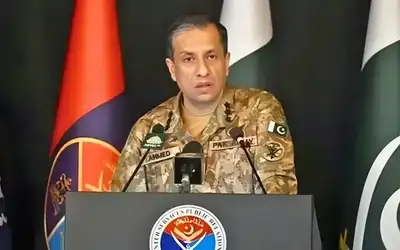
Pakistan’s military spokesperson says dozens of terrorist groups operating in Taliban-ruled Afghanistan are training, arming and planning cross-border attacks.
Citing United Nations reports, Ahmed Sharif Chaudhry said Pakistan would continue to take all necessary measures against terrorist groups to protect its citizens.
Speaking to Al Arabiya, Chaudhry said Pakistan’s military objectives were determined by the country’s political leadership, adding that Islamabad wanted interference and terrorist attacks originating from Afghan territory to end.
He said the Taliban authorities were allowing territory under their control to be used by such groups to recruit, train, arm and direct various terrorist attacks inside Pakistan and across the region.
The Pakistani military spokesman said recent UN reports had also documented the presence and activities of dozens of terrorist groups in Taliban-ruled Afghanistan, including al-Qaeda, ISIS-Khorasan, the Balochistan Liberation Army, Tehreek-e-Taliban Pakistan, the East Turkistan Islamic Movement and the Islamic Movement of Uzbekistan.
He said Afghanistan should not be allowed to become a global centre for terrorism.
Referring to Article 51 of the UN Charter and the right to self-defence, Chaudhry said Pakistan’s government and armed forces were committed to protecting the lives, property and security of their citizens and would take all necessary measures regardless of where or how such attacks were planned.
He described Pakistan’s counter-terrorism campaign as the only successful model of its kind over the past two decades, saying security forces had carried out more than 42,000 intelligence-based operations so far this year, in which more than 2,100 militants had been killed.
Chaudhry said Pakistan had strategic clarity in its fight against militancy, adding that the TTP’s claim that it was engaged in jihad or a religious war was completely false.
He said the Pakistani government and public understood that the group’s actions had no connection to religion.
Since the Taliban returned to power in Afghanistan in August 2021, Islamabad has repeatedly warned that terrorist groups, particularly the TTP, are using Afghan territory to plan and carry out attacks against Pakistan.
Pakistani officials say the Taliban has either failed or been unwilling to fulfil its commitments to prevent Afghan territory from being used as a base for terrorism. The issue has also been raised in several United Nations reports.
Border tensions between Afghanistan and Pakistan have led to armed clashes on several occasions in recent years, while Pakistan has carried out air and ground operations which it says were in response to TTP attacks.
Islamabad has repeatedly said its objective is to combat terrorism rather than interfere in Afghanistan’s internal affairs and has called on the Taliban to take stronger action against militant groups based in the country.
On International Day of Democracy, assessments by major international organisations show that Afghanistan under Taliban rule ranks at the bottom of global democracy tables after a historic collapse in political and civil rights.
The Economist Intelligence Unit’s annual Democracy Index shows Afghanistan’s score fell from 2.85 in 2020 to 0.32 in 2021, and then to 0.25 in both 2024 and 2025, a decline of nearly 89%, reflecting the dismantling of mechanisms based on public will and the rule of law.
Meanwhile, Freedom House, in its 2026 report, classified Afghanistan as “Not Free”, giving it just 8 points out of 100. The organisation awarded Afghanistan only 1 point out of 40 for political rights and 7 out of 60 for civil liberties.
According to the report, key indicators, including the election of the country’s leader and parliament, the existence of a transparent electoral framework, political party activity, the ability of opposition groups to win through political processes, media freedom, judicial independence and access to a fair trial, are all at their lowest levels.
A Vote With No Ballot Box
In democratic systems, elections are the main mechanism through which citizens participate in determining the political structure of their country. But after the Taliban returned to power, electoral commissions were dissolved in late 2021 and national elections were removed from the political agenda.
At the same time, political parties were banned across the country, eliminating the legal basis for political competition.
This structural change has taken place despite continued public interest in participating in decisions about Afghanistan’s political future.
The results of a field study involving 400 respondents in six Afghan provinces found that 91.5% supported elections as a method for choosing the country’s leadership.
Shahim Ahmadi, a university lecturer and political science expert, told Afghanistan International that the weaknesses of the former regime should not be equated with the complete absence of political mechanisms.
He said that in the republic regime, even though elections faced fraud, weak institutions and party crises, the basic right to protest, compete politically and seek peaceful change still existed. Today, the issue is not simply that there is no election day; the issue is that citizens have lost all legal means of monitoring and pressuring those in power.
Ahmadi added that political parties are not merely election machines, but institutions that formulate the demands of different sections of society and turn them into political programmes.
He believes that eliminating both political parties and ballot boxes has deprived society of political representation and concentrated power within a closed circle.
Civil Protest: The Heavy Cost of Seeking Justice in the Streets
Political participation is not limited to voting. The right to peaceful assembly is also one of the main ways citizens express demands and object to government decisions.
Over the past five years, the Taliban has suppressed protest gatherings and demonstrations, while protesters and civil society activists have faced threats, detention and violence.
In August 2026, the Taliban approved and published the “Shurta Law”, banning protest gatherings and demonstrations across Afghanistan.
After the law was issued, Taliban spokesperson Zabihullah Mujahid said that the concept of demonstrations did not exist within the group’s system.
Such restrictions had already existed before the law was formally adopted.
In June 2026, following the detention of several women in Herat, public protests in the city’s Jebrael area were met with violence.
The United Nations Assistance Mission in Afghanistan, UNAMA, said at least one teenager was killed and several others wounded after Taliban security forces opened fire and suppressed the protest.
Ahmadi said the securitisation of public space had cut off a key channel of communication between society and those in power.
He stressed that when citizens cannot protest peacefully, the main channel of dialogue between society and the authorities is severed. Protest does not necessarily mean opposition to an entire political system; it can be a way to correct a wrong policy. Fear and enforced silence should not be interpreted as public satisfaction. People are dissatisfied, but the high cost of repression forces them into silence.
Media Under Censorship and Systematic Intimidation of Journalists
The media is widely considered a pillar of democracy and an important means of holding those in power accountable. But recent monitoring reports point to an unprecedented decline in freedom of expression under Taliban rule.
The Afghanistan media support organisation NAI said in a report marking five years of Taliban rule that it had documented more than 700 cases of violence against journalists and media workers during that period.
According to the report, at least six journalists were killed and around 400 journalists and media workers were detained.
NAI also reported around 300 cases of journalists being beaten, nearly 5,000 journalists and media workers losing their jobs, and around 500 media outlets ceasing operations over the past five years.
At the same time, arbitrary detentions by the Taliban’s intelligence service and morality enforcers have continued, while a ban on filming living beings in more than 20 provinces has restricted the work of some visual media outlets.
Reports published in 2026 by UNAMA and Reporters Without Borders place Afghanistan 175th out of 180 countries in the World Press Freedom Index, among the lowest-ranked countries in the world.
Reporters Without Borders has also said that 43% of Afghanistan’s media outlets disappeared within the first three months after the Taliban returned to power, while more than two-thirds of the country’s 12,000 journalists left the profession.
Ahmad Mousavi, a pseudonym, told Afghanistan International that self-censorship had become an inseparable part of journalism.
“Before publishing every fact, a journalist has to calculate what security consequences the report could have for themselves, their family or the continued operation of their media outlet.”
Mousavi, who still works as a journalist inside Afghanistan, said major media organisations had altered their language to suit those in power, violating media ethics and press freedom.
He said that when access to information is cut off and questioning major political and security cases risks imprisonment, the media is reduced from a watchdog to a provider of harmless administrative news.
Restrictions on the media have not been limited to news content and journalists’ work.
Female journalists and media workers have also faced widespread pressure, and many have been pushed out of the profession because of Taliban restrictions.
Women and Systematic Exclusion
Under Taliban rule, Afghanistan has become the only country in the world where girls are formally and systematically barred from education beyond primary school and from university.
UNESCO reported in August 2026 that around 2.4 million girls are currently excluded from secondary and high school education.
Before the collapse of the former republic in 2021, nearly one million girls were enrolled at those levels.
Since December 2022, universities have also been completely closed to female students.
These restrictions have created a structural crisis in the education system.
According to UNESCO figures, the number of female university lecturers across Afghanistan fell from 2,599 in 2019 to 794 in 2024.
At the same time, a field assessment of 198 women working in teaching and education found that 98.5% had experienced a sharp fall in income.
Their average monthly earnings fell from 40,000 afghanis to 4,852 afghanis, while 91% of the women were the sole breadwinners in their households.
The exclusion of women from education has been accompanied by growing censorship and the entrenchment of restrictions through laws such as the Taliban’s “Promotion of Virtue and Prevention of Vice Law”.
Under the law, women’s voices and images are treated as “awrah”( parts of the human body that must be covered in public), and their appearance in media and public spaces is subject to censorship.
The Taliban judiciary has also continued to use corporal punishment and public flogging of defendants in stadiums and other public places.
Hosina Akbar, a women’s rights activist and athlete, told Afghanistan International that removing women from schools and universities was not simply about denying literacy.
She said it also meant the social isolation and economic exclusion of half the country’s population.
Women have lost pathways to independence and influence in healthcare, administration and the justice sector, she said.
Afghanistan is effectively losing a generation of skilled professionals, doctors and lecturers whose absence will create long-term consequences for the whole of society.
Ethnic and Religious Concentration of Power
Experts say the erosion of democratic principles in Afghanistan under Taliban rule is not limited to civil restrictions.
Critics argue that power has also become heavily concentrated along ethnic lines, with Tajiks, Hazaras, Uzbeks and other groups having only limited influence over major decisions.
Research by the Middle East Institute indicates that nearly 90% of key leadership positions in the Taliban are held by Pashtuns.
According to the data, Tajiks hold 5.2% of key posts and Uzbeks around 3%, while Hazara representation in the Taliban’s leadership structure is close to zero.
UN reports have also pointed to the concentration of power within the Taliban and the prominent role of Pashtuns in judicial and executive structures.
At the same time, Richard Bennett, the UN special rapporteur on Afghanistan, has warned in his reports about structural discrimination and the marginalisation of ethnic and religious minorities.
His reports have raised issues including forced displacement, land disputes and restrictions on some religious practices.
Wasi Rahmani, a legal affairs expert, told Afghanistan International that the existing legal structure had created conditions for widespread violations of the rights of ethnic groups.
Rahmani said that one ethnic group had monopolised power and that major laws and national decisions were being developed solely based on Hanafi jurisprudence.
He said the Taliban, despite repeatedly denying the issue, had effectively placed the core structures of power under its complete control.
According to Rahmani, this ethnic and religious concentration not only undermines inclusion but directly and structurally creates conditions for violations of the fundamental rights of other ethnic and religious communities.
Hussain Yasa, a writer and political analyst, believes the Taliban’s approach to Afghanistan’s diverse society is rooted in a denial of the political existence of different communities.
He said the current authorities not only reject democratic legitimacy and the legal legacy of previous governments but also disregard Afghanistan’s historic diversity through religious and ethnic homogenisation.
Yasa said actions such as taking over cultural and religious centres or disregarding the rights of Hazaras and Shia communities should not be viewed merely as administrative or legal disputes.
He argued that they reflect a policy in which ethnic participation in power and the independent religious and social existence of communities are effectively denied.
Experts say the single-ethnic and male-dominated composition of security, judicial and executive institutions, the exclusion of Jaafari jurisprudence and forced displacement have deepened national divisions.
They say the situation has also pushed Afghanistan to the bottom of global rankings on inclusive governance and the rule of law.
Collapse of Judicial Independence, New Codes and Public Punishments
The rule of law and an independent judiciary are central to protecting citizens from political power.
But in its 2026 report, Freedom House gave Afghanistan under Taliban rule a score of zero on indicators relating to judicial independence, access to a fair trial and equality before the law.
At the same time, the abolition of previous statutory laws and the constitution has brought major changes to Afghanistan’s legal and judicial structure.
The Taliban Justice Ministry and Supreme Court have introduced and approved documents such as the “Code of Criminal Procedure” and the “Code on Separation of Spouses”, reshaping parts of the legal system.
The “Code on Separation of Spouses”, issued by decree of The Taliban leader Hibatullah Akhundzada, includes provisions on marital separation and issues relating to the marriage of minors.
The “Code of Criminal Procedure” removes independent investigation procedures and bases proof of crimes largely on confession and testimony.
The document also criminalises leaving the Hanafi school of jurisprudence, provides for heavy prison sentences for defying orders from officials, and allows men to use domestic violence and corporal punishment within defined areas of authority.
At the same time, the independent bar association has been closed, professional legal staff and women have been removed from judicial positions, and corporal punishment and public executions have continued.
An Afghanistan International review of official Taliban Supreme Court statements shows that from the Taliban’s return to power in August 2021 until the end of March 2026, defendants received more than 100,000 lashes in public.
During the same period, the Taliban also carried out several public executions.
Rahmani said: “The essence of justice is measured before a sentence is carried out. A fair trial requires the right to a defence lawyer, documented notification of charges and the right to defend oneself before an impartial court.”
“When the judge and law enforcer come from the same structure, follow a strict interpretation and base decisions on documents such as the court and family codes, women and religious minorities are deprived of meaningful access to justice.”
He added that public sentences and flogging served no purpose other than social intimidation and the consolidation of power.
A Fundamental Threat to Political Culture
Democracy is not simply a mechanism for distributing power.
Academic research identifies tolerance, civil competition and peaceful dispute resolution through legal institutions as central elements of democratic political culture.
Depriving society of civil institutions, independent media and elections does not only change today’s political structure; it also shapes the political experience of future generations.
Five years after the collapse of the former republic, the gap between Afghanistan’s Democracy Index score of 2.85 in 2020 and 0.25 in recent years illustrates the scale of the change.
An Afghan citizen today cannot decide the country’s future through the ballot box, cannot protest without facing severe consequences, cannot send his daughter to school, and cannot turn to an impartial court when fundamental rights are violated.
The central question for Afghanistan’s future is therefore not simply who holds power in Kabul.
The deeper question is how much influence the collective will of the Afghan people will have over the country’s future.
The Netherlands Filmfonds says “Paikar”, by Afghan filmmaker Dawood Hilmandi, has been selected as the Netherlands’ official submission for the Academy Awards.
Hilmandi confirmed the news to Afghanistan International on Tuesday, saying the film is in Persian, was made in Afghanistan and was directed by an Afghan filmmaker.
He said the film was selected as the Netherlands’ official Oscar entry following a rigorous selection and review process among Dutch films.
Paikar previously won three awards at the 2025 International Documentary Film Festival Amsterdam, known as IDFA, and also received an award at Hot Docs.
The Oscar shortlists are due to be announced on December 15 this year, with nominations to follow on January 21. The Academy Awards ceremony will be held on March 14 2027, when the winners will be announced.
Paikar is a 97-minute documentary in which Hilmandi explores his family history, migration, separation from his homeland and, in particular, his relationship with his elderly and strict father. After years away, he returns to Iran and Afghanistan and tries to rebuild his relationship with his father. The film is in Persian and Dutch.
The film achieved notable success at IDFA in 2025, winning three awards: Best First Feature, the FIPRESCI Prize and a Special Mention in the Best Dutch Film category.
IDFA jurors described the film as a courageous work exploring the complexity of a family shaped by generations of war and displacement. They also described the father-son relationship at its centre as a poetic story that transcends borders and traditions.
One of the most compelling aspects of Paikar is that it is not simply a film about Afghanistan or migration. It is a family story that uses the relationship between a father and son to explore broader themes including war, exile, identity, belonging, home and freedom.
Who Is Dawood Hilmandi?
Dawood Hilmandi is an Afghan filmmaker, photographer and researcher who has spent parts of his life in Afghanistan, Iran and the Netherlands. His work explores themes including migration, identity, family, borders and the idea of “home”.
He graduated from the Netherlands Film Academy in Amsterdam and is the brother of Afghan filmmaker Aboozar Amini.
“A Journey Into Zero Space”
One of Hilmandi’s earlier notable works is the 2016 documentary “A Journey into Zero Space”. The film does not fit neatly into a single genre and combines family footage, archival material, handheld filming and elements of video art.
Some critics have described Hilmandi as a filmmaker with a kind of “patchwork identity” — part Afghan, part Iranian and part Dutch — and say this fragmented sense of identity is also reflected in the themes of his films.
Films About the Afghan Experience
In 2025, the 97-minute documentary Paikar became a major milestone in Hilmandi’s career. The film follows several generations of his family and explores migration, separation from homeland and the search for belonging, security and freedom. At the heart of the story is Hilmandi’s relationship with his elderly and strict father.
Some observers say Hilmandi is less interested in making films about Afghanistan itself than in exploring the experience of being Afghan while living between different homes and different worlds.
In “A Journey Into Zero Space”, fragmented identity and the search for home are central themes. In Paikar, that search is expressed through the relationship between father and son and the history of one family. The success of Paikar can therefore be seen as the continuation of an artistic trajectory rather than a sudden breakthrough.
Afghanistan’s History at the Oscars
Afghanistan began officially submitting films for the Academy Award for Best International Feature Film in 2002, following the fall of the Taliban’s first government.
Its first submission was “FireDancer”, directed by Jawed Wassel. It was followed by films including Siddiq Barmak’s “Osama”, Atiq Rahimi’s “Earth and Ashes”, Barmak’s “Opium War”, Jamshid Mahmoudi’s “A Few Cubic Metres of Love”, Roya Sadat’s “A Letter to the President” and Sahraa Karimi’s “Hava, Maryam, Ayesha”.
Despite submitting 14 films by 2019, no film representing Afghanistan has reached the final list of Oscar nominees. Some entries were also withdrawn or disqualified before the final stages of the competition.
Afghan stories have nevertheless received recognition at the Oscars outside the country’s official submissions. “The Breadwinner”, about an Afghan girl, and “Flee” were both nominated for Academy Awards, although neither was Afghanistan’s official entry.
Every day, Laila attends a classroom that is not supposed to be seen. She leaves home in the morning, goes to a school with no signboard and studies alongside girls who must remain hidden to continue their education.
Five years ago, Laila was 12 and had just entered seventh grade when the Taliban closed secondary schools to girls. Formal schooling ended for her, but her education did not.
A few months later, she found a secret school in her neighbourhood.
Laila is now in the 12th grade at “Invisibles” and is close to graduating. She says the greatest difficulty over the past five years has been the fear that the school could be discovered, students arrested and classes shut down.
Yet those years have also given her opportunities to learn.
She told Afghanistan International: “My intellectual skills have developed greatly, I understand my lessons better, and I have learnt tailoring, which I can use to earn an income.”
For Parasto Hakim, founder of the “Invisibles” initiative, remaining hidden is part of the price girls must pay to continue their education in Afghanistan.
The Invisibles Are Many
Hakim says the programme began with one secret school in September 2021, shortly after the Taliban returned to power. Today, she says, the network operates in 16 provinces, with 35 schools, more than 45 teachers and 1,830 students.
But for Hakim, “Invisibles” is not simply the name of schools that must remain out of the Taliban’s sight.
Girls leave home in the morning without people around them knowing they are going to school, while teachers give lessons behind closed doors in ordinary homes.
Hakim says what initially began as a security necessity gradually became part of the network’s identity.
“Every day, a girl wakes up early in the morning, goes invisibly to school and studies invisibly. The teacher teaches invisibly, and the team works invisibly.”
She says that very condition has become one of the network’s strengths.
“They wanted to define us as a weak force, but we used our invisibility to show what power looks like.”
UNICEF says more than 2.6 million girls in Afghanistan have been deprived of secondary education since 2021. Afghanistan is the only country in the world where secondary and higher education are banned for girls and women.
Under these conditions, “Invisibles” is trying to preserve part of girls’ education outside the formal system.
Students Who Became Teachers
Yalda, 18, graduated from an “Invisibles” school last year with high marks. Her name has been changed for security reasons.
But graduation was not the end of her journey. After finishing school, she set up a class in her area of Kabul, brought together dozens of children and asked the “Invisibles” initiative for help obtaining books and other educational materials.
According to Hakim, initiatives by students and teachers themselves have helped the network expand. More than 2,000 teachers across Afghanistan have also expressed willingness to join the programme and continue teaching their students.
Yalda says that after graduating, she was given the opportunity to work as a teacher through the same school where she had studied.
“After graduating, I got the opportunity to work as a teacher through the same school I had graduated from.”
She says the experience taught her that education is not only a right but something capable of changing lives.
Hosi, another student at one of the schools, had also lost hope of continuing her education when girls’ schools were closed.
“It was unbelievable that we could find an underground school, study there for five years and celebrate our graduation.”
She says security concerns were always present, but continuing their education kept them from remaining at home without learning.
“It saved us from illiteracy. We did not end up staying at home as illiterate girls doing only housework.”
Hosi also began working as a teacher with “Invisibles” after graduating.
Alongside academic subjects, the initiative’s schools teach skills such as carpet weaving, tailoring, digital skills, jewelry-making, design and art.
Hakim says the aim is to help girls use these skills to earn an income.
Education Against a Restricted Future
UNICEF has warned that girls who are out of school face greater risks, including early marriage, child labour and violence.
UNICEF data shows that around 29% of Afghan women aged 20 to 24 were married before turning 18. However, the data alone does not show that child marriage has increased since the Taliban returned to power in 2021.
Hakim says that after universities were closed to women and restrictions intensified, the responsibility of “Invisibles” went beyond academic education.
“Our responsibility went far beyond simply teaching. We had to help girls protect themselves from forced marriage, imposed decisions and economic dependence.”
Maryam, a teacher whose name has been changed for security reasons, stayed at home for around six months after the Taliban returned to power. She says the isolation had a negative effect on her mental wellbeing.
Later, children from the neighbourhood came to her home and asked her to teach them. Maryam gradually gathered more students and later began working with “Invisibles”.
She says that during five years of secret teaching she has “felt afraid every day”, but what encouraged her to continue was seeing hope in her students’ eyes.
“The main reason I continued was seeing hope in the girls’ eyes.”
Maryam has now graduated one group of students and is preparing for the graduation of a second.
Saba, 15, another student at the schools, says secret education has given her hope that she can achieve her future goals.
“Every time we fell, our teacher helped us stand up again, stronger than before.”
She says she wakes up every morning motivated to go to school and has learnt from her teachers to set ambitious goals for her future.
A Secret Classroom, a New Choice
Yalda says her secret school was shut several times, but she eventually graduated in 2026.
After graduating, she considered herself one of the luckiest girls in Afghanistan. But that feeling led her to ask why other girls should not have the same opportunity.
That is why she started a secret class for younger girls.
“This experience taught me that education is not only about building the future; it can also change who we are today.”
Yalda now hopes to continue her studies at a leading university abroad and plans to apply for a scholarship.
Hakim says that alongside academic teaching, “Invisibles” holds reading sessions on human rights, human dignity, justice and respect.
She says the aim is to strengthen girls’ ability to defend their rights within their families and communities, particularly at a time when they are being excluded from formal education.
This part of the initiative did not exist when the programme began. Hakim says her own view of the project has also changed over the past five years.
“When I started this work, I thought there was no way the Taliban could last five years. I thought perhaps I only needed to buy the girls some time; perhaps the world would do something to save us.”
But five years later, the secret schools are still operating.
Hakim says Afghan women have, on the one hand, been pushed to the margins by the country’s rulers and, on the other, have felt that the world does not sufficiently see their suffering.
“We were invisibles who were suffering, but somehow we kept going, just as we always have.”
For Hakim, continuing the initiative is no longer only about keeping classrooms open. It is about preserving the possibility of choice for a generation of girls whose usual paths through life have largely been closed.
“If a woman decides to change her future, she can do it even invisibly.”
For Laila, who has spent five years fearing that her school might be discovered and that she could be arrested, continuing her education means preserving the possibility of choosing a different future.
For Yalda, that choice has now taken another form: she is giving younger girls the same opportunity that was once given to her.
The schools may be invisible, and the teachers may work in silence, but inside these small classrooms, girls are preparing for a future they do not want an education ban to define for them.
Hakim says the struggle for the basic rights of women and girls does not always require taking to the streets or appearing in front of cameras.
“The struggle for basic human rights can be invisible and secret.”
Five years after girls’ schools were closed, these small classrooms remain open, out of the Taliban’s sight and with the hope that one day girls will no longer need to be invisible simply to learn.