• العربية
  • پښتو
  • فارسی
BrandBrand
  • Afghanistan
  • Sport
  • Analysis
  • Markets
  • Afghanistan
  • Sport
  • Analysis
  • Markets
  • Theme
  • Language
    • العربية
    • پښتو
    • فارسی
  • Afghanistan
  • Sport
  • Analysis
  • Markets
All rights reserved for Volant Media UK Limited
volant media logo

European Union Appoints New Special Envoy For Afghanistan

Oct 10, 2026, 16:42 GMT+1

The EU has appointed Thomas Frellesen as its new special envoy for Afghanistan. He says support for Afghans, particularly women and girls, will remain central to the bloc’s engagement with the country.

Frellesen announced the start of his mission in a post on X on Saturday, 10 October, saying he looked forward to working with European Union partners in the region and beyond.

“The Afghan people, and in particular women and girls, will remain at the heart of the EU's engagement,” he said.

Tomas Niklasson, the EU’s former special envoy for Afghanistan, also announced the appointment, saying Frellesen would continue the bloc’s mission of supporting Afghan women, men and children, engaging with the United Nations and other key partners, and pursuing principled engagement based on the conclusions of the Council of the European Union.

Frellesen has previously worked in various roles within the European Union, including as deputy head of the EU delegation to Ukraine.

The appointment of a new EU special envoy for Afghanistan comes as member states have stepped up efforts in recent months to return Afghan migrants.

Germany and several other European countries have entered into contacts and talk with the Taliban administration to facilitate the return of Afghan nationals. Berlin has in recent years resumed deportations of Afghans who, according to German authorities, have committed serious crimes.

The European Union has also stressed greater cooperation with countries of origin to return migrants whose asylum applications have been rejected or who do not have the right to remain in member states.

At the same time, the EU continues to criticise the Taliban administration’s policies towards women and girls, while stressing support for their rights and continued engagement with Taliban authorities.

Most Viewed

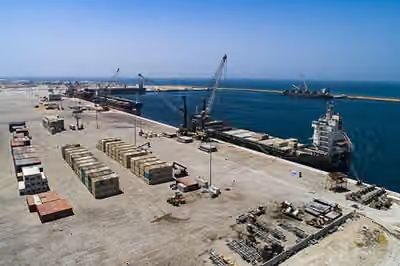
More Than 110 Hectares In Chabahar To Be Allocated To Afghanistan, Says Iranian MP
1

More Than 110 Hectares In Chabahar To Be Allocated To Afghanistan, Says Iranian MP

2

Child Soldiers, Sexual Exploitation Persist Under Taliban, Says US State Department

3

ISIS-K Remains One Of Islamic State’s Strongest Branches, Says UN

4

Over 6.5 Million Afghans Returned From Iran, Pakistan In Three Years, Says UN

5

Pakistan Rejects ISKP Allegations, Accuses Taliban Of Harbouring Militants

•
•
•

More Stories

Talks With Opponents Would Give Them Legitimacy, Says Taliban Official

Oct 10, 2026, 15:31 GMT+1
100%

Shahabuddin Delawar, head of the Taliban’s contact commission, has ruled out political talks with opponents, saying negotiations would amount to recognising them as a party to Afghanistan’s conflict.

He also said the Taliban made no commitments in the Doha agreement regarding the formation of an inclusive government or the rights of women.

Delawar, a senior Taliban official, said political negotiations with opponents would give them legitimacy as one side of Afghanistan’s political dispute.

Speaking to Shamshad TV in Kabul, Delawar said: “We will not negotiate with them and give them the status of being one side of Afghanistan’s issue. We do not recognise them. They have already been tested, and we do not consider them a party with whom we should enter political negotiations.”

He added that only a small number of prominent figures opposed the Taliban.

Delawar, who was a member of the Taliban negotiating team in talks with the United States, said of the Doha agreement that the word ‘woman’ does not appear in it from beginning to end.

He added that Pashtuns and Afghans are so strict regarding the issue of women that they do not even mention women by name in meetings. How could we have raised this issue with the Americans?

Without giving a specific explanation for the ban on girls’ education beyond sixth grade, Delawar defended Taliban leader Hibatullah Akhundzada’s order and said girls’ education would remain prohibited until “further notice”.

His remarks come despite comments he made during negotiations in Doha saying women had the right to study up to doctoral level and to work, and that the Taliban would remain committed to those rights.

Around three years ago, Delawar also said in several speeches that he hoped restrictions on girls’ education would be lifted.

He was later removed as minister of mines and petroleum and appointed head of the Taliban-run Afghan Red Crescent Society. Some reports linked the move to his earlier statements supporting girls’ education.

Under the Doha agreement signed by the Taliban and the United States in February 2020, intra-Afghan negotiations were expected to begin. The Taliban had agreed within the framework of the deal to participate in those talks.

Pakistan Minister Calls PTI a ‘Branch’ of Tehreek-e-Taliban Pakistan

Oct 10, 2026, 14:30 GMT+1
100%

Pakistan Information Minister Attaullah Tarar accused the PTI-led Khyber Pakhtunkhwa government of poor governance and called the party a branch of the TTP, alleging it spends provincial funds on protests instead of counter-terrorism.

Speaking at a press conference in Islamabad on Saturday, 10 October, Tarar said the Khyber Pakhtunkhwa government had received 700 billion rupees through Pakistan’s National Finance Commission for development projects but had failed to strengthen the Counter Terrorism Department.

He said the provincial government had also failed to establish forensic laboratories or install “safe city” surveillance cameras in the merged districts and at entry and exit points across the province.

Tarar alleged that Pakistan Tehreek-e-Insaf was using these financial resources to organise political protests.

“You don’t even give half an hour to discuss terrorism in the province, but you organise six-hour meetings to spread turmoil and vandalism,” he said.

The information minister also accused PTI of keeping the people of Khyber Pakhtunkhwa in difficult conditions in pursuit of the release of party leader and former prime minister Imran Khan, who remains in prison.

He said people in the province were facing poverty, inadequate healthcare, educational deprivation and a lack of infrastructure development and were, in his words, being held “hostage by terrorists”.

“From the very first day, this is my opinion that they [PTI] are the B-team of the Tehreek-e-Taliban Pakistan,” Tarar said.

He also accused the party of facilitating the return of people linked to armed groups and questioned how long security forces should continue clearing areas of militants if, as he alleged, the same individuals were later allowed to return.

Tarar accused the PTI-led provincial government of taking Khyber Pakhtunkhwa back to the “stone age” during its 13 years in power and of putting personal interests ahead of national interests.

He said the province needed peace, not politics.

Dispute Over Pakistan’s Policy Towards the Taliban

Tarar’s accusations come as Pakistan’s ruling parties have repeatedly criticised Imran Khan and PTI in recent years for what they describe as a soft approach towards the Tehreek-e-Taliban Pakistan.

One of the main points of dispute has been efforts to negotiate with the group and proposals to allow some of its fighters to return and resettle in Pakistan’s tribal areas.

During his time as prime minister, Imran Khan spoke about efforts to bring TTP fighters and their families back to the tribal regions.

However, PTI figures have said that negotiations and resettlement plans were not solely the party’s initiative and that Pakistan’s military leadership was also involved in the process.

PTI has also accused Pakistan’s ruling parties of damaging relations with Afghanistan’s Taliban administration through their policies.

The party has supported negotiations to resolve disputes, while Pakistan’s federal government has opposed some independent attempts by provincial governments to hold talks, arguing that such matters fall under federal authority.

Nearly 500 Children Killed In Afghanistan Over Three Years, Says UN

Oct 10, 2026, 13:31 GMT+1
100%

The UN says 1,415 children were killed or wounded in Afghanistan over three years, including 446 killed and 969 injured. The casualties included 1,094 boys, 310 girls and 11 children of unknown sex.

According to the UN secretary-general’s latest report on children and armed conflict, the Taliban recruited and used 557 boys during the same period, including children as young as 12.

Cases of child recruitment increased by 81 per cent compared with the previous reporting period, and all verified cases were attributed to the Taliban.

Around 80 per cent of child casualties were caused by explosive devices. The UN warned that unexploded ordnance and explosive remnants of war continue to pose a serious threat to children in Afghanistan.

The report verified a total of 4,582 grave violations against children. This represented a 38 per cent decrease compared with the previous reporting period, but the UN stressed that the decline did not indicate an overall improvement in the situation of children.

Most verified violations were attributed to the Taliban, followed by unidentified perpetrators.

Increase in obstruction of humanitarian aid

During the reporting period, 2,241 incidents involving the denial of humanitarian access were recorded, an increase of 189 per cent compared with the previous period. This was the most frequently documented violation.

The report also recorded 338 attacks on schools and hospitals, including 163 attacks on schools and 175 on hospitals.

The UN verified 24 cases of sexual violence against children, involving eight boys and 16 girls.

Seven children, two boys and five girls, were also abducted during the reporting period, with all of those cases attributed to the Taliban.

Restrictions and their impact on children

The report said Taliban restrictions on women and girls, including the ban on girls’ education beyond sixth grade, the morality law and restrictions on women working for humanitarian organisations and the United Nations, had disrupted the delivery of essential services and affected children.

Virginia Gamba, the UN secretary-general’s special representative for children and armed conflict, called on all parties to take every possible measure to protect children and to avoid the use of explosive weapons in populated areas.

She also called on the Taliban authorities to lift restrictions on women and girls, align the definition of a child with the Convention on the Rights of the Child and allow the United Nations unhindered access to detention facilities.

During the same period, 576 boys in northern and north-eastern Afghanistan were separated from Taliban ranks and enrolled in reintegration programmes.

Russia Using Taliban Ties To Reshape Regional Politics, Says Pakistani Analyst

Oct 10, 2026, 12:25 GMT+1
100%

A Pakistani security analyst says Russia’s changing stance towards the Taliban and ISIS suggests Moscow is reshaping its Afghanistan policy and creating a new “Great Game” in the region.

Imtiaz Gul, head of Pakistan’s Centre for Research and Security Studies, wrote in an article published by The Express Tribune on Saturday, 10 October, that recent remarks by Russian Foreign Minister Sergei Lavrov about the Taliban administration and its fight against ISIS had raised serious questions about Moscow’s objectives.

He said Lavrov told participants at the Moscow Format meeting on 5 October that they should acknowledge that the Taliban administration had successfully governed the country. Lavrov also praised Taliban security forces for fighting ISIS and other terrorist groups in Afghanistan.

Gul said Russia had in July referred to ISIS as “Islamic State-Khorasan Province” and described it as a threat based in Afghanistan. However, he said Lavrov did not use that term on 6 October and instead described the Pakistani branch of ISIS as a group carrying out terrorist attacks in Afghanistan and Pakistan.

According to Gul, this apparent shift strengthens the Taliban’s narrative about ISIS activity in the region. The Taliban claims ISIS centres are in Pakistan and are used to conduct operations against neighbouring countries, including Afghanistan.

He questioned whether Moscow’s decision to move away from the term “Khorasan Province” and adopt language closer to the Taliban’s narrative was coincidental or part of a broader change in Russia’s calculations towards Afghanistan and Pakistan.

Gul also pointed to Lavrov’s opposition to the deployment of NATO military infrastructure in Afghanistan and neighbouring countries, arguing that Moscow remains deeply concerned about a renewed Western military presence in the region.

He suggested that by moving closer to the Taliban, Russia could be sending a political message to the United States and Pakistan. According to Gul, Moscow may be prepared to assist Kabul in countering threats if Washington and Islamabad support armed groups opposed to the Taliban.

The Pakistani security analyst also cited Russia’s allegations that ammunition had been supplied from Pakistan to Ukraine as another possible factor in Moscow’s changing calculations. He wrote that Russia may now see Pakistan as aligned with the US- and European-led coalition supporting Ukraine.

Gul questioned whether these changes in relations between Russia, the Taliban and Pakistan could also explain why the latest Moscow Format meeting ended without a joint statement or a significant outcome.

Relations between the Taliban and Pakistan have become increasingly strained in recent months. Both sides accuse each other of supporting armed groups, while clashes along the border have also increased.

Russia is the only country to have formally recognised the Taliban administration. Moscow has expanded its ties with Kabul this year and supported greater political and economic engagement with the Taliban.

The Taliban has repeatedly accused Pakistan of supporting ISIS. Following recent attacks by Taliban opponents in Nuristan and Badakhshan, Taliban authorities also suggested that ISIS might have played a role in the fighting.

However, observers say claims linking armed Taliban opponents to ISIS are not supported by available evidence. Fighting in Nuristan and Badakhshan has largely involved the Afghanistan Freedom Front, which includes former members of Afghanistan’s security forces. No independent evidence of ISIS involvement in those clashes has been presented.

The Moscow Format meeting brought together representatives from Russia, the Taliban, Pakistan, Iran, China and several other regional countries. Russia sought to mediate between the Taliban and Pakistan, but their disagreements overshadowed the talks.

The Taliban delegation rejected the proposed wording of the final declaration, and the meeting ended without a joint statement. Pakistan said its disagreement with the Taliban was substantive and was not merely about wording.

Taliban Faces Growing Risk Of Civil War, Says Japanese Media

Oct 10, 2026, 11:26 GMT+1
100%

Nikkei Asia says continued clashes between the Taliban and Pakistan, along with failed Chinese mediation, have complicated Afghanistan’s security situation and could increase the risk of renewed civil war.

The Japanese outlet warned that continued tensions could strengthen armed groups opposed to the Taliban and increase the risk of Afghanistan sliding back into civil war.

In an article published on Friday, 9 October, Nikkei Asia said recent clashes between the Afghanistan Freedom Front and Taliban forces showed that groups opposing the Taliban administration were stepping up their military activities.

The publication also pointed to growing tensions between the Taliban and Pakistan, saying China’s efforts to ease the dispute had so far failed.

China hosted talks between the Taliban and Pakistan in May 2025, followed by negotiations in Kabul in August that year. In April 2026, China hosted seven days of talks in Urumqi and urged both sides to avoid further escalation and work towards a comprehensive agreement. However, none of the negotiations or mediation efforts has yet produced a breakthrough.

Two Pakistani government officials told Nikkei Asia that the failure of peace efforts had encouraged anti-Taliban groups to intensify their attacks. One official said these groups expected fighting between the Taliban and Pakistan to expand if the deadlock in bilateral relations continued.

Experts interviewed by Nikkei Asia said continued clashes with Pakistan could weaken the Taliban.

They were also not optimistic that differences between Kabul and Islamabad would be resolved quickly through Chinese mediation, stressing that the success of such efforts would depend on the willingness and readiness of both sides to reach an agreement.

Nikkei Asia warned that increased activity by anti-Taliban groups, combined with continued tensions with Pakistan, could reverse progress towards peace and push Afghanistan towards wider violence or even renewed civil war.

The report comes as continuing border clashes with Pakistan and increased activity by armed groups opposed to the Taliban have added to the security challenges facing the Taliban administration.