Afghan Journalist Released From Taliban Detention

Salam Watandar Radio on Monday confirmed that the media group’s reporter in Faryab has been released by the Taliban intelligence.

Salam Watandar Radio on Monday confirmed that the media group’s reporter in Faryab has been released by the Taliban intelligence.
Gul Mohammad Geran, the news manager of Salam Watandar Radio, said that Alauddin Erkin, a provincial reporter of the radio station, had been detained by the Taliban for two hours on Monday.
Geran said that Erkin had been detained as the result of a “misunderstanding”.
Media watchdog groups said that the Taliban have imposed severe pressure on journalists and restricted freedom of expression ever since it came to power last year.
In the latest case on Friday, July 24, the Taliban beat Selgai Ehsas, a local female journalist in Nangarhar province.
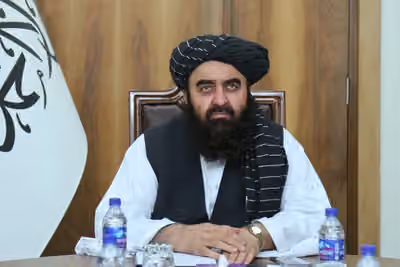

Markus Potzel, acting head of the United Nations Assistance Mission in Afghanistan (UNAMA), has emphasized on the establishment of an inclusive government in Afghanistan. Potzel, during a trip to Bamiyan province met with Taliban officials, civil society members, and women.
Markus Potzel said that they discussed “a wide range of issues including the importance of inclusive representation and decision making”.
Potzel had been recently appointed as the acting head of UNAMA and UN Sec Gen deputy special representative in Afghanistan. The German diplomat, who has worked in Afghanistan for many years, travelled to Nangarhar and Khost province too.
During his trip to Khost province, he met Sirajuddin Haqqani, Taliban’s acting minister of interior and representatives of local leaders from earthquake-affected areas.

Republicans, a new Afghan political organisation, announced its presence on Monday. In a statement, the leaders of the organisation stressed on the formation of “a republic, political democratic system, revival of the republican-era national flag, and all national values”.
The organisation stated that it will maintain regular and meaningful contact with all parties and will formulate plans to resolve the problems of Afghanistan by holding academic conferences.
The organisation has not introduced its leader, but has named several figures as members of its technical group. They include several former government officials, including Shahmahmood Miakhil, former Minister of Defense; Abdul Ghafoor Liwal, former ambassador of Afghanistan in Tehran; and Abdullah Raqibi, a former deputy minister of defense.
Other members of the organisation are Subhanullah Ludin, Sabrina Hamidi, Mahboob Shah Mahboob, Aziz Ahmadi, Maryam Zurmati and Faisal Jabarkhil.
In a statement published on social media, Shahmahmood Miakhil, has been introduced as the head of political relations and spokesperson of this political group.

The National Resistance Front of Afghanistan (NRF) indirectly criticized Uzbekistan for excluding “democratic forces” opposing the Taliban from the Tashkent summit.
NRF in a statement on Monday stressed that in the absence of a legitimate government, the participation of the anti-Taliban forces was essential for the summit.
Ali Maisam Nazary, head of foreign relations of the NRF, tweeted that Afghanistan enjoyed deep ties with Uzbekistan. He said that the two nations’ relations "are rooted in our common history and civilization”.
The Tashkent summit on Afghanistan started on Monday and will continue for two days. Representatives of 20 countries and international organizations have participated in the summit.
On Saturday, a Taliban delegation led by Amir Khan Muttaqi, acting foreign minister of the group, left for Uzbekistan to participate in the Tashkent Summit.
On July 24, the Taliban delegation attended a banquet hosted by the Deputy National Security Council of Uzbekistan. The Tashkent summit has been held close on the heels of the first anniversary of the fall of Afghanistan to the Taliban.
It has been almost a year since the Taliban entered Kabul in August 15, 2021, but the group’s government has not been recognized by any country as the legitimate government of Afghanistan.
The Taliban delegation will lobby for more support from the participating countries of the summit. On the other hand, Central Asian countries are expected to share their national security concerns emanating from Afghanistan with the Taliban officials.

Fawzia Koofi, a former member of Afghanistan’s negotiating team with the Taliban, on Monday, criticized Uzbekistan for inviting the Taliban to a summit on Afghanistan. Koofi said that countries bribe the Taliban to keep themselves safe from “global military extremism”.
She also warned on Twitter that "short-term pleasing will further help growth of extremism in the region”.
Koofi, who was an elected member of the House of Representatives for two terms in the previous Afghan government, said that inviting the Taliban to the Tashkent meeting will not help the people of Afghanistan.
The international Tashkent summit is scheduled to start on Monday with the presence of representatives of 20 countries, focusing on Afghanistan.
Koofi was one of the four women members of the peace negotiating delegation between the Islamic Republic of Afghanistan and the Taliban in Qatar.
The Taliban advanced on the battlefield during the peace talks and the group entered Kabul after Ashraf Ghani, the former president of Afghanistan left the country.
After entering Kabul on August 15, 2021, this group severely restricted the rights of Afghans, especially women across the country.
It has been more than 311 days that the Taliban have not allowed the doors of secondary schools to open for Afghan girls.
During this period, women's political and social participation has been widely limited.
After entering Kabul, the Taliban abolished the Ministry of Women Affairs and dedicated the ministry’s headquarters to the newly-established Ministry of Promotion of Virtue and Prevention of Vice.
This ministry has restricted the rights of Afghan women over the past one year, including in the education sector, and work life and also restricted their freedom of political participation and movement.

Local sources in Nangarhar province report that Taliban officials severely beat up a female journalist, Selgai Ehsas, on Friday. The Taliban officials also threatened her and asked her to quit her job. Sources said that the Taliban confiscated her smartphone.
Taliban's beating rendered Selgai unconscious and she was transferred to a hospital with the help of the local residents.
It has been said that the Taliban had warned Selgai’s family that she can’t continue her job as a journalist. However, local sources said that the journalist had no other option, but to continue her job due to economic challenges.
International journalist defender organizations have often expressed concerns over severe restrictions on freedom of speech and free media under the Taliban regime.
In the latest case, UNAMA in a report of the last ten months under Taliban’s rule said that after Taliban’s takeover, media personnel have been restricted in their activity.
Free Speech Hub in March announced that after the Taliban’s takeover, all democratic structures, specially freedom of speech, have suffered a severe blow.