Torkham Border Crossing Between Afghanistan And Pakistan Reopened
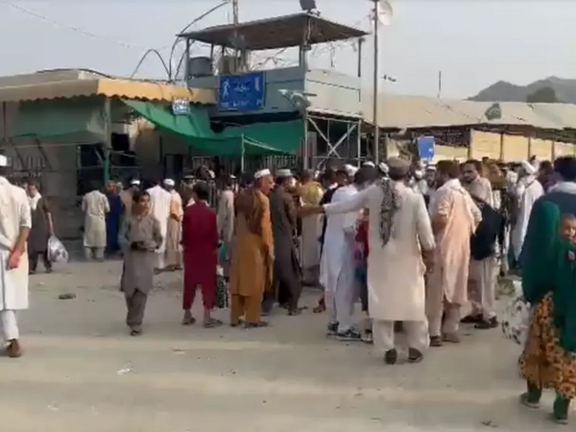
The Taliban’s governor’s office in Nangarhar province announced that the Torkham border has been reopened for traders and travellers on Friday.

The Taliban’s governor’s office in Nangarhar province announced that the Torkham border has been reopened for traders and travellers on Friday.
The Torkham border crossing remained closed since the past nine days following a skirmish between Pakistani border guards and the Taliban fighters.
After several meetings, Taliban and Pakistani officials have finally reached an agreement regarding the reopening of the Torkham border crossing.
Video clips sent to Afghanistan International show a large gathering of people waiting to cross this border checkpoint.
After the Taliban returned to power in August 2021, the group has had more than 20 armed clashes with the Pakistani border guards at the Torkham crossing, Spin boldak and other border areas.
On September 6, the Torkham crossing had been closed due to ongoing tensions between the Taliban and Pakistani forces.
Reports indicate that Afghan and Pakistani traders have lost millions of dollars due to the closure of the Torkham border crossing over the past few days.

On Thursday, Russian state news agency RIA Novosti, reported that Amir Khan Muttaqi, Taliban’s Foreign Minister, will participate in the Moscow Format Consultations in Kazan.
This meeting will be held on September 29 in the presence of representatives from 10 countries in Russia.
Delegates from Russia, India, Iran, Kazakhstan, Kyrgyzstan, China, Pakistan, Tajikistan, Turkmenistan, and Uzbekistan are expected to participate in this meeting.
The Taliban has not yet clarified the status regarding their attendance at this meeting. However, sources from the group have confirmed to RIA Novosti news agency that Muttaqi will participate at the upcoming session.
On Wednesday, September 13, Maria Zakharova, the spokesperson for the Russian Foreign Ministry in a press conference stated that the Moscow-format meeting would address the ongoing situation in Afghanistan, Afghan reconciliation, regional security, and post-war reconstruction efforts in Afghanistan.
According to her, the participants will release a joint statement following their discussion on Afghanistan.
Earlier, Zamir Kabulov, the special representative of the Russian president for Afghanistan said that the issue of forming an inclusive government in Afghanistan is on the agenda of this meeting. According to Kabulov, so far, no progress has been made regarding the formation of such a government.
Andrei Rudenko, Deputy Foreign Minister of Russia, also said that it is necessary to understand what the international community and especially the participants of the Kazan meeting can do to improve the situation in Afghanistan.
The Moscow format was formed to address the conflicts in Afghanistan. The upcoming meeting in Kazan is the fifth round of Moscow format talks. The Taliban had not been invited to the previous Moscow format meetings.

Following last week's border skirmish between Pakistani and Taliban forces at the Torkham border, the border crossing has remained closed for the ninth day.
Pakistani media quoted the head of the Afghanistan-Pakistan Joint Chamber of Commerce and reported that businesses on both sides are incurring daily losses totalling approximately USD 5 million.
The Torkham border crossing was closed on September 6, following a skirmish between Taliban and Pakistani border guards.
In a statement explaining the cause of the skirmish, the Taliban's Foreign Ministry on September 9 wrote, "Pakistani forces opened fired on the Afghan border forces when they were busy repairing a security outpost that had been built years ago."
Abdulsalam Jawad, Taliban’s spokesperson for the Ministry of Commerce and Industry, told the Taliban-controlled Radio Television Afghanistan (RTA) on September 14, that the group is negotiating with the Pakistani authorities to reopen the Torkham border.
Local sources told Afghanistan International that clash began when the Taliban started construction of a checkpoint near the Torkham Gate and Pakistani forces tried to stop it.
On the other hand, Pakistani officials have accused Taliban of "illegal" constructions and resorting to "unwarranted and indiscriminate firing" towards Pakistani border guards.
In the past few days, Taliban officials have demanded the reopening of the Torkham crossing and said that the closure of this border is detrimental to the merchants on both the sides.
The closure of this crossing caused hundreds of trucks full of fruits, vegetables and other commercial items to get stuck on both sides of the border.
Zahid Ullah, Director of Pakistan-Afghanistan Joint Chamber of Commerce told a Pakistani media outlet that the total value of exports and imports between Afghanistan and Pakistan in the last fiscal year was USD 1.8 billion.

Asif Durrani, Pakistan’s Special Representative to Afghanistan, during his visit to Tehran, stressed on cooperation with Iran to help stabilise Afghanistan.
Iran's Foreign Ministry in a statement on Wednesday wrote that Durrani met Iran's Foreign Minister Hossein Amir-Abdollahian.
In the statement, the Ministry of Foreign Affairs of Iran stressed that the officials of both countries discussed developments in Afghanistan.
Pakistan and Iran, like other countries, do not recognise the Taliban, but they have accepted the diplomats of the group in the Afghan embassy in both the countries.
Despite close relations of both countries with the Taliban, Taliban forces have had several border clashes with the Iranian and Pakistani border guards.
In the meeting with the Pakistan special envoy, Iran's Foreign Minister expressed hope that the continuation of negotiations between these two countries would contribute to greater peace and tranquillity in the region, particularly in Afghanistan.
This is Durrani's first official visit to Iran since his appointment as Pakistan's special representative for Afghanistan.

Esmail Pour Abed, Iran’s head of Dogharon border terminal, announced that the Taliban has lifted the time limit applicable on Iranian trucks entering Afghanistan.
Abed said that currently, between 550 and 600 trucks carrying export and transit cargo pass through the Islam Qala-Dogharon border crossing.
The Iranian head of Dogharon border terminal added that since the beginning of this week, the Taliban had put a limitation on the entry of Iranian commercial trucks into Afghanistan on the routes from Dogharon to Islam Qala and Herat, respectively, with a one-time entry limit in 10 and 20 days.
Dogharon border terminal is located 130 kilometers from Herat province of Afghanistan.
He explained, "The restrictions were such that Iranian trucks carrying export cargo were only allowed to enter the customs area of Islam Qala in Afghanistan every 10 days, or every 20 days from Dogharon to Herat. They had to wait for this duration to pass in order to re-enter the country."
This Iranian official said that Iranian officials held meetings with the Taliban officials at the border. According to him, in this meeting the issues that had arisen were discussed, and the Taliban lifted the time restrictions for the entry of Iranian trucks into Islam Qala.
Like other countries, Iran does not recognise the Taliban and despite its close relations with the group, it has had border tensions with the Taliban's border guards several times in the past two years.

Sabera Akbari, who was on a hunger strike along with Tamana Zaryab Paryani, was taken to the hospital due to her worsening health condition.
Paryani and a number of female activists have been on a hunger strike calling for the recognition of the gender apartheid in Afghanistan.
On Wednesday night, Akbari told Afghanistan International that she was taken to the hospital due to her deteriorating health condition. She added that she has been discharged from hospital.
This women's rights activist added that due to the hunger strike, the doctors told her that her heart rate had increased and she needed more care.
Sabera Akbari and Roqaya Saei said that on the 8th day they stopped their hunger strike and entered a new round of their protests against the Taliban's misogynistic actions.
Paryani and a number of human rights activists went on a 12-day hunger strike in the Cologne city of Germany from September 1. This protest, which started with the aim of recognising gender the apartheid in Afghanistan, continued until September 13.
A number of other women activists went on a hunger strike in front of the Norwegian Parliament supporting Paryani and other rights activists in Germany.
