Taliban Beats Up People In Kandahar For Non-Payment Of Taxes

Sources in Spin Boldak, Kandahar, told Afghanistan International, that Taliban members beat up some car sellers for not paying taxes.

Sources in Spin Boldak, Kandahar, told Afghanistan International, that Taliban members beat up some car sellers for not paying taxes.
A source said that the Taliban members were using force to collect taxes from the people of the district.
According to these sources, the Taliban members are constantly visiting shops, companies, commercial markets, and hotels and pressuring people to pay taxes.
The Taliban went to some car shops on Tuesday and beat people up. According to a video provided to Afghanistan International, a person lost consciousness after being beaten up by the Taliban and people gathered around him.
An informed source said that car sellers refused to pay taxes due to the high tax rates and the unfavourable economic and market situation, which was met with violence by the Taliban.
A number of people said that the Taliban does not provide services despite collecting a lot of taxes. Trade unions and businessmen have called the Taliban's taxes "back-breaking".
The Taliban said that they rely on internal revenues to run their government. The group hopes to fund its government by collecting taxes and mining.
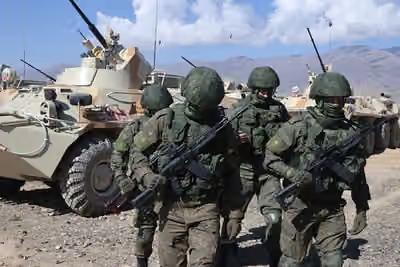
Haalvsh News Agency reported that Taliban and Islamic Republic border guards clashed on Wednesday morning at the zero point of the border in Helmand city.
According to the report, the clash began after Iranian border guards opened fire on Baloch fuel truckers on the border, killing one person.
At the same time, Haalvsh, which covers the news of Sistan and Baluchistan, has published pictures and videos in which the sound of gunfire can be heard in succession.
The clash between the Taliban and the Islamic Republic's border guards began after "the forces of the Border Guard Regiment of Burjak 4 of the Sasoli village outpost in Helmand city" opened fire on a number of Baloch fuel truckers, the news agency said.
According to the report, 26-year-old Naeem Rigi, a resident of the village of Khatam Ghaljaei Sasoli, was killed.
Official sources of the Taliban and the Islamic Republic have not yet commented on the clashes.
In over three years, since the Taliban took power in Afghanistan, the group's border guards have clashed with the Islamic Republic's border guards several times.

The United Nations Children's Fund (UNICEF) said that due to rapid urbanisation and climate change, there may be no groundwater left in Kabul by 2030. UNICEF called on its partners to take immediate action to address the problem.
UNICEF announced on Tuesday (October 29) that UNICEF's representative in Afghanistan, Tajudeen Oyewale, and the UN Secretary-General's Special Envoy, Roza Otunbayeva, met members of a number of vulnerable communities in Kabul.
UNICEF said that the meeting focused on finding solutions to meet basic human needs in the water sector in Kabul.
Oyewale wrote on his account on the social media network X that the impact of the water crisis in Kabul city is visible. "The water crisis is a humanitarian crisis that requires urgent support," he stressed.
The UNICEF representative called on international partners to take action to support children and families affected by the water crisis in Afghanistan.
Taliban officials have repeatedly warned about the water crisis in Kabul over the past three years. The group said that it was trying to transfer water from the Panjshir River to Kabul to solve the water crisis in Kabul.
The Taliban's mayor in Kabul said in 2021 that Kabul has only 29 million cubic metres of water, while the capital's residents need 100 million cubic metres of water.
The United Nations has previously announced that about 80 percent of the population of Afghanistan does not have access to adequate drinking water.
According to a report by the United Nations Development Programme published in late 2023, Afghanistan ranks sixth among countries vulnerable to climate change.
The European Union's mission to Afghanistan also expressed concern over the growing water crisis in the country in August this year, saying that drought, pollution and excessive use of water resources threaten people's lives.

A Taliban intelligence official told India Today, an Indian media outlet, that he wants to flee Afghanistan under the pretext of illness.
India Today did not name the Taliban official, reporting that he was a "teacher" and taught girls before the group's takeover again.
The Taliban official said that he wants to migrate with his family to Türkiye, Tajikistan, Syria or any country that gives him shelter. The commander said that he would migrate to any country where he can find a job.
The Indian media outlet wrote that the Taliban commander tried to flee Afghanistan several times, but his wife prevented him from doing so. According to the outlet, the commander's wife is religious and has no interest in fleeing the country.
India Today wrote that the Taliban commander taught girls as a teacher before the group's takeover of Afghanistan and the collapse of the previous Afghan government. Before the Taliban came to power, he prepared for a change and grew a long beard.
"I already had a hint of their arrival. I grew a beard, started preparing the girls so that they don't get disheartened about having to stay at home all of a sudden. But the most disturbing thing in this was that I was going to enforce these rules and regulations myself in the future. With the fall of the (Ashraf Ghani) government, I became a part of the Taliban. A commander of their intelligence department," he added.
As a Taliban commander, his job now is to monitor whether people were joining Al Qaeda or the Islamic State or were not in cahoots with any other terrorist group. Regarding his duty, he said, "My duty is to spy and punish those who conceal. I don't punish myself, but my subordinates do. If the crime is big, we need to inform the higher authorities, then they will decide. That's what we get paid for."
"From the soldier who brings me tea to the soldier who opens the car door, anyone can spy and get a reward in return," he told India Today, adding that if he does not leave Afghanistan, he will be in danger along with his family.
"If ordinary people make mistakes, they will be imprisoned. But if we as officials commit a crime, the penalty is death," he added.
As for how Taliban commanders are selected, he said that the group's administration checks the background of individuals, but "ethnic prejudice" is decisive.
Earlier, German media outlets had reported that a number of dangerous Islamists were also brought to Germany from Afghanistan during the German evacuation programme.

The Taliban's Supreme Court announced that it had sentenced four people, including a woman, to 39 lashes in public in the Kuz Kunar district of Nangarhar province.
The court said in a statement that the men had been convicted of running away from home and having extra-marital relations.
According to a statement issued by the Taliban's Supreme Court, the flogging sentence of a woman and three men was carried out on Monday, October 28, in the presence of the group's officials and residents of Kuz Kunar district.
On Monday, the Taliban also punished four other people, including a woman, with 39 lashes in public in Sayed Khel district of Parwan province.
In the past two weeks, the group has publicly flogged about 25 men and women on various charges in Khost, Kabul, Takhar, Parwan, Faryab and Nangarhar provinces.
After taking control of Afghanistan, the Taliban announced the abolition of all laws in force in the country, and the group's courts tried the defendants based on what they call "Islamic law”.

The Committee to Protect Journalists (CPJ) announced that the Taliban's ban on the broadcast of images of living beings in the media is a matter of concern.
An official of the New York-based committee called on the international community to end "passively watching Afghanistan's rapid retreat”.
"The Taliban's recent ban on television, filming and photography in Takhar should worry anyone who cares about media freedom around the world," said Carlos Martínez de la Serna, programme director of the Committee to Protect Journalists.
Recently, the Taliban's Ministry of Promotion of Virtue and Prevention of Vice announced that the group is implementing a law prohibiting the broadcast of images of living beings in the media, calling it "un-Islamic".
Earlier, Saiful Islam Khyber, a spokesman for the Taliban's Ministry of Promotion of Virtue and Prevention of Vice, confirmed to the Associated Press that the media group in Takhar, Maidan Wardak and Kandahar had advised them to refrain from broadcasting images of living creatures.
Khyber said that the directive is a part of the group's recently signed law on the promotion of virtue, the Associated Press reported.
Earlier, Afghanistan International had reported that Yousuf Ahmadi, the head of the Taliban-controlled National Television, said during a meeting with the directors of the channel that the group intends to stop the broadcast of the channel.
Previously, the Taliban had stopped broadcasting on national television in Kandahar and Takhar.
Earlier, the spokesman for the Taliban's Ministry of Promotion of Virtue and Prevention of Vice announced that the group would gradually implement this law on all media outlets. Saif Khyber told AFP that the ban had initially started in some provinces and would gradually be implemented across Afghanistan.
Since the Taliban's return to power in August 2021, the group has made extensive efforts to suppress and censor Afghan media.
The Taliban's restrictions on the media have included banning music and TV series, imposing masks on female presenters, banning live broadcasts of political programmes, shutting down some media outlets, and jamming the broadcasts of the Afghanistan International Network.
