• العربية
  • پښتو
  • فارسی
Brand
  • Afghanistan
  • Sport
  • Markets
  • Afghanistan
  • Sport
  • Markets
  • Theme
  • Language
    • العربية
    • پښتو
    • فارسی
  • Afghanistan
  • Sport
  • Markets
All rights reserved for Volant Media UK Limited
volant media logo

Request For Arrest Warrants For Group’s Leaders Lack Legal Basis, Says Taliban

Jan 24, 2025, 12:23 GMT+0

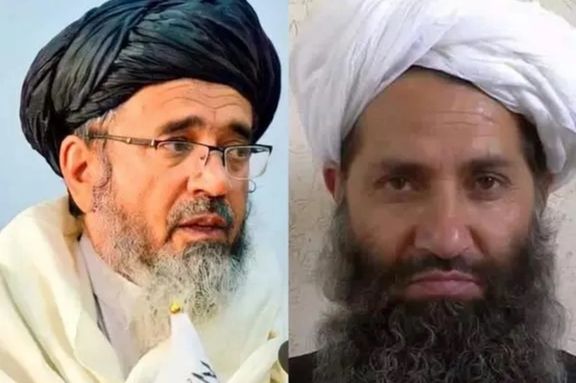
In response to the request for an arrest warrant for the group’s leader and chief judge of the Supreme Court, the Taliban accused the International Criminal Court (ICC) of double standards.

The Taliban’s Foreign Ministry said that the request for arrest warrants for Hibatullah Akhundzada and Abdul Hakim Haqqani “lack a fair legal basis” and were “politically motivated”.

The Taliban’s Foreign Ministry responded almost a day after the ICC’s chief prosecutor announced his request for arrest warrants for Hibatullah Akhundzada and Abdul Hakim Haqqani.

The Taliban’s Foreign Ministry issued a statement saying that the ICC prosecutor’s charges “like many other decisions of this institution, lack a fair legal basis, are double standards, and are politically motivated”.

ICC Prosecutor Karim Khan has charged Hibatullah Akhundzada and Abdul Hakim Haqqani with crimes against humanity for gender-based violence.

The Taliban’s Foreign Ministry said that it called the charges “baseless” and strongly condemned them.

The Taliban Foreign Ministry wrote on Friday, February 24, that the International Criminal Court had requested the arrest warrant for the group’s senior officials at a time when security in Afghanistan had been established under the group’s administration.

The ministry said that “private prisons, kidnappings, islands of power of warlords and many other tragedies and inhumane acts have disappeared”.

The Taliban accused the International Criminal Court of “turning a blind eye to war crimes and inhumane acts committed by foreign forces and their domestic allies” over the past 20 years.

The Taliban said that the court’s disregard for past incidents in Afghanistan had further weakened the institution’s credibility.

The Taliban Foreign Ministry said that the court should not try to impose its own interpretation of human rights on the world and ignore the religious and national values of other nations.

Most Viewed

Former Afghan President Questions Taliban Over Pakistan Border Peace Deals
1

Former Afghan President Questions Taliban Over Pakistan Border Peace Deals

2

Taliban Confirm Two Killed In Clashes In Badakhshan’s Argo District

3

Taliban Besieged TOLOnews Offices After Journalist Detentions, Say Sources

4

Pakistani Envoy Urges Taliban to Take Practical Action Against Militants

5

Exiled Media Watchdog Urges UN, EU To Seek Release Of Journalists Held By Taliban

•
•
•

More Stories

Book Bans Common Practice In Many Countries, Says Taliban Official

Jan 24, 2025, 11:12 GMT+0

Hayatullah Mohajir Farahi, the Taliban's Deputy Minister of Information and Culture, defended the group's ban on the distribution and publication of dozens of books, saying that banning books is a "common practice" in many countries.

Farahi added that the Taliban has banned some books in order to build a "single nation" in Afghanistan.

In an interview with the group's controlled national television, the Taliban official said that "all over the world" governments have adopted different methods regarding the ban on books.

In "neighbouring countries, Arab countries and even Europe", he said, books that contradict their values are banned.

"This issue is not limited to Afghanistan," Farahi said. “Throughout history as well as in the current world, it is a common occurrence that governments in some cases give themselves the right to ban certain books."

After coming to power in Afghanistan, the Taliban, along with imposing other restrictions on freedom of expression, have banned hundreds of books in the fields of politics, religion, art and culture, history, literature, and philosophy and collected them from libraries and bookstores.

The Taliban has called the books "undesirable" and "contrary to Afghan and Islamic values".

Critics of the Taliban, however, say that by removing books, the group seeks to strengthen the intellectual foundations of its ideology in society.

Will Deport More Criminals To Afghanistan, Says German Interior Minister

Jan 24, 2025, 10:06 GMT+0

A day after a deadly knife attack in Germany, the country's interior minister said that she was working hard to deport more criminals to Afghanistan.

Nancy Faeser said that Germany is the only country in Europe that has deported serious criminals to Afghanistan since the Taliban came to power.

A 28-year-old Afghan asylum seeker was arrested after a deadly knife attack in the German city of Aschaffenburg that resulted in the death of a two-year-old child and a 41-year-old man. The attack has once again intensified the debate over the deportation of criminal asylum seekers to Afghanistan ahead of Germany's general elections.

"We are the only country in Europe that has deported serious criminals to Afghanistan for the first time since the Taliban came to power, and I want to say frankly that we are working hard to deport more criminals to Afghanistan," Faeser said on Thursday in Berlin.

The German interior minister also criticised the lack of implementation of the Dublin Rules in the European Union, saying, "We are once again seeing that the Dublin system no longer works."

The Afghan asylum seeker, who is a suspect in Wednesday's attack, should also have been deported from Germany to Bulgaria under the Dublin rules, but officials said that the deportation was not carried out due to the deadline.”

Ahead of Germany's early elections on February 23, Wednesday's attack has once again sparked a debate about immigration among Germany's political parties.

Friedrich Merz, head of the conservative Christian Democrats (CDU), said in Berlin on Thursday that if he forms a government after the election, he wants to make German border controls permanent and ban undocumented people from entering Germany.

Merz, who is likely to be elected chancellor in February's election, said that the Aschaffenburg attack showed "a new face of unbridled cruelty in Germany". He stressed that all "illegal immigrants" should be turned back at the border.

Criticising the "inefficiency" of EU immigration laws, he said, "We are facing the ruins of a 10-year wrong asylum and migration policy in Germany."

Merz called for a departure from the Schengen principle on free movement within the European Union and pledged to order permanent control of all German borders on the first day of his chancellorship if elected.

Afghan Refugees Petition Australian Parliament Against Ban On Women's Education

Jan 24, 2025, 09:21 GMT+0

A number of Afghans living in Australia have submitted a petition to the country's parliament against the ban on Afghan women's education in Afghanistan.

They say that the Australian parliament has accepted the petition and that a session of the Australian parliament is scheduled to be held to discuss it.

In their petition, they expressed their serious concern over the ban on the education of Afghan girls under the Taliban's rule, calling this ban a clear violation of human rights and international law.

"This ban has a detrimental impact on the lives of Afghan girls and women," they wrote in their petition.

They called on the Australian Parliament to take immediate steps to help reopen girls' schools in Afghanistan.

Their petition reads, "We condemn the Taliban's efforts to introduce children to extremist ideology. This is a form of psychological abuse and a threat to global security."

In the petition, they said that the Australian Parliament must take decisive steps to support the right of Afghan girls and women to education.

Mohammad Sami Mohmand, president of the Afghan Refugee Association in Australia, who submitted the petition to parliament on behalf of Afghans, told Afghanistan International, "We have asked the Australian parliament to take decisive steps on girls' education. Fortunately, they have accepted our petition, published it on their official website, and it is scheduled to be discussed in Parliament."

"We strongly request that they issue a statement on the ban on girls' education in Afghanistan and refer the Taliban to the International Criminal Court," he added.

The Australian parliament should encourage the International Criminal Court to investigate the Taliban's crimes against humanity, the Afghans say.

"We support any effort to restart the process of girls' education in Afghanistan and stand with those who have submitted this petition to the Australian Parliament," said Hamid Mohammadi, an Afghan refugee living in Australia.

Iran's Foreign Minister To Visit Afghanistan Soon

Jan 23, 2025, 16:22 GMT+0

The Embassy of the Islamic Republic of Iran in Kabul announced on Thursday, January 23, that Foreign Minister Abbas Araghchi will visit Afghanistan soon.

Without providing further details, the embassy wrote on its account on social media platform X, "Araghchi's imminent visit to Afghanistan."

In response to Araghchi's visit, the Taliban's Foreign Ministry called it a "constructive step" towards strengthening relations between the two countries and said that his visit could "enter a new phase" in relations between the two countries.

Zakir Jalali, a Taliban foreign minister official, wrote in a note on his X account, "The common political, economic and security interests between Afghanistan and Iran are an opportunity to strengthen bilateral cooperation."

After the fall of Afghanistan to the Taliban, Iran was one of the few countries that continued its diplomatic relations with the Taliban and became a serious regional supporter of the Taliban, but no Iranian foreign minister had visited Kabul in the past three and a half years.

Earlier, on August 27, 2023, Amir Khan Muttaqi, the Taliban's acting foreign minister, had invited Amir Hossein Abdollahian, the foreign minister of Ebrahim Raisi's government, to visit Kabul.

In that phone conversation, the two sides discussed the distribution and management of water in the Helmand River, especially Iran's water rights.

In recent weeks, Iranian officials have spoken several times about Iran's water rights from the Helmand River, and in some cases, they have threatened to take it from the Taliban by "force".

Recently, after a visit to Sistan and Baluchestan province, Iranian President Masoud Pezeshkian emphasised in a television interview that Iran's Sistan and Baluchestan water rights are being pursued in talks with the Taliban.

In addition to the issues of terrorism and narcotics, it seems that Abbas Araghchi's visit to Kabul is not unrelated to Iran's water rights.
Taliban Publicly Flogs 10 People, Including Woman, In Khost

Jan 23, 2025, 15:32 GMT+0

The Taliban's Supreme Court announced on Thursday that the group had flogged 10 people, including a woman, in front of the public in Khost province.

The Taliban have accused these individuals of extramarital affairs, same-sex relations, running away from home, threats and "illegitimate relationships".

In a statement on Thursday, January 23, the Taliban's Supreme Court wrote that in addition to flogging, these individuals were also sentenced to one to three years in prison.

According to a statement by the Taliban's Supreme Court, the Taliban's judicial authorities in Khost have sentenced six people to 39 lashes and two years in prison.

It is said that the other three defendants were also given 30 lashes and sentenced to three years in prison.

Another defendant was sentenced to 39 lashes and one year in prison, according to the statement.

The Taliban's Supreme Court announces the implementation of corporal punishment sentences against citizens almost every day.

The international community has repeatedly called on the Taliban to stop corporal punishment of the accused. The Taliban, however, says that they will sentence the defendants to corporal punishment based on "Islamic law".

Human rights organisations say that the Taliban's judicial system is not standardised and that defendants do not have access to the most basic due process, such as a defence lawyer.