Pakistan’s Interior Minister Briefs PM On Afghan Deportation Plan
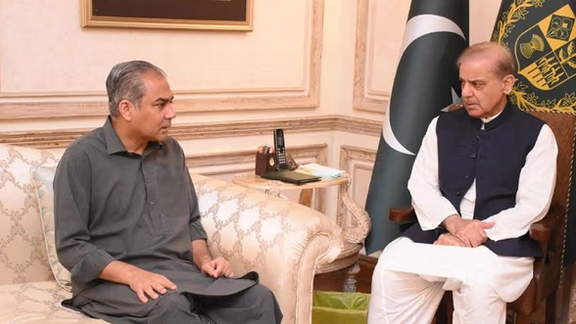
On Wednesday, Pakistan’s Interior Minister Mohsin Naqvi briefed Prime Minister Shehbaz Sharif on national security measures for Eid and the ongoing repatriation of Afghan refugees.

On Wednesday, Pakistan’s Interior Minister Mohsin Naqvi briefed Prime Minister Shehbaz Sharif on national security measures for Eid and the ongoing repatriation of Afghan refugees.
The discussion focused on enforcing measures following the deadline for Afghan refugees to depart Pakistan.
According to the Express Tribune, officials reiterated that legal action would target those staying in violation of government policies. Senior Pakistani leaders have consistently underscored their resolve to deport Afghan refugees, a topic revisited during Wednesday’s meeting between Sharif and Naqvi.
The Express Tribune reported that Sharif praised security agencies for upholding law and order, though his position on deporting Afghan Citizen Card (ACC) holders remained unspecified. The original 31 March deadline for Afghan refugee deportations was postponed due to Eid al-Fitr.
A Pakistani official confirmed the deadline has now been extended to early next week, after which the deportation of approximately 800,000 ACC holders, as estimated by the UN, will commence.


The Purple Saturdays Movement has sounded the alarm over the worsening plight of Afghan women and girls, decrying the Taliban’s ongoing violations of their rights and freedoms.
In a statement issued on Wednesday, 2 April, the Afghan women-led protest group called for global solidarity to support those affected.
“Millions of girls are denied education, barred from schools and universities, while countless women are stripped of their right to work and live freely,” the statement declared. “Afghan women are confined to their homes, trapped in fear, oppression, and despair.”
The movement also drew attention to the wider impact of these restrictions, noting a surge in mental health struggles, depression, and hopelessness among Afghan women and girls due to the persistent denial of basic rights. “With global solidarity and a united voice of protest, we can stand with Afghan women,” it urged. “This is not merely a moral obligation but a shared responsibility for us all.”
Despite sustained efforts by the Purple Saturdays Movement and international criticism, the Taliban has shown no sign of relaxing its policies nearly four years after seizing power. Afghan women and girls remain excluded from education beyond the sixth grade and prohibited from attending universities, with no policy shift in sight.

Faisal Khamoosh, spokesperson for the Taliban’s Ministry of Martyrs and Disabled Affairs, announced that since the group’s return to power in August 2021, around 650,000 differently-abled individuals, orphans, and widowed women in need have been registered.
Speaking to Taliban-run Radio Television Afghanistan (RTA), Khamoosh said the registration process for these groups is expected to conclude by the end of March 2026.
The ministry accused the previous Afghan government of enrolling thousands of “fictitious” individuals as disabled or widowed, claiming these have now been removed from the list of beneficiaries. Some families of former Afghan government military personnel previously told Afghanistan International that their monthly financial aid from the ministry was halted after the Taliban’s takeover.
In November 2024, the Taliban’s Ministry of Martyrs reported distributing 10.17 billion Afghanis to orphans, disabled individuals, and widows. However, it remains unclear whether this aid extends to families of security forces or victims of suicide attacks from the prior administration.
On Tuesday, Taliban spokesperson Zabihullah Mujahid told RTA that since seizing power, the group has prioritised support for families of its suicide attackers. He revealed that 12 billion Afghanis—equivalent to the budget of two or three ministries—had been allocated through the Ministry of Martyrs and Disabled to assist the orphans and widows of these fighters.

Pakistani officials confirmed on Tuesday that 90 Afghan migrants were arrested in Islamabad and Rawalpindi and deported via the Torkham border. Of those expelled, 77 held Afghan Citizen Cards (ACC), while 13 lacked legal residency documents.
Authorities noted this action was distinct from the formal expulsion process, set to begin once temporary migrant camps are operational.
The temporary repatriation camp in Landi Kotal, Khyber Pakhtunkhwa, remains shut due to Eid holidays. A Pakistan’s immigration authority told Afghanistan International on Tuesday that the forced deportation of undocumented Afghan migrants had officially started, with arrests occurring nationwide. In this initial phase, only those without valid residency papers are being targeted.
The Associated Press, citing government documents, previously reported that Pakistan delayed the forced repatriation of Afghan migrants until 10 April due to Eid al-Fitr. The report added that Islamabad plans to deport three million Afghans this year.
Amid the crackdown, the Taliban’s consul in Karachi met Sindh’s Chief Minister on Tuesday, pressing for an end to police harassment of Afghan migrants with legal residency documents. The Taliban have consistently urged a dignified return for Afghan migrants, but Pakistani authorities have rejected these pleas, continuing with widespread arrests and deportations.

Iranian media report that President Masoud Pezeshkian has engaged with leaders of 11 neighbouring and Muslim countries in the first 12 days of the Hijri solar year 1404 (March–April 2025) to mark Nowruz and Eid al-Fitr.
Notably, no Taliban officials were included in these discussions.
On Wednesday, IRNA news agency stated that Pezeshkian’s calls aimed to bolster ties with friendly, neighbouring, and allied nations in the face of threats and pressure from “bullying and arrogant enemies.”
Over the past 12 days, he spoke with the leaders of Uzbekistan, Iraq, Tajikistan, Algeria, Turkmenistan, Pakistan, Qatar, Egypt, Oman, Malaysia, and Türkiye, according to the agency.

Zabihullah Mujahid, the Taliban’s spokesperson, hailed Russia’s proposal to suspend its terrorist designation as a “necessary and important step” towards bolstering Afghanistan-Russia ties.
Speaking on Tuesday to TASS news agency, Mujahid expressed optimism, stating that such measures enhance relations between the two nations and are highly valued by the Taliban.
The move follows a formal request from Russia’s Prosecutor General’s Office to the Supreme Court to temporarily lift the Taliban’s status as a banned organisation, with a hearing scheduled for 17 April, according to state news agency RIA Novosti. This shift in policy stems from a law signed by President Vladimir Putin on 28 December 2024, which permits judicial bodies to conditionally suspend terrorist designations upon a request from the Prosecutor General or their deputy, subject to court approval. Leonid Slutsky, head of the State Duma’s Committee on International Affairs, noted that the legislation paves the way for official engagement with the Taliban.
Suhail Shaheen, head of the Taliban’s political office and ambassador to Qatar, told RIA Novosti that the anticipated suspension benefits both countries by removing barriers to cooperation. He expressed hope that, once the ban is lifted, delegations would travel between Kabul and Moscow to explore collaborative opportunities.
Russia first labelled the Taliban a terrorist group in 2003, rendering official interactions illegal. However, Moscow’s stance has evolved in recent years, with diplomatic engagement increasing. Before the Taliban regained power in 2021, Russia hosted several Afghan peace talks under the Moscow Format, marking the group’s initial media appearances.
The decision coincides with the Taliban’s broader diplomatic outreach, including efforts to formalise ties with the United States. Recently, a senior US delegation visited Kabul to discuss bilateral relations and the release of American hostages. The Taliban, seeking to reopen its embassy in Washington, subsequently freed two American hostages “as a goodwill gesture to Trump,” according to group statements.