Over 4000 Afghans Deported From Iran, Pakistan Within 24 Hours

The Taliban’s High Commission for Addressing Migrants’ Issues has reported that a total of 4135 Afghan nationals were deported from Iran and Pakistan on Thursday, 8 May.

The Taliban’s High Commission for Addressing Migrants’ Issues has reported that a total of 4135 Afghan nationals were deported from Iran and Pakistan on Thursday, 8 May.
According to the commission, 2627 Afghans were deported from Pakistan and 1508 from Iran. The returnees entered Afghanistan through the Torkham, Spin Boldak, Islam Qala, and Pul-e-Abrisham border crossings.
In an update issued on Friday, 9 May, the commission stated that 745 of the returnees had been transferred from Kabul to various provinces, including Ghazni, Logar, Khost, Paktia, Paktika, Baghlan, Takhar, Balkh, Jowzjan, and Kunduz.
Just one day earlier, on Wednesday, 4978 Afghan migrants were also deported from Iran and Pakistan, reflecting a continuing wave of forced returns.

The Iran Human Rights Organisation has reported that the Iran executed seven prisoners, including one Afghan national and four Iranian Baluch citizens, at Birjand Prison in South Khorasan Province.
According to the rights group, the executions were carried out in the early hours of Sunday. All individuals had been sentenced to death by the Iranian judiciary on drug-related charges.
The Afghan national was identified as 52-year-old Alireza Lalouzai, a resident of Mashhad. He had been arrested three years earlier and later convicted of drug trafficking offences.
The six other individuals executed were named as Khosrow Sarani (42), Mahmoud Sarani (41), Yousef Sorourvash (52), Mousa Shokoohi (41), Mojtaba Lakzaei (34), and Ali Noori (35). The organisation noted that four of them were Iranian citizens of Baluch ethnicity.
The executions were reportedly carried out in secrecy, with no prior notification or final visitation rights granted to the prisoners’ families.
As of now, there has been no official confirmation or reporting from Iranian state media or judicial authorities regarding the executions.

The Japanese humanitarian organisation Peshawar-kai has announced plans to resume the treatment of leprosy in Afghanistan, nearly 15 years after suspending its operations in the country.
The initiative is being relaunched in memory of Dr Tetsu Nakamura, the former head of Peshawar-kai, who was affectionately known in Afghanistan as “Kaka Murad”. Dr Nakamura, a revered figure for his decades-long humanitarian work, was killed in an armed attack in Jalalabad, Nangarhar Province, in 2019.
According to Japan’s Yomiuri Shimbun newspaper, the organisation intends to restart its medical programme later this year. The project will focus on providing medication, training healthcare personnel, and dispatching mobile medical teams to areas including Nangarhar Province.
Dr Nakamura began treating leprosy patients in Pakistan during the 1980s and later expanded his efforts into Afghanistan, where he also led major water management and irrigation projects aimed at improving agricultural livelihoods.
With the slogan “Keeping Dr Nakamura’s spirit of service alive,” Peshawar-kai aims to strengthen healthcare services in some of Afghanistan’s most underserved regions.
Despite restrictions imposed by the Taliban authorities on female participation in the health sector, the organisation hopes to recruit women doctors to help deliver treatment.
In January 2024, officials from the Nangarhar provincial administration and the Taliban-run Ministry of Public Health formally requested the organisation to restart its leprosy treatment services.
According to World Health Organisation data, only 45 cases of leprosy were officially recorded in Afghanistan in 2017. However, due to ongoing challenges in the country’s healthcare infrastructure, the true number of infections remains unclear.

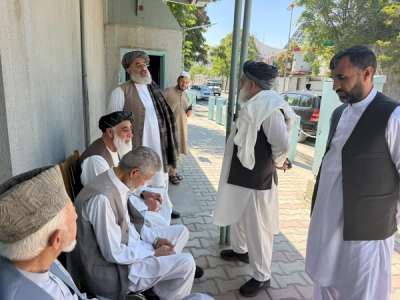
Several provincial governors affiliated with the Taliban travelled to the Afghan capital for meetings with senior officials from the Ministry of Interior, according to a statement released by the ministry.
The governors held talks with Mohammad Nabi Omari, Deputy Minister of Interior, and Zainullah Aaber, chief of staff of Interior Minister Sirajuddin Haqqani. During the meetings, the governors presented reports on their respective provinces and briefed officials on local governance activities.
Photographs published by the Interior Ministry showed the presence of Sher Ahmad Haqqani, Governor of Laghman; Mustafa Azizullah, Deputy Governor of Nangarhar; and Mohammad Edrees Anwari, Governor of Parwan.
All appointments within the Taliban administration are made by the group’s supreme leader, Hibatullah Akhundzada. However, recent reports suggest growing dissatisfaction within the ranks, particularly from Interior Minister Sirajuddin Haqqani, over what is perceived as excessive centralisation of decision-making power in Kandahar.

A new report from the United Nations Development Programme (UNDP) reveals that 90 percent of Afghan households experienced economic shocks in 2024, driven by a worsening humanitarian crisis and deepening socio-economic instability.
According to the report, 65 percent of households were directly affected, marking a 35 percent increase compared to 2023. The UN agency warns that Afghanistan is sliding further into severe economic distress, with growing inequalities disproportionately impacting women and rural communities.
The European Union delegation in Kabul echoed these concerns, noting that restrictions on women and girls imposed between 2024 and 2026 are projected to cost the Afghan economy more than $920 million.
The UNDP assessment found that nine out of ten households have lost key productive assets, sources of income, and access to employment opportunities. Many families have been forced to reduce daily consumption and cut essential expenses, significantly weakening their resilience to future shocks.
Despite these challenges, Afghanistan recorded its first positive gross domestic product (GDP) growth since 2019, with a modest 2.7 percent increase between 2023 and 2024. However, the UNDP cautioned that this recovery is fragile. The country’s trade deficit grew sharply, reaching $6.7 billion in the first three quarters of 2024, up from $5.1 billion during the same period in 2023.
The report attributed the widening deficit to declining domestic production and limited job creation, underlining Afghanistan’s continued reliance on imports and foreign aid.
It further noted that 75 percent of the population faced livelihood insecurity in 2024, a six percent rise from the previous year. Rural areas, home to 71 percent of Afghans, remain critically underserved, with limited access to healthcare, sanitation, and sustainable economic opportunities.
The report also highlighted deteriorating conditions in housing, healthcare, and access to basic goods, compounded by economic and climate-related shocks.
Women-led households, rural populations, and internally displaced persons were identified as the most affected groups, having suffered the greatest drops in income and spending. The ongoing restrictions on women’s education and employment continue to deepen gender inequality, pushing Afghan women further into poverty and social exclusion.

Zamir Kabulov, the Russian president’s special envoy for Afghanistan, stated that while Afghanistan is not among Moscow’s top foreign policy priorities, it holds critical importance due to its geopolitical positioning.
In an interview with the Russian radio station Komsomolskaya Pravda, Kabulov described Afghanistan as a strategic transit corridor connecting northern Eurasia, including Russia, to southern Asia, enhancing its value as a geopolitical bridge.
Kabulov stressed that normalising relations with the Taliban was essential for promoting Russia’s regional interests. However, he noted that formal engagement remains constrained by legal barriers, particularly the Taliban’s continued designation as a terrorist organisation in Russia.
That designation was officially suspended on 17 April, when Russia’s Supreme Court approved a request from the Prosecutor General’s Office to lift the ban on the Taliban’s activities. Supreme Court Judge Oleg Nefedov confirmed the ruling would take effect immediately.
Kabulov emphasised that full legal recognition of the Taliban is necessary to enable Russian governmental bodies, private companies, and NGOs to sign valid contracts and engage in official dealings with Afghanistan. He did not elaborate on the next steps in the recognition process.
Reflecting on historical ties, Kabulov said that during the Soviet era, commercial exchanges with Afghanistan were virtually non-existent, limited mostly to humanitarian and development aid. In contrast, he argued, Russia now sees strategic incentives to engage more substantively with Afghanistan.
According to Kabulov, a stable governing authority in Kabul is vital for containing terrorism and other cross-border threats that could affect Russia and its allies. Still, he warned that the Taliban cannot maintain power indefinitely through coercion alone. He underscored the need to address Afghanistan’s deep socioeconomic challenges and to prioritise national development, particularly efforts to meet basic human needs such as food security.