Turkiye, Pakistan Envoys Hold Talks On Afghanistan
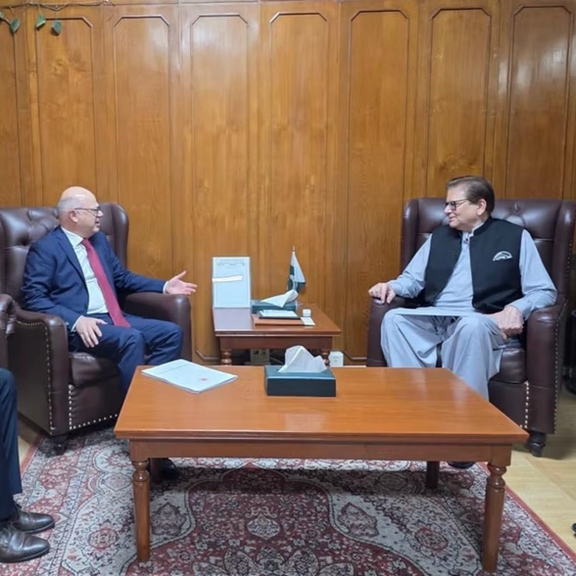
Pakistan and Türkiye's special envoys for Afghanistan met this week to discuss developments in the country and their regional implications, Pakistani officials said.

Pakistan and Türkiye's special envoys for Afghanistan met this week to discuss developments in the country and their regional implications, Pakistani officials said.
Mohammad Sadiq Khan, Pakistan’s special representative for Afghanistan, said in a post on X on Monday that he held a “comprehensive exchange of views” with his Turkish counterpart, Cihad Erginay. He added that the talks covered “ongoing developments in Afghanistan and their broader implications for stability, security and regional cooperation.”
Sadiq Khan did not provide further details, and the Turkish embassy has not commented on the meeting.
Pakistan has struggled over the past four years to prevent Pakistani militants from launching attacks from Afghan territory, a persistent issue that has strained relations between Islamabad and the Taliban.
Türkiye, meanwhile, is one of the few countries that has kept its embassy in Kabul open since the Taliban returned to power. Afghan embassies and consulates in Türkiye are also under Taliban control.
Turkish President Recep Tayyip Erdoğan has previously criticised the Taliban’s policies restricting women and girls, though Ankara has generally adopted a cautious approach in its dealings with the group.


Afghans were the second-largest group of asylum seekers in Europe in the first half of 2025, after Venezuelans, according to the European Union Agency for Asylum.
Overall asylum applications across the EU fell by 23 percent compared with the same period last year, the agency said, driven mainly by a sharp drop in claims from Syrians following the fall of President Bashar Assad in December. Officials noted the decline was the steepest since the COVID-19 pandemic and not the result of policy changes in the bloc.
Despite continuing violence in parts of Syria and Israeli airstrikes, the formation of a new government under Ahmad Sharaa has raised hopes for stability and reconstruction. The UN Refugee Agency said more than 500,000 Syrians have returned home since mid-May.
By contrast, Afghan applications have remained high since the Taliban seized power in 2021. In Britain alone, 33,970 Afghans have applied for asylum since October 2021, most arriving through irregular routes. A further 35,706 Afghans have resettled in the UK through official programmes.
Germany’s asylum office said Afghans filed the largest number of applications there this year, with 104,012 submitted between 1 January and 31 August. But Berlin’s new government has tightened migration rules and vowed to restrict arrivals.
Reports from the European Commission and the International Organization for Migration show Afghans remain among the five largest groups of asylum seekers across Europe. Observers cite Taliban-imposed restrictions, particularly on women, and security pressures as key drivers.
Germany, once the main destination for Afghan refugees, has now been overtaken by Spain, Italy and France.
In total, EU countries along with Switzerland and Norway received nearly 399,000 asylum applications in the first half of 2025, the EU agency said.

Russia’s special envoy for Afghanistan said Moscow supports Pakistan and China’s policies on Afghanistan and shares their concerns over militant threats.
Zamir Kabulov told The Express Tribune that Pakistan and China regularly raise complaints with the Taliban about Tehreek-e-Taliban Pakistan (TTP) and the East Turkestan Islamic Movement (ETIM). He described the groups as serious threats to the region, with TTP targeting Pakistan and ETIM posing risks to China.
Kabulov said that the militants could damage the Taliban’s diplomatic relations with Beijing and Islamabad. He suggested Pakistan and China should resolve such issues bilaterally.
Kabulov said the Taliban should be given sufficient support to counter terrorist threats, calling them “troublesome” for Pakistan and China. He urged the Taliban to address these issues with neighbouring countries “in a friendly manner.” The Taliban have repeatedly denied that Afghanistan poses a terror threat to other nations.
He also referred to remarks by Sergei Shoigu, secretary of Russia’s Security Council, who said 23,000 foreign terrorists were present in Afghanistan; a figure Kabulov called concerning.
Kabulov said Russia’s decision to recognise the Taliban in July was based not only on political and economic considerations but also on security grounds, arguing that strengthening the group could help eliminate terrorism in Afghanistan. He added that creating a secure environment for Russian investors was another factor.
Recognition of the Taliban by other countries, however, “will not be easy,” Kabulov said.

The Shanghai Cooperation Organisation (SCO) on Monday urged the formation of an inclusive government in Afghanistan, calling it the only path toward lasting peace and stability in the country.
In a joint statement issued at the end of its two-day summit in the northern Chinese port city of Tianjin, the organisation expressed support for international efforts to ensure peace and development in Afghanistan.
Member states emphasised the “need for an independent, neutral Afghanistan free from terrorism, war and narcotics,” and pledged to back global initiatives aimed at achieving that goal. The statement stressed that a broad-based, inclusive government with representatives from all ethnic and political groups of Afghan society is the sole way to achieve durable peace and stability.
More than 20 world leaders attended the summit, though the Taliban were not invited. Mongolia, also an observer state, was represented at the meeting.
Founded in 2001, the SCO is a regional security and political bloc whose full members include Russia, China, India, Kazakhstan, Kyrgyzstan, Tajikistan, Pakistan, Iran and Uzbekistan. Belarus joined as a full member on 4 July 2024. Afghanistan and Mongolia hold observer status.

The Iranian Writers’ Association has condemned a new Taliban law restricting poetry, warning it will further stifle freedom of thought and expression in Afghanistan.
In a statement issued Sunday, the association said the “Law on Regulating Poetry Recitals,” recently signed by Taliban leader Hibatullah Akhundzada, marks a systematic expansion of repression. The group said the measure would “undoubtedly tighten the space for dissenters even further.”
The law bans the writing of romantic poetry and criminalises criticism of Akhundzada’s decrees. Members of Afghanistan’s cultural community have widely denounced the decision, with some responding by posting videos of romantic and protest poems on social media.
Founded in 1968, the Iranian Writers’ Association is an independent professional and cultural body that has long campaigned for freedom of expression. Renowned Persian literary figures including Ahmad Shamlou, Houshang Golshiri and Bahram Beyzai were among its members.

Around 400 Afghan women and girls are living in limbo in Britain after their asylum applications were rejected, according to a report by The Observer. The paper said they cannot return to Afghanistan yet are not permitted to remain in the UK.
Figures from the Home Office showed that by the end of June 2025, more than 6,000 Afghan asylum claims had been refused, including 367 from women and girls, despite widespread reports of human rights abuses in Afghanistan.
The Observer reported on Sunday that thousands of Afghan asylum seekers, among them hundreds of women and girls, were stranded in temporary accommodation such as hotels with no source of income and no clear future.
An Oxford University study found that acceptance rates for Afghan asylum applications had more than halved in the past year. While nearly 99 percent of applications were approved at the end of 2023, the figure fell to just 37 percent in the first half of 2025.
By June this year, more than 6,700 Afghan asylum seekers were still awaiting an initial decision. If rejections continue at the current rate, the total number of Afghans refused asylum could surpass 10,000.
The Home Office has argued that the rejections are based on its assessment of “security in Afghanistan,” claiming there is only limited evidence that all groups in the country face persecution. Officials maintained that vague or general fears of the Taliban were insufficient grounds for asylum.
At the same time, the department has admitted that rejected applicants cannot be returned to Afghanistan, as the UK does not recognise the Taliban as a legitimate government. The Taliban, for their part, have refused to accept passports or documents issued by the former Afghan embassy in London. Since 2021, at least nine Afghans are believed to have returned voluntarily.
A Home Office spokesperson told the newspaper that the previous government had left behind a chaotic asylum system, leaving thousands of people in uncertainty. The official said the current government was working to reform the system by removing those with no right to remain, while allowing others to rebuild their lives. The spokesperson acknowledged that women could face Taliban persecution and said most Afghan women seeking asylum were accepted.
According to official data, more than 8,000 Afghans arrived in the UK by small boats in the first half of this year.