Taliban, Iranian Officials Hold Talks On Boosting Trade To $10 Billion
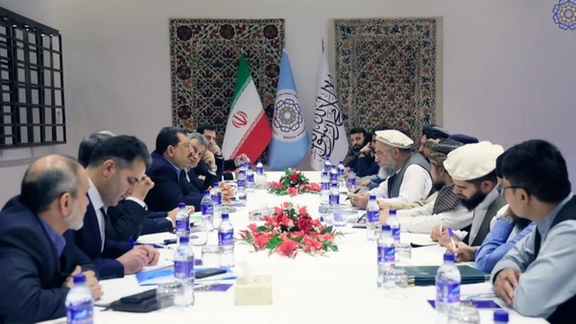
The Taliban’s Ministry of Industry and Commerce said it has held talks with an Iranian delegation aimed at boosting annual trade between the two sides to $10 billion.

The Taliban’s Ministry of Industry and Commerce said it has held talks with an Iranian delegation aimed at boosting annual trade between the two sides to $10 billion.
The ministry said in a statement Wednesday that Taliban commerce minister Nooruddin Azizi met in Kabul with Mohammad Atabak, Iran’s minister of industry, mining and trade, and his delegation to discuss expanding trade ties and easing transit.
According to the statement, the two sides discussed signing trade and investment agreements, addressing customs and non-tariff barriers, and lifting restrictions at border crossings. They also highlighted the need to resolve transit challenges for Afghan goods at the Milak, Dogharoon, Chabahar and Bandar Abbas crossings.
Taliban officials asked for regular meetings of the joint economic committee, the reactivation of the joint commission, and solutions to banking problems affecting cross-border trade.
Atabak, leading the Iranian delegation, has so far met with several Taliban officials. The visit was described as focused on expanding bilateral trade, improving transit facilities and strengthening joint investment projects.
Although Tehran does not formally recognise the Taliban administration, Iran is its largest trading partner. Current trade between the two countries exceeds $3 billion annually, according to Mohammadreza Modoudi, head of the Dogharoon Free Trade and Industrial Zone.


The Taliban’s Ministry for the Propagation of Virtue and Prevention of Vice said this week it has rounded up more than 1,500 people with mental health conditions across Afghanistan and handed them over to the Red Crescent.
Ministry spokesperson Saif al-Islam Khyber told Taliban-run media on Wednesday that most of those detained were from Herat and Faryab provinces. He said officials in Kabul, Maidan Wardak, Zabul, Badakhshan, Kunduz, Takhar and Helmand provinces were also carrying out similar operations.
In a statement, the ministry said 770 people with psychological disorders were collected from Faryab province alone, while about 200 were gathered in Herat. The ministry said the campaign was launched under orders from Taliban leader Mullah Hibatullah Akhundzada, who has instructed authorities in all 34 provinces to collect mentally ill people.
The Taliban-controlled Red Crescent has not explained how the individuals will be treated or where they will be housed.
Mental health experts warn that people with psychiatric conditions need specialised care, which Afghanistan’s public health system is unable to provide. The World Health Organization estimates that one in five Afghans suffers from a mental health disorder, a figure that experts say has risen since the Taliban's takeover of Afghanistan due to poverty and unemployment.

Taliban leader Mullah Hibatullah Akhundzada’s decision to cut fibre optic internet across Afghanistan is final, sources in Kandahar told Afghanistan International.
Talks between a Taliban delegation from Kabul and the leadership in Kandahar ended without results, the sources said, adding that Akhundzada has so far refused to discuss the shutdown.
According to the sources, Akhundzada ordered the creation of a new company to provide internet access for government offices and diplomatic missions. The Taliban may also allow Salam, a state-owned operator, to distribute limited services.
An executive at a private internet company said only a small number of WhatsApp accounts with special Taliban-issued permits will be allowed to connect, under strict surveillance.
The Taliban has already cut fibre optic services in Balkh, Kandahar, Uruzgan, Helmand and Nimroz provinces, while disruptions have been reported in Baghlan, Ghazni, Parwan and Herat provinces.
Failed Talks
Meetings between telecom operators and Taliban officials in Kabul, the ATRA regulator and Kandahar have yielded no progress. During one session at the Taliban-run Ministry of Communications and Information Technology, officials said mobile data speeds would be reduced to 2G.
“The order from the Taliban leader is irreversible and will be enforced nationwide,” one informed source said.
Banking Disruptions
Afghanistan’s banking sector has been among the first hit. Sources said banking services in Mazar-i-Sharif faced severe interruptions this week, prompting Taliban governor Yousuf Wafa to order exemptions for banks, the national ID office and a handful of other institutions. Internet access for banks in the city was restored by midday.
The Taliban ministries of finance and economy, along with the central bank, had previously opposed the order. Days earlier, a delegation led by the Ministry of Economy and joined by senior officials from finance, the central bank and other ministries travelled to Kandahar to warn Akhundzada of the risks.
The delegation, which included Mines Minister Hedayatullah Badri, Deputy Interior Minister Ibrahim Sadr and the Taliban-appointed central bank chief, stressed that government institutions depend on online systems and that cutting high-speed internet would cripple operations.
Impact on Education
The restrictions have also disrupted online schooling. Thousands of students and teachers have been unable to join classes.
A female student told Afghanistan International the shutdown had “closed the gates of online schools to girls,” depriving many of their last opportunity for education after the Taliban banned girls from secondary schools and universities.

Afghanistan’s banking system has suffered major disruptions after the Taliban cut Wi-Fi services in several provinces, including Balkh, sources told Afghanistan International.
Banks in Mazar-i-Sharif city the capital of Balkh province faced serious interruptions on Tuesday, prompting Taliban governor Yousuf Wafa to order exemptions for banks, the national ID office and several other institutions. Internet access for banks in the city was restored by midday, according to sources.
The Taliban suspended internet services in five provinces on Monday including Kandahar, Uruzgan, Helmand, Nimroz and Balkh as part of an order issued by the group’s leader, Mullah Hibatullah Akhundzada. The shutdown initially included households and government offices.
Days earlier, a delegation from the Taliban Ministry of Economy, joined by officials from the Finance Ministry and the central bank, travelled to Kandahar to warn Akhundzada that the restrictions would cripple institutions that rely on online systems.
Talks between telecom companies and Taliban officials have failed to produce a solution. At a meeting with private firms, the Taliban-run Ministry of Communications and Information Technology said mobile internet speeds would also be throttled to 2G. Officials stressed the order from Akhundzada was final and would be enforced nationwide.
The ministry said organisations seeking Wi-Fi access must file a formal request, which would be reviewed by the Taliban’s intelligence agency before a permit is issued.
NetBlocks, an internet watchdog, confirmed disruptions across Afghanistan. Wi-Fi services had been widely used in homes, offices and businesses before the shutdown.
The restrictions come as Taliban officials continue to court foreign investors, claiming the country is more open for business than at any time in recent history. Critics say cutting internet access undermines those claims and threatens Afghanistan’s fragile economy.
During two decades of international engagement, Afghanistan saw rapid growth in telecommunications, with several major providers offering internet services nationwide.

Thousands of Afghan schoolchildren and university students have been unable to attend online classes after the Taliban cut internet services in several provinces, sources said Tuesday.
A female student told Afghanistan International that the shutdown had effectively closed the last remaining door to education for girls. “With the internet cut, the Taliban has also shut online schools for us,” she said.
The head of an online school reported that dozens of teachers and students across Afghanistan failed to log into their classes. Hazrat Wahrez, who runs one such school, wrote on Facebook that “just today, dozens of students, teachers and learners I know from at least three provinces, including Kandahar, could not attend their online lessons.”
The disruption follows the Taliban’s decision to block fibre optic and Wi-Fi internet in Kandahar, Uruzgan, Helmand, Nimroz and Balkh provinces, with sources saying the restrictions will soon extend to more regions.
Since the Taliban returned to power, schools above grade six and universities have been closed to female students. According to United Nations figures, nearly 3 million girls have been barred from education. Many turned to online schools and universities to continue their studies.
Former Education Ministry spokesperson Noria Nezhat wrote on Facebook that “the internet is the last tool Afghan girls have to continue their studies,” warning that the restrictions would most severely impact those already denied access to classrooms.
Experts say the Taliban’s internet shutdown may provide short-term control over the flow of information but will cause long-term harm to education, the economy and technological development.

The Taliban has cut off wireless internet access in five provinces, reliable sources told Afghanistan International on Tuesday.
Residents in Kandahar, Uruzgan, Helmand, Nimroz and Balkh provinces have lost access to Wi-Fi services, which are typically provided through home routers and other wireless devices.
The move came a day after the Taliban blocked fibre optic internet in Mazar-i-Sharif city, the capital of Balkh province. Sources within the group said the shutdown was ordered directly by Taliban leader Mullah Hibatullah Akhundzada.
According to the sources, the measure is part of a broader Taliban plan to gradually restrict both fibre optic and Wi-Fi services across the country. Independent observers confirmed that over the past three weeks, fibre optic companies’ services have either been completely suspended or severely disrupted nationwide.
Experts warn the restrictions may provide the Taliban with short-term control over the flow of information, but in the long run will cause serious harm to Afghanistan’s economy, education and technological development.