• العربية
  • پښتو
  • فارسی
Brand
  • Afghanistan
  • Sport
  • Markets
  • Afghanistan
  • Sport
  • Markets
  • Theme
  • Language
    • العربية
    • پښتو
    • فارسی
  • Afghanistan
  • Sport
  • Markets
All rights reserved for Volant Media UK Limited
volant media logo

Militants Behind Military College Attack Had Links To Afghanistan, Says Pak Minister

Nov 11, 2025, 13:42 GMT+0

Pakistan’s interior minister said Tuesday that militants who attacked the Wana Military College in South Waziristan, killing at least three people, had been in communication with handlers based in Afghanistan.
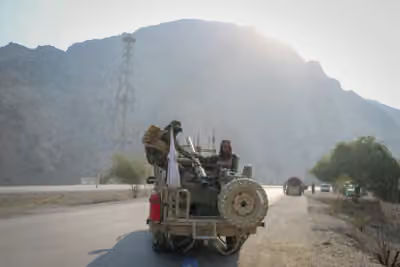
Interior Minister Mohsin Naqvi said the attackers attempted to take hostages inside the military college but failed in their attempt.

The Pakistani military on Monday blamed the assault on Tehreek-e-Taliban Pakistan (TTP), saying India-backed terrorists attacked the Wana Cadet College, adding that security forces killed two attackers and trapped three others inside the compound.

Pakistani security officials said the militants were receiving instructions from Afghanistan and had taken shelter in a building located some distance from the students’ residential quarters.

According to security sources, about 650 students were inside the college at the time of the attack.

The army called the attack a “blatant act of barbarism orchestrated by Khwarij from Afghanistan is in contrast to assertions made by the Afghan Taliban Regime claiming non-presence of these terrorist groups on their soil.”

Pakistan uses the term “khwarij” to refer to militant groups opposed to the state.

Most Viewed

EU Parliament Approves Resolution Urging Sanctions Against Taliban Leaders
1

EU Parliament Approves Resolution Urging Sanctions Against Taliban Leaders

2

Senior Taliban Delegation Visits Turkmenistan

3

Kabul Military Airport Hit In Rocket Attack, Claims Anti-Taliban Group

4

Russia & China Raise Alarm Over Terrorism Threat In Afghanistan

5

More Than 300 Afghans Released From Pakistani Prisons

•
•
•

More Stories

Taliban Condemn Delhi Blast But Remain Silent On Islamabad Attack

Nov 11, 2025, 12:20 GMT+0

The Taliban’s Foreign Ministry on Tuesday condemned a deadly explosion in New Delhi that killed at least eight people, while remaining silent on a suicide bombing in Islamabad that left at least 12 dead.

In a statement issued on Tuesday, the ministry denounced the blast in the Indian capital and expressed condolences to the victims’ families, as well as to the people and government of India.

The reaction came as Islamabad on the same day was hit by a powerful explosion near the city’s judicial complex. Pakistani security officials said the attack was carried out by a suicide bomber.

No group has claimed responsibility for the Islamabad bombing.

Taliban Have Brought War To Islamabad, Says Pakistan Defence Minister

Nov 11, 2025, 11:32 GMT+0

Pakistan’s defence minister said Tuesday’s suicide bombing at a judicial complex in the capital is a “serious warning” for the country, claiming the Taliban have now brought their conflict onto Pakistani soil.

In a post on X, Defence Minister Khawaja Asif wrote that Pakistan is in a state of war. He said anyone who believes the army is fighting only in border regions or in Balochistan “should be awakened” by the attack. “This war belongs to all of Pakistan,” he said, adding that the military is making daily sacrifices while providing citizens with a sense of protection and security.

Asif said that in the current circumstances, placing hope in negotiations with the ‘rulers in Kabul’ would be a mistake, insisting that the Taliban have the ability to prevent terrorist attacks inside Pakistan.

He said the fact the violence has reached Islamabad sends a message from Kabul, but Pakistan, by the grace of God, has the capability to respond decisively.

At least 12 people were killed and 27 wounded in the blast near the Islamabad judicial complex. The explosion occurred Tuesday morning in the capital’s G-11 district, and officials said the blast ignited several vehicles in the area.

Climate Change In Afghanistan Pushing Farmers Toward Opium Cultivation, Says UN

Nov 10, 2025, 17:26 GMT+0

The United Nations Office on Drugs and Crime warned on Monday that climate change is worsening economic pressures on rural communities in Afghanistan and reducing the viability of legal crops.

According to the UN office a combination of the two is driving farmers back toward opium cultivation.

In a post on X, UNODC said that countries and relevant organisations should prioritise climate-resilience efforts to prevent a renewed surge in illicit crop production.

The agency noted earlier that poppy cultivation in Afghanistan is projected to decline by 20 percent in 2025, with farmers’ income from opium sales during the same period nearly halved.

Despite this decline, UNODC cautioned that the increasing return of Afghan migrants from neighbouring countries is adding strain to the labour market and limited resources, raising concerns about a potential rise in illegal opium cultivation.

The warning coincides with the opening of the COP30 global climate summit in Belém, Brazil, on Monday, where representatives from more than 190 countries are discussing emissions reductions, renewable energy expansion and aid for climate-vulnerable nations. The Taliban was not invited to the event.

According to the UN, Afghanistan is among the world’s 10 most climate-vulnerable countries, facing severe drought, floods, irregular rainfall and declining water supplies.

Taliban Block Women Without Burqas From Entering Herat Hospital

Nov 10, 2025, 10:53 GMT+0

Local sources told Afghanistan International early Monday that Taliban members once again prevented hundreds of women without burqas from entering Herat Regional Hospital.

The Taliban’s Ministry for the Promotion of Virtue and Prevention of Vice earlier rejected claims that wearing a burqa was mandatory in Herat, but sources said the restriction remains strictly enforced.

A viewer in Herat shared a video with Afghanistan International, saying that Taliban officers used violence while blocking women from entering and that they were beating them.

On Sunday, the Taliban’s virtue ministry denied that the burqa had been made compulsory for women in Herat and said women in the province had not been denied government services for not wearing one.

However, according to local sources and videos received by Afghanistan International, Taliban members have required women to wear the burqa in public places and government offices in Herat since Wednesday.

NRF Leader Urges World Not To Abandon Afghans As Taliban Rule Deepens Repression

Nov 10, 2025, 09:41 GMT+0

Ahmad Massoud, leader of the National Resistance Front of Afghanistan, told an annual forum in France that Afghanistan has once again become a global centre for militant training under Taliban rule.

He delivered the remarks on Saturday in Saint-Raphaël, in France’s Var region, at the “Meetings for the Future” conference, where he addressed challenges to democracy.

Massoud said his movement had not pursued armed resistance as a goal but as a last resort after attempts at dialogue were rejected by the Taliban. He described the resistance as a means to achieve a political settlement that would allow Afghans to choose their own government and enable women and girls to access education and equal opportunities.

He argued that while international dynamics have shifted since the time of his father, Ahmad Shah Massoud, the Taliban’s behaviour has remained unchanged. He said the group continues to inflict repression similar to its earlier rule and warned that global fatigue and competing crises may be contributing to declining international attention to Afghanistan.

Massoud called on the international community to keep Afghanistan high on both humanitarian and political agendas. He said Afghanistan should remain under consideration by international judicial mechanisms, that sanctions against Taliban leaders should remain in place, and that no government should grant the Taliban formal recognition. He described these steps as straightforward measures that could significantly improve the lives of millions of Afghans.

He highlighted values such as democracy, women’s rights, and freedom of expression as shared principles between Afghans and Europeans, and said they had been systematically dismantled by the Taliban.

The “Meetings for the Future” conference, held annually in France, brings together policymakers, academics, and civil society leaders to discuss long-term global challenges.

Massoud also commented on recent clashes between the Taliban and Pakistan, saying the tensions reflected long-standing structural problems. He said Pakistan had long believed it could control the Taliban but that the group has its own ideology and maintains ties with organisations such as Tehreek-e-Taliban Pakistan, which claims territory inside Pakistan.

He added that Western governments had previously attempted to convince themselves that the Taliban had changed, possibly due to diplomatic misjudgements or a desire to move past the war. However, he said current Taliban actions and policies make clear that such assumptions can no longer be sustained.