Former Prosecutor Murdered By Unknown Individuals in Nangarhar
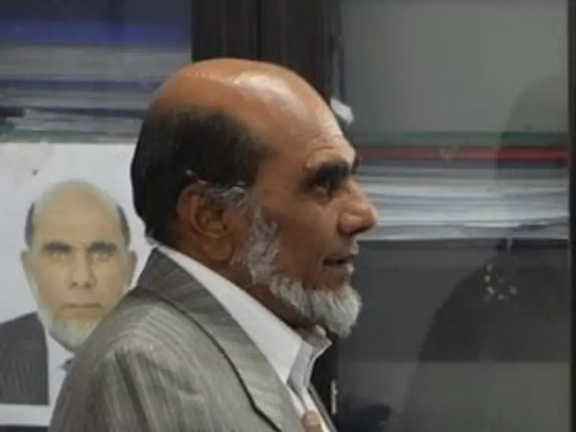
The family of Naqi Mohammad Taqi, one of the prosecutors of the previous government, said that he has been killed along with his sister, by unknown individuals.

The family of Naqi Mohammad Taqi, one of the prosecutors of the previous government, said that he has been killed along with his sister, by unknown individuals.
Gul Wais Taqi, his son, who fled to Iran after the Taliban’s takeover of power, confirmed the incident.
He told Afghanistan International that his "father was invited to Jalalabad by influential individuals on November 16 under the pretext of a party”. He added that the bodies of his father and aunt were discovered in a house in the Behsud district of Nangarhar after five days.
A source in Kabul told Afghanistan International that the prosecutor's body was buried in District 9 of Kabul, on Tuesday.
So far, the Taliban have not commented about the incident.
Naqi Mohammad Taqi, was the former prosecutor of the crime department in the Attorney General’s Office (AGO) of the previous government.
Jamshid Rasouli, the former spokesperson for the AGO, posted on X social media platform that Taqi and his sister were killed on the Kabul-Jalalabad route.
He added that Taqi had lost one of his sons, who was a lawyer, in a "terrorist" attack in Maidan Wardak province.

Sources said that the pro-Taliban Al Mirsad website, under pressure from Pakistan, was directed by the Taliban intelligence agency to halt the publication of critical content against Pakistan indefinitely.
Al Mirsad has recently published many reports and materials regarding the relations between Pakistan and ISIS.
According to the source, the Taliban ordered media officials to continue their anti-ISIS programmes.
Al-Mirsad website has been activated following the takeover of power by the Taliban and all the news related to ISIS is published on this website.
The decision to stop anti-Pakistani contents has been taken while two weeks ago, Al Mirsad published an article by Ehsanullah Ehsan, the former spokesperson of the Pakistani Taliban, in several languages, including Urdu, which faced reactions from the Pakistani government.
Al Mirsad reported that the Taliban shared information about ISIS with the governments of Pakistan and Iran. However, Pakistan has not taken any action against ISIS leaders within its territory.
According to the claim of the former spokesperson of Tehreek-e-Taliban Pakistan, ISIS members are kept in government hotels by Pakistan's intelligence.
In the article, Ehsan had claimed that ISIS has been tasked to defeat TTP and shift the war from Pakistan to Afghanistan.
Sources added that Pakistan has officially complained to the Taliban that Al-Mirsad website broadcasts contents against Pakistan.
Publishing news against ISIS in Al Mirsad website, the Taliban aim to prevent the publication of reports related to ISIS in other domestic media under their control, ensuring that it does not negatively impact public opinion.

Sources have indicated that a cabinet meeting of the Taliban, presided over by the group's leader Mullah Hibatullah Akhundzada, has been underway for two days at Mandigak Palace in Kandahar.
The Taliban have not disclosed any details regarding the meeting or its agenda. However, it is suggested that the discussion of Afghan immigrants returning from Pakistan is a primary focus.
In Kandahar, heightened security measures have been implemented by the Taliban over the last three days, restricting local citizens' movement. Mandigak Palace, the meeting's location, is reportedly under stringent security.
Notably absent from the meeting are key figures such as Mullah Mohammad Yaqoob and Sirajuddin Haqqani, the defence and interior ministers, and Abdul Haq Wasiq, the head of the Taliban’s intelligence agency.
The meeting is attended by several high-ranking Taliban officials, including Mullah Abdul Ghani Baradar and Abdul Salaam Hanafi, the deputy prime ministers.
Among the discussed topics, sources mention the forced repatriation of Afghan immigrants from Pakistan and the inauguration of a new 400-bed hospital in Kandahar. This hospital project, reportedly funded by the Qatari government, is expected to commence soon with Qatari officials visiting Kandahar to initiate the construction.
This meeting continues the trend of the Taliban's leader holding cabinet meetings in Kandahar over the past two years.

Marking World Television Day, Nai, Supporting Open Media in Afghanistan, reported a significant decline in Afghanistan's visual media post-Taliban takeover.
According to Nai, 52% of the nation's visual media outlets have halted operations. The media landscape in Afghanistan, as per Nai's statement, remains far from ideal.
The date, November 21, aligns with World Television Day, a day recognizing the impact of television as a medium for communication and enlightenment. Nai highlighted television's critical role in the past 20 years, notably in fostering freedom of speech, educating the public, and promoting awareness.
Nai's surveys revealed that out of 147 television channels, 77 have stopped broadcasting, primarily due to financial difficulties. The organization has appealed to the Taliban for a revised media support strategy, focusing on tax relief and financial aid, to avert the possible collapse of Afghanistan's media sector.
Furthermore, Nai is urging both national and international media support entities to aid Afghan media. Recently, on November 18, the Afghanistan Journalists Centre reported 75 instances of freedom of expression violations over a six-month period.

The United Nations High Commissioner for Refugees in Afghanistan (UNHCR) said that a number of refugees deported by Pakistan had left Afghanistan due to security threats.
Caroline Gluck, the UNHCR spokesperson, emphasised that these individuals have undergone significant developments and are currently confronting numerous perils in Afghanistan.
On Tuesday, publishing a video, UNHCR said that since the announcement of Pakistan's decision to deport undocumented refugees in mid-September, more than 327,000 Afghan refugees have returned to Afghanistan.
Many deported asylum seekers have told UNHCR that they were persecuted during their deportation. The spokesperson of the commission stressed that the return of migrants to Afghanistan should be voluntary and not forced.
Following the end of the one-month deadline, the interim government of Pakistan announced that it will detain and deport people without legal documentation.
Over the past few weeks, Pakistani police have initiated door-to-door searches, detaining and deporting undocumented immigrants. Additionally, there have been reports of misbehaviour by Pakistani police towards Afghan immigrants, including the confiscation of their property. These actions have prompted a strong reaction from the Taliban officials.

In response to the assessment of the UN special coordinator on Afghanistan, the Taliban announced their opposition to an “intra-Afghan dialogue” and participation of other Afghan politicians.
The group has said that there is no need to form an inclusive government and the people of Afghanistan are satisfied with the Taliban government.
The Taliban claimed that they had saved Afghans from corrupt and repressive rulers of the previous government and had ended warlordism in Afghanistan.
On November 17, Feridun Sinirlioglu, the UN special coordinator on Afghanistan, presented his assessment report of the situation in Afghanistan to the UN Security Council. The report is described as the road map of interaction with the Taliban.
Sinirlioglu said that the Taliban's adherence to human rights, and a political process for the participation of Afghan political factions can lead to the normalisation of relations between the international community and the Taliban government.
In response, the Taliban said that the group’s government is inclusive and represents various ethnic and religious groups.
The group said, "Any attempt to bring back the failed figures of the past or form a coalition government is contrary to the sacrifices made by the Afghans."
The Taliban had accepted and agreed to "starting an intra-Afghan dialogue" in the Doha agreement with the United States, which led to the withdrawal of the United States from Afghanistan. The group had announced that after the withdrawal of foreign forces from Afghanistan, it would start a dialogue with Afghan political factions.
Following the fall of Kabul in August 2021, the leaders of prominent Afghan political groups fled the country to the neighbouring countries. They stressed that an inclusive government must be formed in Afghanistan.
