• العربية
  • پښتو
  • فارسی
Brand
  • Afghanistan
  • Sport
  • Markets
  • Afghanistan
  • Sport
  • Markets
  • Theme
  • Language
    • العربية
    • پښتو
    • فارسی
  • Afghanistan
  • Sport
  • Markets
All rights reserved for Volant Media UK Limited
volant media logo

Taliban Minister Boosts Security At Sapedar Palace Amid Rising Internal Tensions

Apr 4, 2025, 17:16 GMT+1

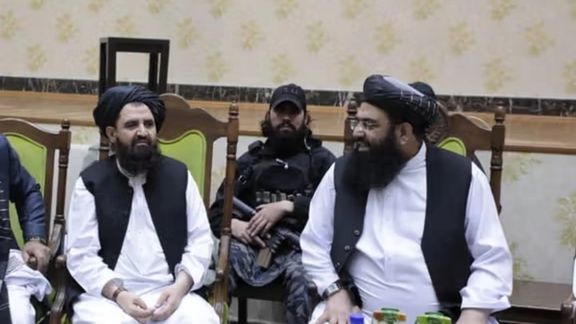
During the Eid al-Fitr holidays, Abdul Kabir, the Taliban’s Minister of Refugees, conducted meetings with Taliban officials and local elders under tight security at his office in Sapedar Palace.

Images released by the Taliban show his guards—armed with American-made weapons—remaining in close proximity, fingers on triggers throughout the meetings.

Even during Eid prayers at Sapedar Palace, which were attended by foreign diplomats, Kabir’s personal guards did not leave his side. On the first day of Eid, Abdul Haq Wasiq, the Taliban’s intelligence chief, visited Kabir. Photos of the meeting show Kabir’s guards positioned directly behind Wasiq, remaining in the room throughout the encounter.

On the second day of Eid, several Shia clerics visited the minister. The Ministry of Refugees published photos showing a heavily armed security presence around Kabir during the meeting, reinforcing his heightened security measures.

This increased security follows the assassination of Kabir’s predecessor, Khalil-ur-Rahman Haqqani, who was killed in a suicide attack at the ministry’s headquarters last year. ISIS claimed responsibility for the attack. Haqqani, a senior figure in the Taliban, was known for carrying a weapon at all times.

Following Haqqani’s death, Abdul Kabir was removed from his former role as Deputy Prime Minister for Political Affairs and reassigned as acting Minister of Refugees. Since then, Kabir has refused to relocate to the ministry’s official headquarters, choosing instead to continue operating from the fortified Sapedar Palace.

Security analysts believe the assassination of Haqqani may have been facilitated from within Taliban ranks, pointing to increasing distrust and internal rivalries. Kabir’s visible reliance on armed protection, even within the heavily guarded Presidential Palace compound, signals rising fear and paranoia among senior Taliban officials.

Most Viewed

Arrests & Killings Of Former Afghan Forces Continue, Says UN
1

Arrests & Killings Of Former Afghan Forces Continue, Says UN

2

Taliban To Put TOLOnews Journalists On Trial

3

Taliban Beat Shia Cleric In Kabul After Marriage Dispute, Say Sources

4

Attack On Pakistani Police Centre Was Not Planned In Afghanistan, Says Taliban

5

Taliban & Pakistan Prepared To Work Together For Peace & Security, Says China

•
•
•

More Stories

Jamiat Commander Assassinated In Ghor, Says Former Balkh Governor

Apr 4, 2025, 15:57 GMT+1

Atta Mohammad Noor, former Balkh governor and a member of the National Resistance Council for Salvation of Afghanistan, said that Shah Wali Khan, a senior Jamiat-e Islami commander in Ghor province, was killed.

Noor claimed Khan was assassinated on 27 March in a conspiracy following his release from Taliban intelligence custody. The Taliban has not yet commented on the allegations.

On Friday, Noor posted images of Wali Khan on X, accusing the Taliban of widespread “crimes” since taking power, including targeted killings. He asserted: “In many instances, these killings aim at ethnic cleansing and political, religious, and local purges,” framing Wali Khan’s death as part of this Taliban policy.

The United Nations Assistance Mission in Afghanistan (UNAMA) has reported ongoing human rights abuses against former government officials and ex-members of Afghanistan’s defence and security forces, despite the Taliban’s 2021 general amnesty pledge.

Iran Bans Agricultural Imports From Afghanistan

Apr 4, 2025, 14:21 GMT+1

The Islamic Republic of Iran has banned the import of agricultural products from Afghanistan, according to a report by the Tehran-based Shargh newspaper.

Alireza Khameh-Zar, head of the South Khorasan Chamber of Commerce, criticised Iran’s stringent Plant Protection Organisation regulations, which he said are obstructing agricultural imports from Afghanistan.

In an interview with Iran’s ILNA news agency, Khameh-Zar stated, “Iran was once Afghanistan’s top trading partner, but it has now dropped to fifth place.” He attributed this decline in part to Afghanistan’s growing dissatisfaction over Iran’s refusal to buy its agricultural goods, which has contributed to an imbalance in trade between the two countries.

Although trade volumes have fluctuated in recent years, Iran remains one of Afghanistan’s largest commercial partners, exporting products such as petrol, gas, construction materials, machinery, pharmaceuticals, and medical equipment.

Khameh-Zar explained that, under Iranian regulations, Afghanistan is classified as a high-risk country for agricultural imports. However, he argued that Afghanistan has the capacity to meet many of Iran’s agricultural needs. He pointed to the current cotton shortage in Iran, noting that Uzbekistan no longer exports cotton to Iran and Türkiye has become a net importer. Under these circumstances, Afghanistan could emerge as a suitable alternative supplier.

He also stressed that as Iran continues to face a worsening water crisis, relaxing restrictions on Afghan agricultural imports could help alleviate domestic challenges in food production.

Khameh-Zar highlighted Afghanistan’s comparative advantages, including low labour costs and vast tracts of undeveloped farmland, which make it an ideal candidate for offshore farming to support Iran’s agricultural market.
Uzbek Leader: World Underestimates Afghanistan Threats

Apr 4, 2025, 12:52 GMT+1

On Friday, at the inaugural Central Asia-European Union Summit in Samarkand, the Uzbek President raised concerns about the international community’s underestimation of threats from Afghanistan, including terrorism, extremism, radicalism, drug trafficking, and illegal migration.

Shavkat Mirziyoyev urged stronger Central Asia-EU cooperation, stating on the Uzbek presidency’s website: “We support the European proposal to launch a counterterrorism dialogue.”

Mirziyoyev reaffirmed Uzbekistan’s dedication to political consultations for Afghanistan’s peaceful progress, saying: “We believe it’s vital to involve Afghanistan in regional economic processes through investment, infrastructure projects, and social sector restoration.” He added, “We hope for support in fostering constructive dialogue with Afghan authorities to meet current commitments.”

Recently, Mirziyoyev described Uzbekistan’s Afghan policy as “pragmatic and strategic,” noting that critics of Tashkent’s Taliban engagement now recognise its value. In a Euronews interview, he highlighted Uzbekistan’s proactive diplomatic and economic approach, contrasting it with the hesitancy of others. Taliban spokesperson Zabihullah Mujahid praised Mirziyoyev’s remarks as a reflection of Afghanistan’s realities.

The Samarkand summit, chaired by Mirziyoyev, hosts Central Asian leaders, European Council President Antonio Costa, and European Commission President Ursula von der Leyen. Discussions focus on enhancing political dialogue, economic ties, green energy, transport, innovation, culture, education, and security.

French Photographer Wins 2025 Roger Pic Award For Afghan Women Photo Series

Apr 4, 2025, 11:40 GMT+1

French photographer and journalist Véronique de Viguerie has been awarded the 2025 Roger Pic Prize for her powerful documentary photo series titled Afghanistan, No Woman’s Land, which captures the lives of Afghan women under Taliban rule.

The Roger Pic Award, named in honour of the French journalist and documentary filmmaker, recognises photography that reflects a strong documentary and humanistic perspective. The jury commended de Viguerie’s work for its striking portrayal of the courage and resilience of Afghan women in the face of severe repression by the Taliban.

De Viguerie, renowned for her work covering conflicts in Afghanistan, Somalia, Iraq, Syria, and Yemen, has used this series to draw global attention to the deteriorating situation for women in Afghanistan. Her visual narrative highlights the everyday challenges and systemic oppression Afghan women endure under the current regime.

The award-winning series will be exhibited at the La Gacilly Photography Festival, opening on 7 June 2025.

India Tracks Sikh Persecution In Afghanistan, Pakistan

Apr 4, 2025, 10:14 GMT+1

On Thursday, Kirti Vardhan Singh, India’s Minister of State for External Affairs, told Parliament that the government closely monitors reports of Sikh persecution in Afghanistan and Pakistan.

His critique focused predominantly on Pakistan rather than the Taliban, with whom New Delhi has recently fostered improved political relations.

In a written parliamentary response, Singh stated: “Atrocities against minority communities in Pakistan, including Sikhs, involve persecution, intimidation, forced marriages, forced conversions, and vandalism of their places of worship.” However, he did not elaborate on the specifics of Sikh persecution in Taliban-controlled Afghanistan, despite detailed accounts from human rights organisations and the US State Department’s annual reports.

After the Taliban seized Kabul, India evacuated 74 Afghan Sikhs via military and Air India flights, citing fears of persecution. The US State Department’s report last year underscored the dwindling Sikh and Hindu populations in Afghanistan, noting their safety concerns under Taliban rule and reluctance to pursue legal action due to risks of torture. It reported that over 900 Sikh and Hindu citizens fled Afghanistan post-takeover, leaving just six individuals to protect their religious sites and sacred texts.