Uzbekistan To Invest $1 Billion In Afghanistan's Energy Sector

The Taliban's deputy prime minister announced on Thursday that the contract for the extraction of gas reserves in the Faryab field has been awarded to an Uzbekistani company.

The Taliban's deputy prime minister announced on Thursday that the contract for the extraction of gas reserves in the Faryab field has been awarded to an Uzbekistani company.
The statement said that Uzbekistan will invest about $1 billion in the 10-year contract.
A statement issued by the office of Abdul Ghani Baradar, the Taliban's deputy prime minister, said that the contract was signed between the Taliban's Ministry of Mines and Petroleum and the Uzbekistani company.
The details of the contract state that the Uzbekistani company will invest $100 million in the first year and $1 billion in 10 years.
The Taliban said that the gas reserves of Tooti Maidan in Faryab province have an area of about 7,000 square kilometres.
According to the Taliban's Minister of Mines, Hidayatullah Badri, the agreement will largely meet Afghanistan's energy needs.
Ismatulla Irgashev, Special Envoy of the President of Uzbekistan, said during a visit to Afghanistan about the investment that thousands of job opportunities and the revival of Afghanistan's national economy are planned.
At the same time, Darya News Agency quoted experts as saying that the agreements signed between Uzbekistan and the Taliban are part of Uzbekistan's strategy to strengthen its influence in the region and create new economic opportunities.
Political scientist Oybek Sirojov said that Afghanistan is a promising market for Uzbekistan.
According to Uzbekistan experts, the country has the necessary leverage over the Taliban, including controlling a significant portion of the humanitarian aid entering Afghanistan that passes through Uzbekistan's railways. In addition, Tashkent also supplies cable power. Another political affairs expert said that these factors create opportunities for Uzbekistan to put pressure on the Taliban.
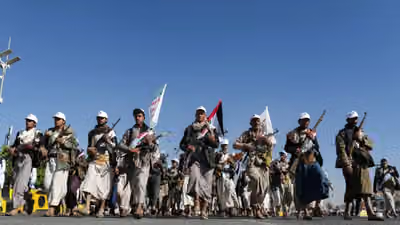

The US State Department has reaffirmed that it continues to classify the Taliban as a "terrorist organisation”.
A spokesperson for the department told Afghanistan International that the United States, alongside its allies, does not recognise the Taliban as the legitimate government of Afghanistan. Until there are discernible changes in the Taliban’s behaviour, meaningful engagement between the US government and the group remains unlikely.
Over the past three years, US efforts have focused on humanitarian aid, securing the release of American hostages held by the Taliban, forging global consensus to improve the situation in Afghanistan, and managing threats from groups such as al-Qaeda and ISIS-Khorasan.
However, this raises the question: does Washington’s continued emphasis on labelling the Taliban as a "terrorist" group signal a harder stance, or is it indicative of increasing flexibility in addressing the evolving situation in Afghanistan?
Why Does the US Still Consider the Taliban a "Terrorist Group"?
When US officials describe the Taliban as an international terrorist organisation, they are referencing legal provisions established by former President George W Bush.
Following the September 11 attacks, Bush signed Executive Order 13224 on 23 September 2001, which officially designated the Taliban as an international terrorist group. This order remains in force, meaning that under US law, both the Taliban and the Haqqani network continue to be recognised as international terrorist entities.
At the time, President Bush emphasised that Executive Order 13224 was intended to disrupt the financing of terrorism and reaffirmed America’s commitment to lead international efforts in combatting terrorism. This order, issued under powers including the National Emergencies Act, directed US agencies to take necessary actions to address extraordinary threats to national security, foreign policy, and the US economy posed by acts and threats of terrorism.
Moreover, the executive order granted the US government tools to dismantle the Taliban’s financial networks, freeze the assets of Taliban leaders, and target foreign entities associated with them.
What is a U.S. Presidential Executive Order?
One of the critical powers vested in the U.S. President is the ability to issue executive orders, which are utilised across various domains such as economic policy, national security, and foreign relations. Executive orders possess distinct characteristics. Firstly, these orders must comply with the U.S. Constitution and federal laws; they cannot contravene legislation enacted by Congress. While executive orders do not require Congressional approval, Congress does have the authority to review them and, if necessary, pass laws to limit or revoke them.
Another significant aspect of executive orders is that each new president has the authority to rescind or amend the executive orders of their predecessors, a process that often occurs at the beginning of a new presidential term.
Under Executive Order 13224, issued by President George W. Bush in 2001, the Taliban has been officially designated as a terrorist organisation. This order remains in effect and has not been repealed. Removing the Taliban from the list of terrorist groups is a complex and protracted process. It is unlikely that President Joe Biden, who has faced substantial criticism over the U.S. withdrawal from Afghanistan, will issue an executive order to repeal Bush’s order and remove the Taliban from the terrorist list.
This decision is more likely to fall to the next president. Regardless of who the next president may be, it is improbable that Afghanistan will be high on their list of priorities. Consequently, no major changes in U.S. policy towards the Taliban are expected for at least a year after the next presidential election. The next president could potentially rescind George Bush’s executive order, which would remove the Taliban from the list of terrorist organisations and open the door to new diplomatic or economic engagements. However, this process would be time-consuming, as such a move would likely face opposition from lawmakers in Congress.
Executive Orders and Humanitarian Aid to Afghanistan
While Executive Order 13224 sanctions the Taliban and the Haqqani network, it does not impede the delivery of humanitarian aid to Afghanistan. The export of agricultural goods, medicines, and medical equipment to Afghanistan is not prohibited. The US Treasury Department has clarified that the sanctions allow US citizens to export goods and services to Afghanistan, provided that such transactions do not involve individuals or entities subject to sanctions.
In addition, the Office of Foreign Assets Control (OFAC) within the U.S. Department of the Treasury has issued several general licences related to Afghanistan, specifically aimed at facilitating the provision of humanitarian aid. These licences provide guidance on the permissible transactions under the existing sanctions and highlight that humanitarian assistance to Afghanistan can be delivered without breaching U.S. regulations.
As a result, U.S. government humanitarian aid to Afghanistan is provided in accordance with the licences issued by the Treasury Department, which are designed to ease the process of delivering such aid. However, any direct economic assistance or commercial transactions between the U.S. government and any entity affiliated with the Taliban could lead to legal consequences under Executive Order 13224. Until this order, which designates the Taliban as a terrorist organisation, is formally rescinded by the U.S. President, any official economic dealings or trade with the Taliban remain illegal under U.S. law and could result in severe repercussions.
Why Did the US Sign An Agreement With a "Terrorist" Group?
A key question that arises is: if the Taliban is officially considered a terrorist group, why did the US engage in negotiations with them and sign the Doha Agreement?
This action can be understood in the context of the United Nations’ approach, which permits negotiations with groups such as the Taliban and Hamas to "secure peace”. Since the 1980s, the UN has engaged in talks with various groups officially designated as terrorist organisations.
Following the September 11 attacks, engaging with the Taliban became even more complicated after the UN Security Council also designated the Taliban as a terrorist group. However, in 2008, the appointment of Kai Eide as the UN Special Representative for Afghanistan marked a shift in this approach. Eide underscored the "importance of engaging with the Taliban to establish peace in Afghanistan," justifying this stance based on the UN’s "principle of neutrality”. He argued that avoiding dialogue could undermine peace-building efforts, and engagement with all parties is essential.
After this shift, the US government began secret negotiations with the Taliban.
From the US government’s perspective, direct talks with the Taliban, culminating in the signing of the Doha Agreement, were in pursuit of "securing peace" and had the support of the United Nations. These negotiations were not considered a violation of any legal framework.

Director of the Iranian Bureau for Aliens and Foreign Immigrants' Affairs (BAFIA) of Khorasan Razavi Governorate said that 270,000 Afghan refugees were returned to Afghanistan in the first half of this year through the Dogharoun border.
According to Hossein Sharafati Rad, this number was calculated through statistics from 11 provinces.
"The repatriation of Afghan citizens from Khorasan Razavi province has also increased by 40 percent since the beginning of this year to the end of September compared to the same period last year," the Iranian official told IRNA news agency during his visit to Taybad on Thursday.
He added that identifying unauthorised foreign nationals throughout Iran and deporting them to their country by the end of this year is one of the most important plans of the Ministry of Interior.
The Director General of Aliens and Foreign Immigrants of Khorasan Razavi Governorate also said that no "authorised or unauthorised" Afghan citizen has the right to live and work in the province's seven border cities.
The Iranian official also announced the education of 60,000 authorised foreign students for boys and girls in Khorasan Razavi province. However, he said that 5,000 students have not yet been able to register because their degrees are not complete.
Regarding the employment of Afghan citizens in Iran, Sharafati Rad said, "75 percent of Afghan immigrants live and work in Iran."
According to the Bureau for Aliens and Foreign Immigrants of Khorasan Razavi, Mashhad has the highest number of foreign immigrants after Tehran, nearly 400,000 of whom have identity and residency documents.

Nobel Peace Prize laureate Malala Yousafzai quoted Afghan human rights activists as saying that "the Taliban's cruelty and extreme oppression of Afghan women" is an example of gender apartheid.
She called on governments, especially Muslim countries, to go beyond verbal sympathy to hold the Taliban accountable.
Twelve years ago, on October 9, the Pakistani Taliban severely wounded Malala Yousafzai, who was campaigning for girls' right to education in Pakistan's tribal areas.
On Thursday, Yousafzai recalled the incident in a post on her social media platform X and criticised the Taliban's policies towards Afghan women, which, like their counterparts in Pakistan, have deprived Afghan women and girls of education.
The Afghan Taliban "have been aiming their guns at Afghan girls and women, both realistically and virtually", Malala said. "They experience everything from being beaten in public to cruel orders banning learning, working and living freely."
"The Taliban's systematic brutality and oppression of women is so severe that Afghan activists and human rights defenders call it gender apartheid," she added.
Malala stressed that Afghan women and girls need more than sympathy right now.
She called on influential governments and institutions to use their power and hold the Taliban accountable through international law. In particular, she called on Muslim leaders and Islamic organisations to challenge the Taliban's policies.

The Taliban's Ministry of Information and Culture recently held the third short film festival with "cultural and jihadi" themes in Kabul.
The ministry announced that a film festival has been held in Kabul at a time when the law for the promotion of virtue of this group prohibits the publication of images of living beings.
The Taliban-controlled National Television reported that the Taliban's Afghan Film and Theater Directorate recently held the third festival of short films with jihadi themes in Kabul. According to the media outlet, the Taliban's Ministry of Information and Culture has handed out awards to some of the directors, writers, and cameramen participating in the festival.
At the closing ceremony of the festival, Atiqullah Azizi, the Taliban's deputy for culture and art, while announcing support for the production of jihadi films, said, "We call on all writers and filmmakers to make such films keeping in mind national and Islamic values."
This is while the Taliban's Law for the Promotion of Virtue criminalises the publication and distribution of images of humans and all animals.

The UN refugee agency reported that the Taliban's law for the promotion of virtue and prevention of vice has increased psychological pressure on Afghan women.
The organisation said that following the restrictions imposed by this law, many Afghan women feel frustrated, depressed and angry.
The United Nations Refugee Agency (UNHCR) on Thursday, October 10, released a report on the occasion of World Mental Health Day, quoting a psychiatric counsellor, as stating that mental illness among Afghan women has increased by 40 to 50 percent in the past year.
Farzana, a mental health advisor for the UN refugee agency, said that factors including increasing restrictions on women and girls, high rates of domestic violence and an overall deterioration in the economic situation have contributed to the increase in mental illness among Afghan women.
The UN Refugee Agency notes that psychological distress affects more than half of Afghanistan's population. According to the organisation, one in five people in Afghanistan suffers from severe mental health problems.
The organisation also announced the provision of psychological counselling services to more than 35,000 Afghans this year, saying that the need for psychosocial services, especially for women, is still much higher than the available services.
The report of the United Nations Refugee Agency on the occasion of World Mental Health Day states that the forced deportation of Afghan refugees from Iran and Pakistan has also had an impact on the increase in stress and mental illness among Afghans.
Earlier, officials of the mental health department of Herat Regional Hospital reported a worrying increase in the number of women suffering from mental illnesses in May this year. According to health officials, at least 80 percent of the patients referred to the Herat Psychiatric Hospital are women and girls.
This comes as the Taliban have increasingly increased restrictions on Afghan women. The Taliban's law for the Promotion of Virtue and Prevention of Vice, which was signed by the group's leader in recent months, considers women's voices to be "illegal" and prohibits their presence in society.